Get Full Government Meeting Transcripts, Videos, & Alerts Forever!
Get email alerts on the Housing Revolving Loan Fund topic
No spam. Unsubscribe anytime.
Proposal to create construction revolving loan fund wins broad support in Finance and Revenue hearing
Summary
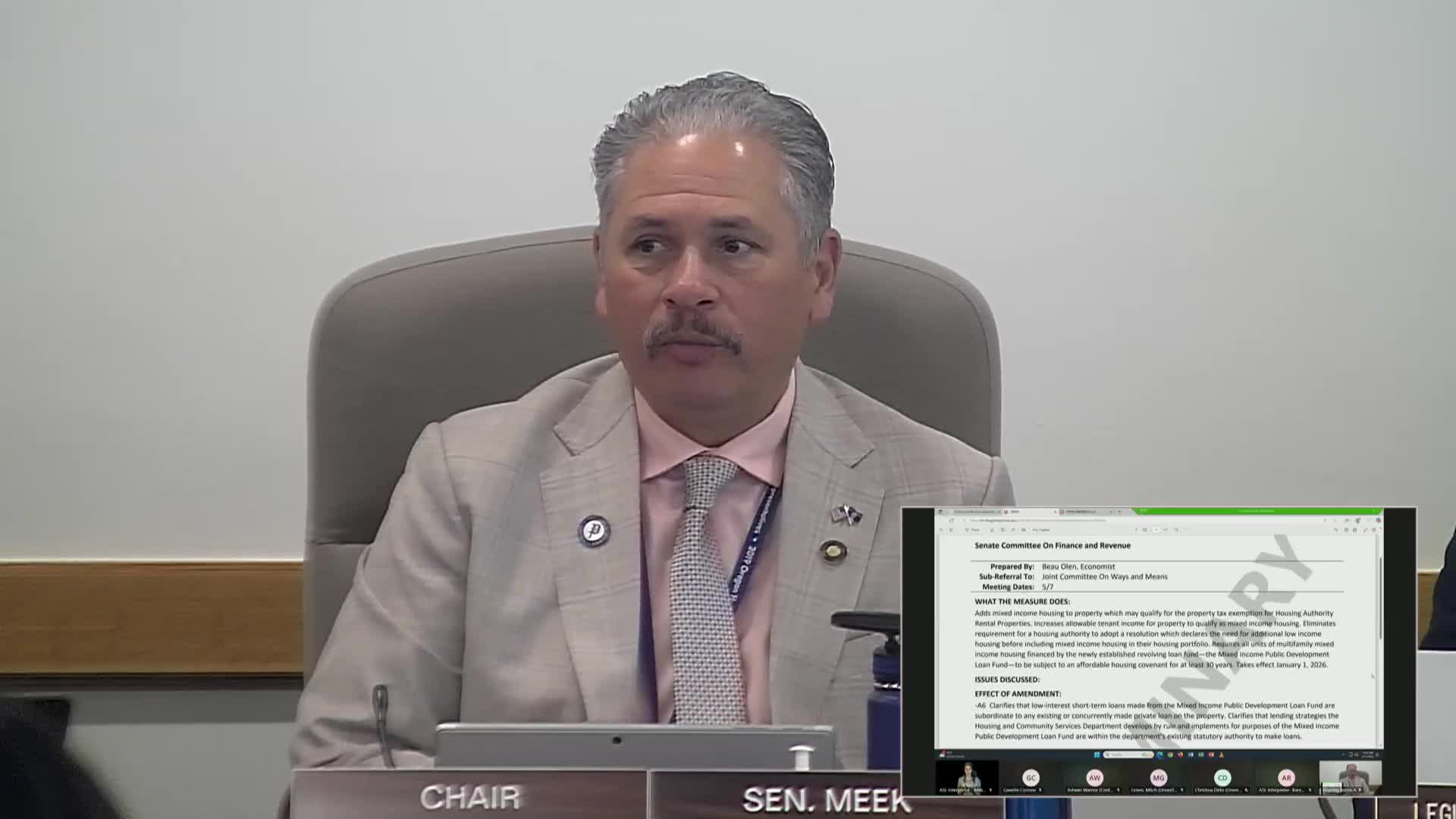
Senate Bill 684 would create a revolving construction loan fund to provide low‑interest, short‑term construction financing for mixed‑income housing. Supporters and experts, including Montgomery County officials who use a similar model, urged passage and further study of capitalization and implementation details.
Senator Khan Pham told the Senate Committee on Finance and Revenue on May 7 that Senate Bill 684 would establish a construction revolving loan fund to provide short‑term, subsidized construction loans aimed at producing mixed‑income housing without relying solely on federal low‑income housing tax credits.
The fund model proposed in SB 684 mirrors a program pioneered by the Housing Opportunities Commission of Montgomery County, Maryland, and presented to the committee by Ashwin Warrier of the Center for Public Enterprise and Council Member Andrew Friedson of Montgomery County. Warrier told the committee Montgomery County launched a $50 million housing production fund in 2021 and used it to make a construction loan that enabled a 268‑unit project to open in mid‑2023; the project included roughly 30% affordable units and did not rely on low‑income housing tax credit equity.
Why it matters: Sponsors said the requirement for lower‑cost private equity and federal tax credits has constrained housing production, especially when interest rates are high. A revolving construction loan fund supplies temporary, lower‑cost construction capital so projects that otherwise "don’t pencil" at current rates can move forward. Loans are short term (typically three to five years) and repaid so capital revolves into new projects.
State and implementation details: Senator Pham and witnesses said initial capitalization is a budget decision; examples from other jurisdictions cited sums ranging from $25 million to $100 million. Council Member Friedson described Montgomery County’s approach: the county approved annual appropriations and financed $100 million in bonds to create a fund, made construction loans with roughly five‑year terms and 5% interest, and used repayments to fund future loans. Friedson said the program is "additive, not competitive" with existing subsidies and reported that the county expects to finance thousands of units over decades. He described tangible economic impacts, saying a modest public investment "can enable $2,000,000,000 in investment" and cited job and tax revenue figures tied to the county’s projects.
State agencies and stakeholders: Natasha Detwiler Davie of the Oregon Housing and Community Services said OHCS would be the implementing agency for the program and noted the agency’s existing lending and asset‑management capacity. The Housing Authorities of Oregon and local housing advocates testified in support. Witnesses urged additional technical work on capitalization, eligible borrowers, ownership structures and long‑term affordability safeguards; Senator Taylor asked whether the fund’s initial capitalization would come from the general fund and was told the bill leaves the amount unspecified for later budget decisions.
Actions and next steps: The committee opened the public hearing on SB 684, heard several in‑person and remote witnesses, and then rolled the hearing over to Monday, May 12, for further testimony and technical questions. Committee members signaled broad support but asked for more details on capitalization, ownership, and implementation.
Ending: Supporters said a revolving construction loan fund is a potentially scalable, reusable tool to increase mixed‑income housing production across the state while preserving scarce federal subsidies for the deepest affordability needs.