Get Full Government Meeting Transcripts, Videos, & Alerts Forever!
Get email alerts on the Estate Tax Small Woodlands topic
No spam. Unsubscribe anytime.
Senate amends estate‑tax exemption to better include small woodland owners, supporters say
Summary
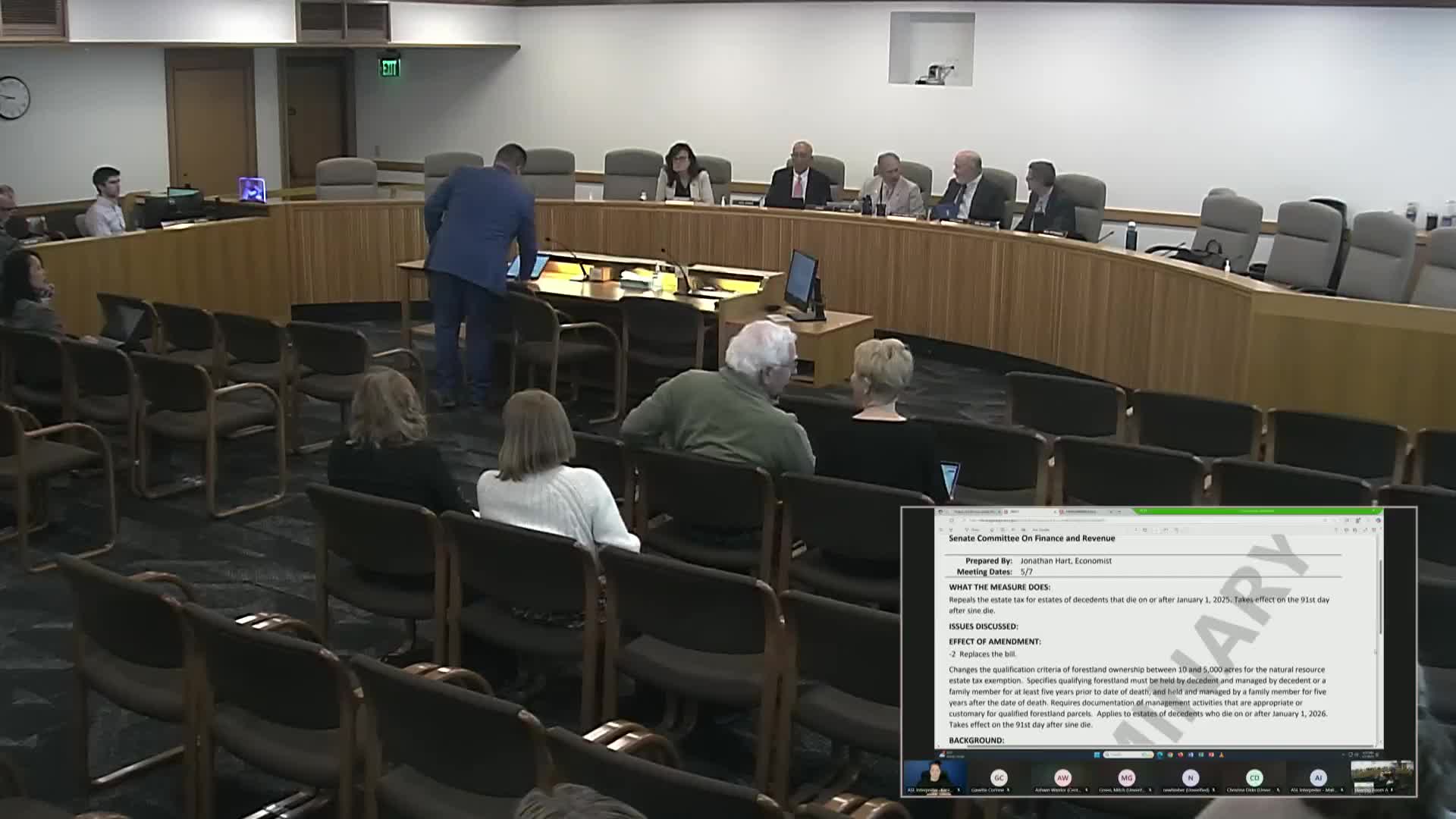
Senate Bill 485 dash‑2 would change the natural resource estate‑tax exemption’s participation requirement so small forest owners can qualify without daily activity records, supporters told the Finance and Revenue Committee on May 7.
Senator David Brock Smith, representing Southwest Oregon, told the Senate Committee on Finance and Revenue on May 7 that the dash‑2 amendment to Senate Bill 485 creates a separate qualification path so small woodland owners can access the natural resource estate‑tax exemption enacted in 2023.
The amendment would preserve the existing five‑year pre‑ and post‑death ownership and management continuity tests but replace a "material participation 75% of days" documentation requirement with a standard that landowners "actively manage the land with customary silvicultural activities appropriate for the age in the forest management cycle." Senator Brock Smith said the change targets small family forest owners who manage timber on longer cycles than row crops or livestock.
Why it matters: Supporters said the original 2023 exemption (Senate Bill 498) aimed to keep family natural‑resource properties in production and in families, but the material‑participation requirement is a poor fit for forestry. Gordon Culbertson, president of the Oregon Small Woodlands Association, said forest management is episodic — intense during harvest and reforestation, then less active for years — and daily tracking for a decade "does not make sense for small woodland owners." Daniel Newton, a small woodland owner from Douglas County, made similar points that forest stewardship includes intermittent silvicultural actions rather than continuous daily tasks.
Details in testimony: Witnesses described customary silvicultural activities that would demonstrate active management, including road maintenance and access, thinning, pruning, reforestation, protection of young trees, salvage after storms and fencing to protect stands. Supporters said the amendment relies on existing statutory definitions for "small woodlands" (10 to 2,500 acres) and maintains safeguards that the property remain in family stewardship for at least five years after the decedent’s death.
Opposition or debate: No opponents offered live testimony at the hearing. Senator Proxmire and others asked clarifying questions about the bill’s scope; proponents reiterated that the change preserves anti‑abuse language while adjusting documentation requirements to reflect forestry’s longer management cycles.
Actions and next steps: The committee opened and heard testimony on SB 485 and the dash‑2 amendment; no vote occurred during the hearing. Supporters asked the legislature to adopt the amendment so family forests could pass to heirs without forced sales to pay estate tax.
Ending: Proponents told the committee the measure would help keep small woodlands as forests and preserve stewardship legacies across generations.