Get Full Government Meeting Transcripts, Videos, & Alerts Forever!
Get email alerts on the Regional Universities topic
No spam. Unsubscribe anytime.
Regional university leaders tell Senate committee that campuses are economic anchors and need sustained public funding
Summary
Presidents and trustees from Oregon's regional universities told the Senate Education Committee the institutions serve first‑generation and rural students, act as regional economic anchors and face funding gaps, with speakers urging continued or increased state support.
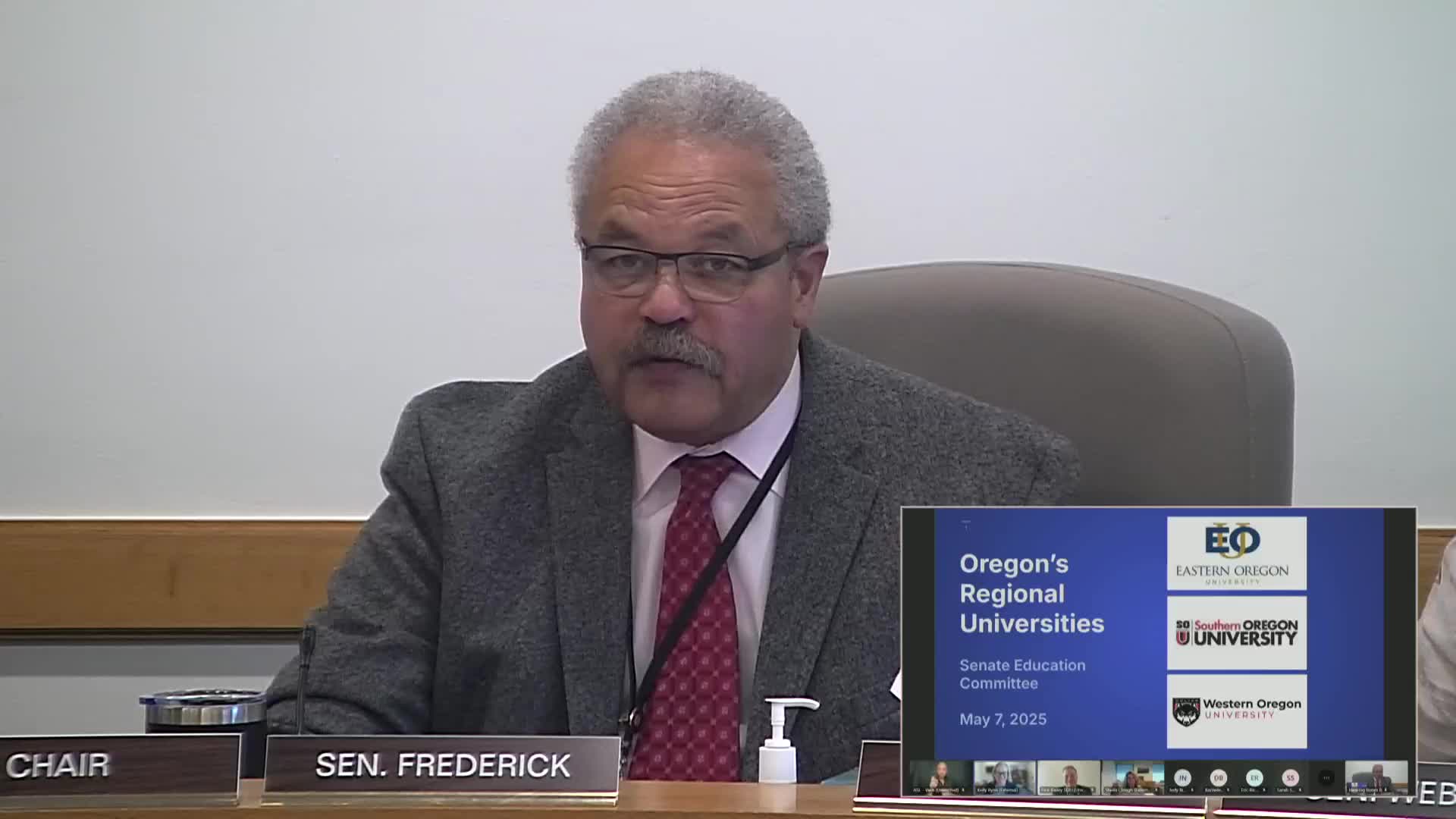
Presidents, trustees and a student testified to the Senate Education Committee on May 7 about the role of Oregon’s regional universities in educating students, supporting local economies and addressing workforce needs.
Dr. Kelly Ryan, president of Eastern Oregon University, described regional universities as "anchor institutions" that provide jobs, cultural offerings and workforce talent to their regions and that are particularly reliant on public funding to serve students from rural and low‑income backgrounds. She said regional universities "exist to create opportunities for individual students" and help limit brain drain by preparing graduates who remain in their home communities.
Cassidy Thompson, a third‑year elementary education major at Western Oregon University, told the committee her path to college was shaped by WOU programs for first‑generation and low‑income students. Thompson said Western's Destination Western bridge program "gave me a strong foundation and bridged the gap between high school and college." She described practical outcomes including higher retention and higher credit loads among participants.
Sheila Clow, chair of the Southern Oregon University board of trustees and CEO of Mercy Flights, spoke as a local business leader and trustee, saying local boards are focused on fiduciary responsibilities and on shaping programs to meet regional employer needs. Clow said regional universities are part of a workforce pipeline and urged continued investment so graduates can fill roles in health care, education and other sectors.
Rick Bailey, president of Southern Oregon University, highlighted finance questions. He told the committee that SOU's share of the Public University Support Fund (PUSF) for the current fiscal year was "just north of $28,000,000," and that more than half of that funding is consumed by PED and PERS costs for employee benefits in the current year. Bailey said Oregon provides roughly $3,000 less per university student than neighboring states, which increases the financial burden on students and families. "The difference and the stark difference is the balance," Bailey said, adding that regional universities carry a disproportionate share of student financial obligation.
Jesse Peters, president of Western Oregon University, described the "magic" of regional campuses: small classes, personal relationships, and support for first‑generation students. Committee members praised the presentations and said they valued hearing from students, faculty and presidents about local impacts.
No committee action was taken; the hearing was informational. Presenters urged continued state investment to maintain access, affordability and workforce training in nonmetropolitan regions of Oregon.