Get Full Government Meeting Transcripts, Videos, & Alerts Forever!
Get email alerts on the Healthcare Finance topic
No spam. Unsubscribe anytime.
Senator Hayden urges task force to study insurer assessments as Medicaid costs near $40 billion
Summary
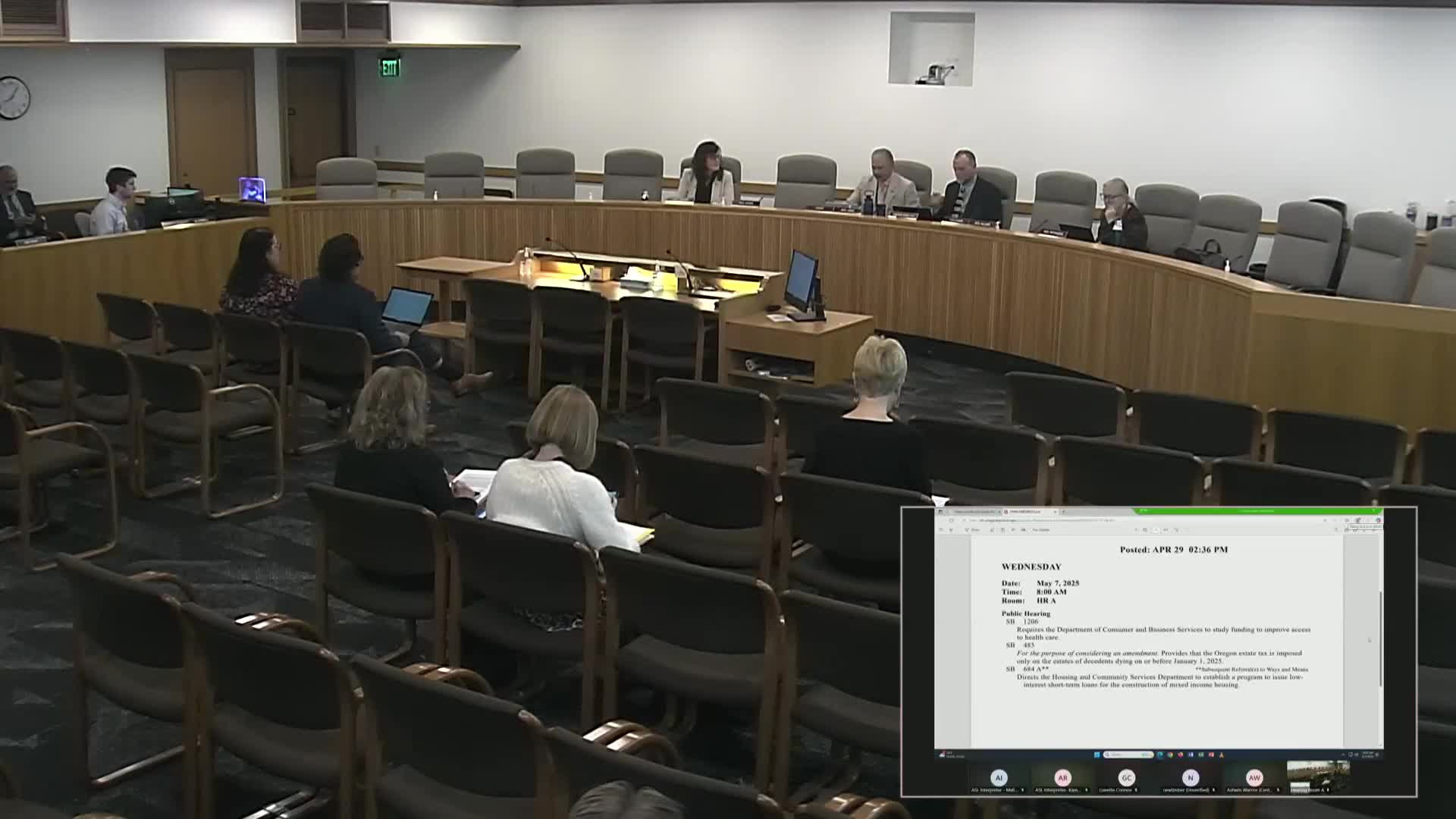
At a May 7 public hearing of the Senate Committee on Finance and Revenue, Senator Hayden presented an amendment to Senate Bill 1206 to form a task force examining insurer assessments, hospital assessments and caseload shifts that he said are straining Oregon’s Medicaid financing.
Senator Hayden, a state senator from Senate District 6, told the Senate Committee on Finance and Revenue on May 7 that Oregon’s Medicaid program is approaching "almost up to $40,000,000,000 in cost," and asked the committee to form a task force to study insurer assessments, intergovernmental transfers and other funding tools contained in Senate Bill 1206.
The task force proposal, contained in the posted dash‑1 amendment to SB 1206, would review how shifts in the mix of payers — including declines in commercial premiums and growth in ERISA and Medicaid enrollments — affect the state’s insurer assessment revenues. "If we have a 10% shift there, that could amount to $4,000,000,000 in our state budget," Hayden said in his presentation.
Why it matters: Hayden said declining commercial enrollment reduces the revenue base for a percentage‑based insurer assessment that helps fund the Oregon Health Plan. He noted past projections have missed targets (a $291 million projection that fell short by $48 million) and warned of a growing gap between projected insurer assessment revenue and Medicaid spending needs.
Hayden walked the committee through charts and historical bills he said set the policy baseline, saying the original insurer assessment was 1.5% and later raised to 2%, based on roughly $14.5 billion in annual premiums. He said the 2% projection produced an estimate of $291 million that ultimately came in about $48 million short. Hayden told the committee that shortfall contributes to pressure on the general fund to backfill Medicaid costs.
On enrollment changes and rates, Hayden cited agency figures showing steep premium increases in earlier years — "in the small group market... an 80% increase on premiums" and in the individual market about "a 72% increase" — while covered lives in some commercial markets have fallen. He said the ACA‑compliant individual market fell from about 191,895 covered lives in 2017 to 157,860 in 2024, a roughly 18% decline, and that the combined individual market decline approaches 25%. Small group enrollment dropped from about 171,000 in 2017 to 147,000 in 2024. By contrast Hayden said self‑insured and ERISA plans grew from roughly 800,000 to over one million covered lives.
Hayden also raised the intergovernmental transfer (IGT) mechanism and hospital assessment changes as part of the funding mix, and mentioned the potential inclusion of the Coos Bay Health District in calculations. He said current IGT formulas deliver higher federal matching dollars for certain hospital payments and suggested those mechanics could be examined by a task force.
On ERISA plans the senator pointed to other states’ approaches. He cited Michigan’s experience and a federal court decision he identified as "American versus Snyder" in the Sixth Circuit, saying that court upheld a 1% assessment on ERISA plans in that state. Hayden said the court outcome shows a possible legal path for including ERISA lives in an assessment, but he acknowledged uncertainty about how a Ninth Circuit court would rule on a similar measure in Oregon.
Providence Health and Services offered cautious support for deliberation. Jessica Adams, representing Providence, told the committee the hospital system "is strongly supportive of the work that this body has done to pass [hospital assessment legislation] this session" and urged that any next steps include broad engagement. She also warned that the dash‑1 amendment arrived to some stakeholders "moments before this hearing started" and asked for additional time for the sector to review and weigh in.
Discussion and next steps: Senators asked questions about the portion of that enrollment shift attributable to Medicare (aging into Medicare) versus other causes; Hayden said Medicare is a federal program the state cannot directly change and that the task force should focus on state levers. Hayden recommended the task force examine alternatives such as a per‑member, per‑month assessment (which proponents have proposed elsewhere) and to consider the legal and federal policy risks to pooled assessments, including possible federal changes to pooled assessment rules he said could arrive in coming years.
No formal action was taken in committee; the hearing on SB 1206 was opened for public testimony and closed without a committee vote. Staff and stakeholders said more work in the interim and broader stakeholder meetings would be necessary before any legislative changes.
Ending: Hayden told the committee he "would be supportive to have a task force to go through this" and that the objective was to consider ways to sustain the Oregon Health Plan’s funding amid shifting payer mixes. Committee staff closed the public hearing and moved to the next agenda item.