Get Full Government Meeting Transcripts, Videos, & Alerts Forever!
Get email alerts on the Rural Hospitals topic
No spam. Unsubscribe anytime.
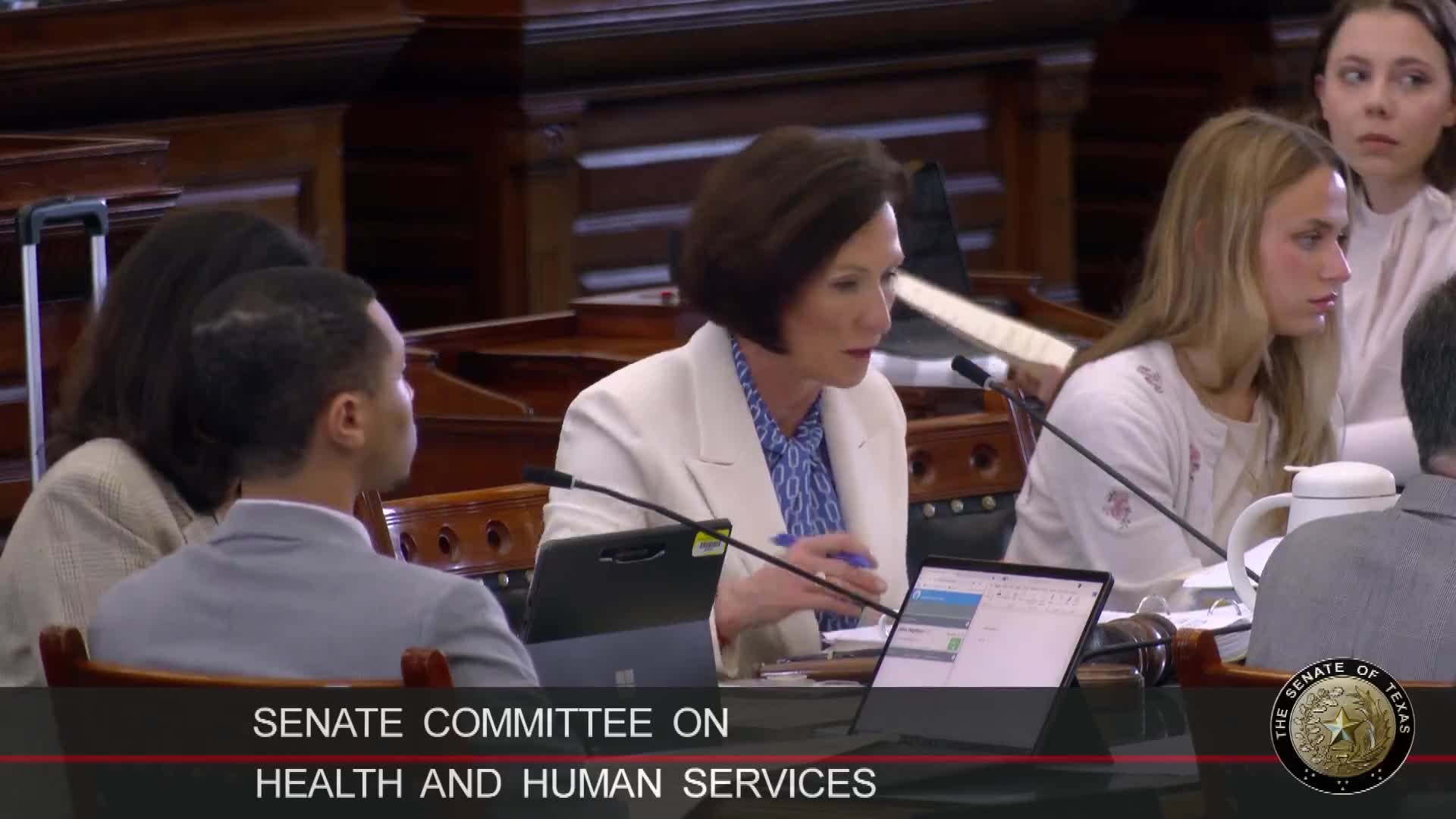
Senate committee hears bill to bolster rural hospitals with grants, training and Medicaid payment changes
Summary
Senators and witnesses described House Bill 18 as a multi-part effort to stabilize rural Texas hospitals through a new HHSC office, grant programs, enhanced Medicaid payments and an officers academy; public testimony supported the bill and the committee left it pending.
The Senate Committee on Health and Human Services heard House Bill 18 on measures intended to stem rural hospital closures by creating new financial and technical support at the Texas Health and Human Services Commission. Sponsor Senator Perry explained the bill would create a state office of rural hospital finance at HHSC, several grant programs, a rural hospital officers academy and an updated Medicaid reimbursement method for rural hospitals.
Supporters told the committee that many rural hospitals operate on thin margins and that targeted financial help and training are necessary to keep 24-hour services, including labor and delivery, available. “We're the association for all 157 rural hospitals in Texas,” John Henderson, CEO of the Texas Organization of Rural and Community Hospitals (Torch), said in testimony supporting HB 18. Henderson told senators the bill “deals with that in perpetuity, so we don't have to come back every session and fight for that.”
John Hewson, CEO of Frio Regional Hospital in Pearsall, described his 22‑bed critical access hospital as “the only hospital delivering babies between Laredo and San Antonio” and said the bill’s rural maternal add‑on payment and stabilization grants would be “potential lifesavers” for low‑volume hospitals. Hewson said 98% of his hospital’s roughly 10 deliveries a year are Medicaid and that full‑cost Medicaid reimbursement would “stabilize us and let us focus on care instead of constantly playing that financial battle.”
The bill would: establish a state office of rural hospital finance at HHSC to help hospitals navigate Medicaid and draw down funding; create a Rural Hospital Officers Academy to provide more than 100 hours of free annual training and reimburse travel expenses for participants; authorize four types of grants including financial stabilization and emergency hardship grants; update Medicaid reimbursement for rural hospitals to a periodically updated average cost and require an OB‑GYN add‑on payment to support labor and delivery care; and expand pediatric telehealth connectivity and rural pediatric mental‑health access through existing consortiums.
Witnesses described prior investments and lingering gaps. Henderson credited earlier stabilization grants with helping at least three hospitals and said Texas has seen recent rural hospital closures (LaGrange in fall 2023; Trinity “about two weeks ago” as of testimony). Senator Perry and witnesses referenced a prior appropriation of $50,000,000 in grants intended for rural hospitals; Tory Grady, HHSC director of provider finance, said HHSC was working to distribute those dollars before the end of the biennium and that the grant design intentionally signaled they were not guaranteed to continue beyond the legislative appropriation.
HHSC and providers discussed the proposed change to Medicaid payment mechanics that would move rural hospital reimbursements toward an average‑cost basis updated on a periodic schedule so hospitals could expect more predictable monthly cash flow. Senator Perry called that change “probably the biggest issue in the bill that really gives a monthly cash flow predictability they don't have today.” Victoria Grady, HHSC director of provider finance, described operational and appropriations limits but agreed that more frequent updates to reimbursement rates could reduce the need for session‑by‑session backfills.
Committee members asked about workforce, quality, telemedicine use and system affiliation. Witnesses said recruiting nurses is especially difficult, that many small hospitals rely on general surgery and other service lines to offset obstetrics losses, and that telemedicine is used “in some form or fashion” by most rural hospitals. Testimony described variation between system‑affiliated and locally governed hospitals and warned that one‑size policies can impose urban standards that are hard to adapt in low‑volume rural settings.
No final action was taken. The committee chair left House Bill 18 pending for further consideration.