Get Full Government Meeting Transcripts, Videos, & Alerts Forever!
Get email alerts on the Campus Traffic And Stormwater topic
No spam. Unsubscribe anytime.
Neighbors press Brewster Academy parking reconfiguration; planning board continues hearing to give staff and applicants more time
Summary
Brewster Academy proposed moving campus parking closer to Main Street to reduce traffic through its central quad and decrease impervious area; nearby residents urged the Planning Board to require measures limiting traffic on narrow Green Street.
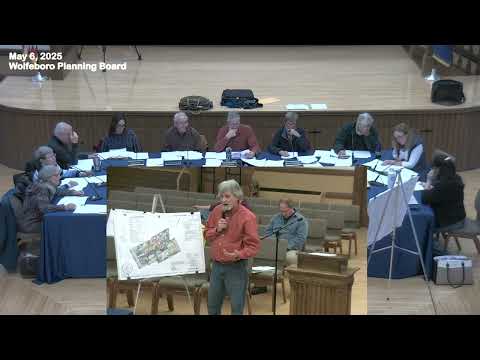
Brewster Academy presented plans May 6 to reconfigure parking and circulation in the center of its campus, a proposal the academy said will move vehicular parking toward Main Street, reduce traffic through the campus core and decrease impervious surface area. Neighbors who live on Green Street pressed the board for protections against increased traffic on their narrow residential street; the Planning Board continued the hearing to June 3 to allow further review and for the applicant to respond to neighborhood concerns.
Architect Andy Smith of DSP Architects said the project’s aim is to “increase safety for the students, faculty, and people using the space in the center of their central quad area, and also to reduce the amount of vehicular traffic in the center of campus.” The revised design shifts parking and delivery access closer to Main Street and proposes a widened fire-access path that accommodates fire apparatus, a turnaround for ladder trucks and consolidated curb entries.
Sean Malone, civil engineer, told the board the project reduces impervious area by about 7,000 square feet, retains the existing overall drainage pattern that moves stormwater away from Main Street into an existing infiltration swale, and adds a stormwater filter in the new parking area because shallow groundwater limits infiltration in parts of the site. Malone said the filter will “capture some of the storm water from the parking area, hold it, allow it to drain through the soil” and then be underdrained into the wider drainage system. He described test-pit results showing shallow groundwater and cited existing bioswales downstream by the boathouse as part of the treatment chain.
Neighbors raised safety and circulation concerns. Peter Batchelder (10 Green Street) said Green Street already carries heavy traffic during events and asked Brewster to “help us control the traffic pattern to divert it away from Green Street.” Amy Hines (22 Green Street) described the street as narrow and said summertime congestion can make it difficult to exit her driveway. Ed Himes (22 Green Street) emphasized pedestrian-safety concerns at the Crescent Lake intersection and said delivery and bus traffic have been a recurring problem.
Board members and Brewster representatives discussed several mitigation options during the public discussion: signage, restricting bus routes, adding or shifting speed-calming devices (speed bumps), and internal routing to encourage drivers to exit at different campus egress points. Brewster officials said no additional permanent curb cuts onto Main Street are proposed; the plan reduces overall curb cuts and consolidates access points.
Town staff asked for complete signed plan sets and flagged late submissions that had arrived to planning staff that day; board members asked the applicant to provide clearer consolidated plan sets, dimensions, parking counts and a response to engineer comments (Tie & Bond memo). The applicant indicated Chief of Fire (Chief Sody/Saudi in the record) had reviewed and provided comments; the project team said they revised plans to address fire-department access and received approval from the chief by e-mail that the access revisions were acceptable.
After public comment, the board voted to accept the application as complete but to continue the public hearing to June 3 so staff can perform a full review and the applicants can present revised materials addressing neighbors’ concerns. The board and neighbors discussed the question of whether a formal traffic study is warranted; the board did not require a long-term traffic count but asked the applicant to consider targeted analyses and to explore practicable mitigations (routing, signage, and coordination with the academy’s vehicle fleet). The continuation gives time for the planning staff and Brewster to prepare follow-up materials for the June 3 hearing.
The board’s continuance passed with the vote recorded and one abstention. No final action was taken; the hearing remains open.