Appropriations Committee lays out $7+ billion biennial budget, flags $262 million shortfall and cash‑reserve transfers
Loading...
Summary
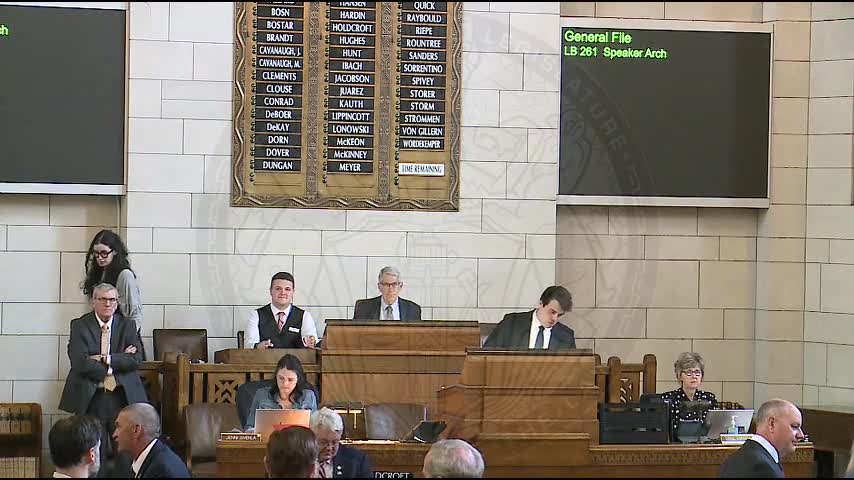
The Nebraska Legislature's Appropriations Committee advanced the governor's biennial budget (LB 261) to general file and described a plan of transfers and select‑file amendments intended to erase a roughly $262 million shortfall while preserving a reduced cash reserve.
Senator Clements, chair of the Legislature's Appropriations Committee, told the Senate on Tuesday that the committee advanced the governor's mainline biennial budget bill, LB 261, to general file with committee amendment AM832 on a 7‑1‑1 vote.
The committee amendment, Clements said, establishes the two‑year budget for fiscal years 2026 and 2027 and folds nine separate bills and other adjustments into the appropriations package. He said the changes include funding for higher education, developmental disabilities, biomedical research, county health and provider rates, and targeted one‑time grants for food banks and other programs.
Why it matters: The committee presented numbers showing a narrowing but still substantial deficit and described select‑file amendments that the panel says will close the remaining gap. That shortfall and the size of the state's cash reserve determine whether the budget meets the Legislature's constitutional duty to adopt a balanced plan.
The most immediate numbers in the blue budget book, Clements said, showed a projected general‑fund shortfall that had been reduced to about $262,000,000 after bills passed earlier in the session and after the committee identified additional revenues and savings. The economic forecasting board's April action, he said, reduced projected revenues earlier in the process; that change cut the previously projected ending balance from a negative $124,000,000 to a larger deficit before committee adjustments.
Committee members described the mix of steps planned to address the gap. The Appropriations report referenced 1) one‑time transfers and fund shifts that together total roughly $120,000,000 to the general fund, 2) a planned reduction in the cash reserve of about $132,000,000, and 3) other select‑file amendments that the committee said would restore the budget to near balance and leave the cash reserve at an estimated $690,000,000 (about 12.4 percent of recommended reserves in committee materials).
Several senators pressed and explained tradeoffs during floor debate. Senator Raybould and others urged preserving longer‑term investments such as the Perkins County Canal and a planned new penitentiary, arguing those projects protect Nebraska's future water and corrections capacity. Senator Von Gillard and others said the committee had faced shifting revenue forecasts but that the budget still projects revenue growth in coming years.
The committee amendment also incorporates nine bills summarized in the committee materials, including: increases for special education and K‑12 state aid, restored biomedical research funding ($15,000,000 per year), Project Health funding drawn from the tobacco settlement cash fund ($50,000,000 per year for two years), and several targeted appropriations (for example, support for nonprofit food banks from TANF and an appropriation tied to a federally qualified health center in Norfolk). The committee print and the blue budget book list these items and their sources.
Clements and other committee members stressed the absence of an across‑the‑board cut to agency salaries; the committee funded planned salary increases and health insurance increases for state employees. The budget materials show specific adjustments for the Supreme Court, the University of Nebraska system, and other large programs.
What remains: The committee said select‑file amendments will be introduced to reflect the April forecast and to implement specific transfers and savings; those amendments had not been adopted on the floor at the time of the session transcript. The bill remains on general file for further debate and amendment.
Ending: Senators on both sides thanked Appropriations staff and committee members for the work required to produce the package and said they would continue debating the bill and select‑file changes in the days ahead.