Get Full Government Meeting Transcripts, Videos, & Alerts Forever!
Get email alerts on the Police Accountability topic
No spam. Unsubscribe anytime.
Boston council hears OPAT budget review; director outlines staffing, outreach and subpoena rules
Summary
At a May 5 Ways and Means hearing, Office of Police Accountability and Transparency Executive Director Ivan DuCarvalho reviewed FY26 priorities — staff hires, public outreach and data on complaints — and said OPAT has not yet used subpoena power and will draft rules for how subpoenas would be used.
The Boston City Council Committee on Ways and Means held a May 5 hearing on the FY26 budget for the Office of Police Accountability and Transparency (OPAT), where Executive Director Ivan DuCarvalho outlined staffing plans, complaint data and community outreach and said OPAT has not yet exercised its subpoena power.
The hearing, chaired by Councilor Brian Worrell, focused on OPAT’s capacity to investigate complaints against the Boston Police Department and on how OPAT’s recommendations are handled after investigations. DuCarvalho described the agency’s history, its panels and boards, and a set of goals for the coming fiscal year, including updated regulations and expanded public engagement.
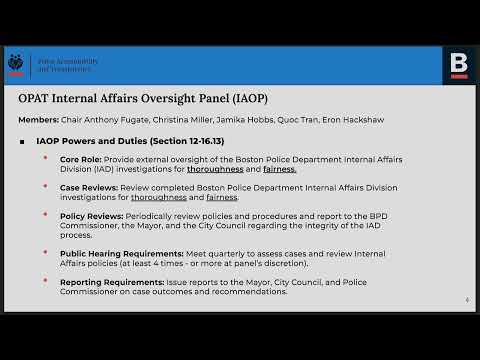
OPAT was created by city ordinance in late 2020 and launched operations in 2022. DuCarvalho told the committee that OPAT’s functions include investigating misconduct complaints against BPD officers, reviewing Internal Affairs Division (IID) investigations, and publishing investigation reports and data on a publicly accessible dashboard. He said the office maintains daily-updated dashboards and produces quarterly and annual reports for public viewing.
On staffing and capacity, DuCarvalho said OPAT currently has nine staff and is recruiting two investigators and an administrative assistant; when those hires are complete he expects the office to reach roughly 13–14 employees. He described recent hires intended to boost outreach — including a community engagement specialist, Abdullah — and said OPAT has attended more than 30 community events this year, holds biweekly executive director coffee hours across neighborhoods and will host an open-door day May 7.
DuCarvalho provided complaint data to the committee: "We have 378 complaints since [January] 2022," he said, and reported 86 active investigations. He told the committee that the Civilian Review Board (CRB) has heard about 58 cases and that, from the agency’s data, there were 14 sustained cases covering 34 sustained allegations, with 34 not-sustained findings and five exonerations since the office began hearing cases. Later in the hearing a council member noted a slide listing nine sustained cases; councilors and staff discussed that the numbers shown on slides and in different reports required follow-up and clarification.
On subpoena power, DuCarvalho said the OPAT commission may authorize subpoenas with a two-thirds vote of the commission but that "we have not used subpoena power yet." He said his intent is to draft regulations with the commission specifying how and when subpoenas would be used.
Council members pressed about where complainants should file reports and about final disciplinary authority. DuCarvalho said members of the public can file with OPAT, with BPD’s Internal Affairs Division, or with the state-level POST body; he added that OPAT is intended to be a “single point of entry” for Boston residents. When asked who makes the final disciplinary decision if OPAT and IID disagree, DuCarvalho said the final decision rests with the police commissioner, Commissioner Michael Cox, and noted that the commissioner must respond in writing to OPAT’s recommendations.
Several councilors, including Council President Louie Jin, expressed concern that ultimate disciplinary authority remains with the commissioner and asked whether that structure provides sufficient independence. Jin said oversight is "important... especially when it comes to holding people accountable." DuCarvalho and councilors discussed transparency measures — publication of OPAT reports and responses from the commissioner — and DuCarvalho said he will pursue clearer regulation of timelines for commission responses (for example, setting a specific window such as 30–90 days) and stronger tracking of outstanding replies.
On spending and outside contracts, DuCarvalho estimated roughly $40,000 in consultant spending in the prior budget cycle, used for digital outreach and training, and said he would provide precise contract and expenditure figures to the committee after the hearing. He said some budget lines were underspent in FY25 because of leadership and staffing gaps that limited the office’s ability to expend funds.
DuCarvalho listed other goals for FY26: publish semiannual and annual reports; develop key performance metrics to measure OPAT’s effectiveness; produce one to three policy recommendations for the Boston Police Department; expand community meetings across neighborhoods rather than holding all meetings at OPAT’s offices; and re-energize OPAT’s youth council, starting from the presence of the youth delegate, Amari Perez.
The hearing produced several staff follow-ups requested by councilors: a detailed breakdown of consultant and contractual spending since OPAT’s creation, clarification of data discrepancies on sustained cases, and a clearer public presentation of which OPAT reports and commissioner responses are published online. DuCarvalho told the committee he would provide additional financial and contract details after the hearing.
Members of the council praised recent hires and outreach work while also pressing for clearer authority and stronger mechanisms to ensure OPAT recommendations lead to meaningful discipline where warranted. DuCarvalho said OPAT will focus this year on capacity building, community engagement and writing regulations to make its subpoena authority operational.
DuCarvalho closed by describing OPAT as "a small but mighty team" and thanked the council and Mayor Michelle Wu for their support. The committee requested follow-up documents and data to reconcile slide figures and to provide more granular budget and contract information.