Get Full Government Meeting Transcripts, Videos, & Alerts Forever!
Get email alerts on the Land Use Rezoning topic
No spam. Unsubscribe anytime.
Residents oppose rezoning request for 20-acre tract on Anderson Road
Summary
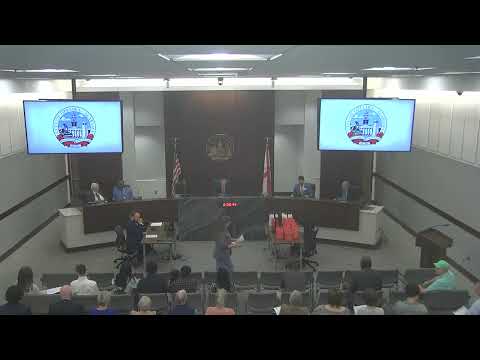
The Opelika City Council held a public hearing May 6 on a request to rezone roughly 20 acres on Anderson Road from R-1 (rural) to R-3 (low-density residential).
The Opelika City Council held a public hearing May 6 on a request to rezone roughly 20 acres on Anderson Road from R-1 (rural) to R-3 (low-density residential).
Residents who live along Anderson Road urged the council to deny the rezoning. John Moore, who said he lives at 2714 Anderson Road, told the council he and neighbors submitted a petition signed by “58 to be exact” opposing the change. Julie Moore, a fourth-generation owner on Anderson Road, said she opposed rezoning because of traffic and wildlife concerns.
At the hearing, several speakers gave estimates of how many homes rezoning could allow. Linda Guy cited external real-estate analyses and said rezoning “could be 48 up to possibly 70 homes on that 20 acres,” and that if the land remained R-1 it “would be probably closer to 18.” Dan Johnson, who lives at 2504 Anderson Road, described the tract as heavily wooded and said he hoped a buyer would preserve it as a single-family property. Bill Perry, speaking for his brother David Perry (the listed property owner), said the plan would be for 48 lots and described the project as “attainable housing” intended for workers in the nearby industrial park.
City staff clarified addressing and procedural points. A staff member said the city GIS lists the parcel as 2508 Anderson Road but that “with any rezoning, we go based off of a legal description, which includes the actual meets and bounds or lot description of that property,” and that the legal description provided in the resolution governs the rezoning process.
The ordinance to rezone the parcel was presented to council for first reading; the planning commission returned a negative recommendation. No final rezoning vote took place at the May 6 meeting.
Why it matters: Neighbors say the rezoning could change traffic patterns, stormwater flows and local property values; the applicant and his representative say it would add moderate-density housing intended for local employees. The council will consider the ordinance in future readings and votes.
What happened next: The council introduced the rezoning ordinance for first reading; no amendment or final action occurred during the May 6 meeting.