Get Full Government Meeting Transcripts, Videos, & Alerts Forever!
Get email alerts on the Special Education Restraint Seclusion topic
No spam. Unsubscribe anytime.
House panel advances bill tightening use of restraint, seclusion in special-education classrooms
Summary
The House Education Committee advanced HB 237 after authors and advocates agreed amendments to curb mechanical restraints, require cameras in special-education classrooms using existing allocations, tighten reporting, and expand training and parental notices.
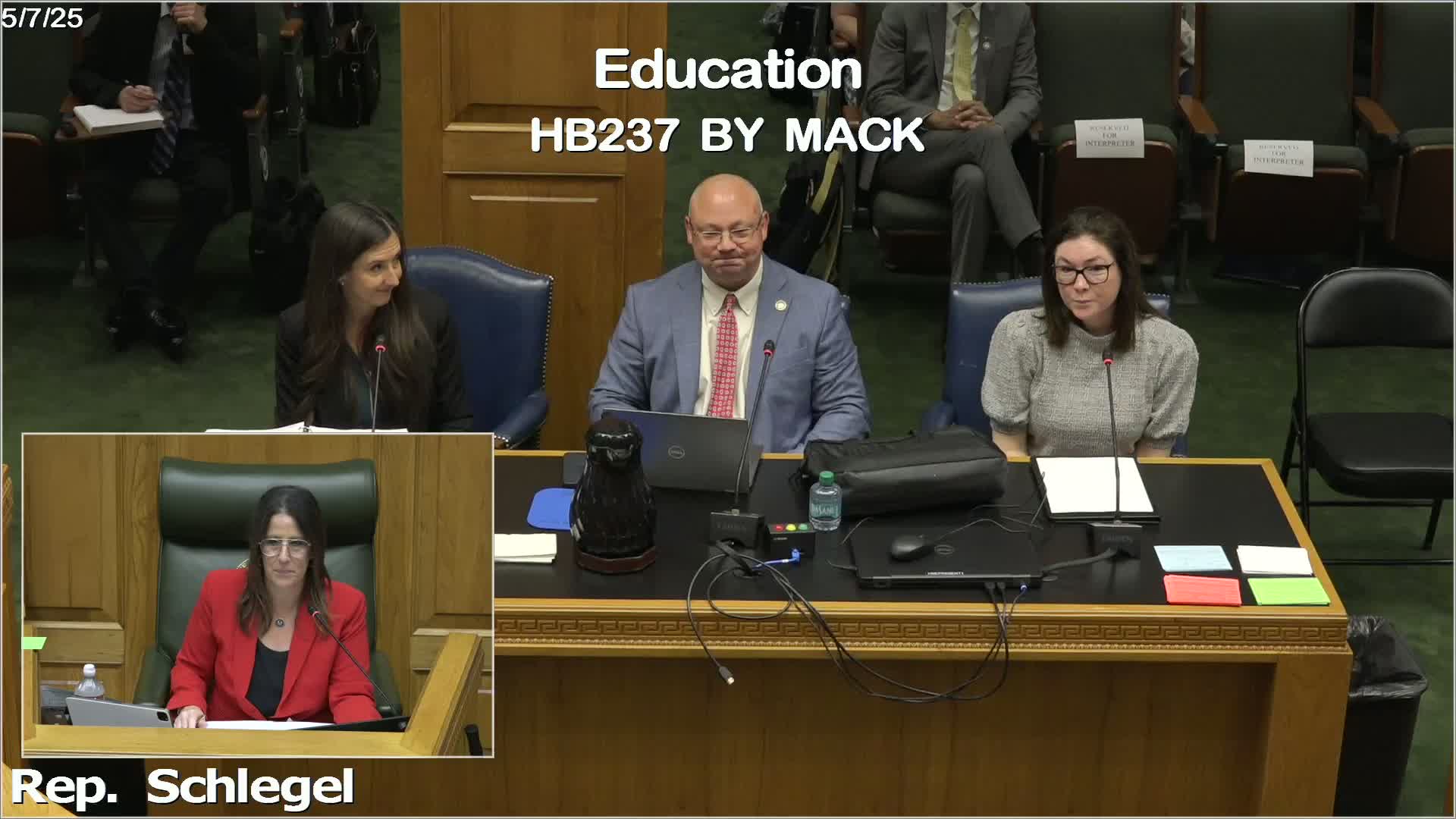
Representative Shane Mack on Wednesday pressed the House Education Committee to advance HB 237, a measure he described as intended to reduce harmful uses of physical restraint and seclusion in public schools and improve protections for students with disabilities.
The proposal would restrict mechanical restraints, shorten the time that counts as a physical restraint from five minutes to three, require local education agencies to install cameras in special-education classrooms using already-allocated funds, require post-incident review of footage when cameras exist, mandate a nurse or school health designee check students after an incident, and require reconvening of IEP teams if restraint or seclusion occurs more than twice in a school year.
Supporters including parents, disability advocates and attorneys described repeated incidents they said left children bruised, traumatized or afraid to return to school. Ashley McReynolds, program director at The Arc of Louisiana and the mother of a young man who experienced restraint, told the committee the amended bill ‘‘aims to make classrooms across Louisiana safer, not just for students, but also teachers and other school employees.’’
Advocates credited changes made in recent weeks that removed broader juvenile-record access and added procedural protections. Tory Rocca of Disability Rights Louisiana said the bill responded to a state legislative auditor report that found gaps in reporting and oversight and called the proposed reporting and post-incident checks ‘‘important’’ steps.
School system representatives and the Louisiana School Boards Association said they supported the bill’s direction but asked for technical clarifications so the measure could be implemented at the school-building level. Michael Faulk and Michael Falk (superintendents’ association) and Danny Garrett of the School Boards Association told the committee they would continue to work with the sponsor to ensure the language is practically implementable.
Parents who testified described specific episodes in school settings. Samantha Reed, a parent, urged mandatory classroom cameras and stronger accountability; Caden Webb, a 19-year-old who said he had been restrained as a child, described seclusion rooms and the lasting effects of those episodes.
Representative Mack said the bill has changed significantly from its original filing and praised the collaborative rewrite: the substitute bill adopted in committee sets training requirements, reporting changes, and an expectation that the Louisiana Department of Education develop crisis-intervention training to be used by higher education teacher-preparation programs as well as school teams.
At the committee’s conclusion Rep. Freyberg moved to report HB 237 by substitute favorably; the committee recorded no objections and the bill was reported by substitute to the next stage.
The measure does not ban all restraint; rather it narrows when and how physical restraint and seclusion may be used, establishes extra notification and review steps, and seeks to expand crisis-intervention training for staff and pre-service teachers. Implementation will depend on administrative rules and guidance the Department of Education provides if the bill passes.
Committee members and stakeholders said they expect additional technical edits as the bill moves through the legislature; supporters asked lawmakers to remember that many of the protections respond to parents’ reports of harm and the committee praised the broad stakeholder engagement that produced the current language.