Get Full Government Meeting Transcripts, Videos, & Alerts Forever!
Get email alerts on the Student Discipline topic
No spam. Unsubscribe anytime.
Committee rewrites discipline policy language to clarify off-campus jurisdiction, debates weapon definitions
Summary
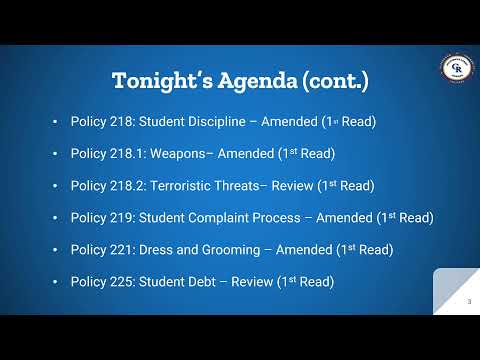
Council Rock policy committee reviewed revisions to student discipline policies to clarify when off-campus conduct can be disciplined, add behavioral threat assessment references, and align weapon definitions with state statute. Board members debated whether to list 'pistol' and whether to keep the term 'serious' in the weapon definition.
Council Rock School District policy committee members reviewed proposed revisions to student discipline policies May 5 that clarify when off-campus student behavior can lead to school discipline and aligned the weapons definition with state statute.
The revised draft narrows when out-of-school conduct is treated as a school matter: conduct that materially and substantially disrupts the school environment; theft or vandalism of school property; planning or proximity tied to school activity; and school-sponsored events. The update also inserts behavioral threat assessment team procedures into several policies and aligns weapon language with current statutory verbiage.
District staff said the changes largely restate existing case law in clearer language and add references to the district’s behavioral threat assessment process. The draft explicitly states that bringing a weapon onto school property — including a weapon stored in a vehicle on school property — can trigger school discipline and a statutory expulsion of not less than one year.
The committee spent substantial time on the weapons definition and examples. Board members debated whether to include “pistol” in the enumerated list alongside “firearm,” “shotgun” and “rifle,” and whether to keep the word “serious” in a clause describing implements “capable of inflicting serious bodily injury.”
“I would be more inclined…keep pistol, keep device and also keep it serious,” said Andy Sankos, superintendent, summarizing one viewpoint in the discussion. District legal counsel said retaining or removing specific example words raises no legal obstacle and recommended the board decide based on policy clarity rather than legal necessity.
Committee members also discussed whether toy or replica items (for example, a brightly colored Nerf-style toy) might be treated as a replica and hence fall under the policy’s definition; members noted the policy’s “include but not limited to” phrasing is meant to avoid an exhaustive list.
No final changes were adopted at the May meeting; staff will prepare a refined draft reflecting committee guidance for later review.