Get Full Government Meeting Transcripts, Videos, & Alerts Forever!
Get email alerts on the Comprehensive Plan Adoption topic
No spam. Unsubscribe anytime.
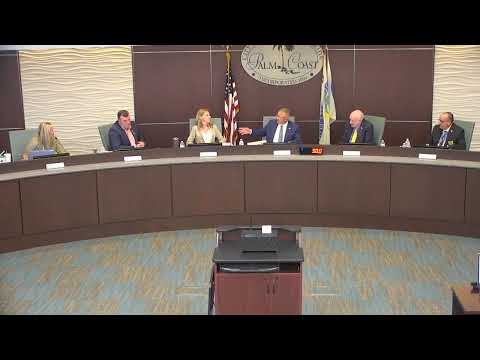
Palm Coast council adopts revised Imagine 2050 comp plan language; planning board recommendations mostly declined
Summary
Council adopted updates to the city’s Imagine 2050 comprehensive plan, approving new mixed‑use standards and greenway protections but rejecting some planning‑board recommendations on density‑bonus and accessory‑dwelling language; vote was 4–1.
Palm Coast City Council approved a set of amendments to the city’s Imagine 2050 comprehensive plan on second reading May 6, revising mixed‑use master‑plan language, strengthening greenway protection language and adopting the updated Capital Improvements Element. The council voted 4–1 in favor of the package.
The adopted changes include new requirements that master‑plan mixed‑use (MPMU) development subareas demonstrate and protect a contiguous greenway and that non‑residential elements (industrial and workplace space) be measured and tracked in each phase of master‑plan development. City staff also inserted language clarifying that an MPMU future‑land‑use designation may be implemented through more than one master‑plan development (MPD), addressing council concern that a single MPD could delay phased economic projects.
Planning staff said those provisions are intended to ensure that major future land‑use changes preserve ecological corridors and deliver the city’s desired mix of industrial, commercial and workplace uses as developments are implemented. “The Greenway overlay is created based on regional context, planned conservation lands and on‑site environmentally sensitive areas,” an outline in the staff presentation stated.
The Planning & Land Development Regulation Board had recommended reinstating earlier strategies encouraging density bonuses and accessory dwelling units — in other words, measures to encourage more affordable or mixed housing — arguing the state’s direction toward ADU support and affordable‑housing tools made removing them premature. The council rejected those particular planning‑board recommendations, with several members saying including such specific strategies in the comp plan could tie the city’s hands or be preempted by state legislative changes. Councilmember comments noted the state legislature has considered bills that limit local controls over accessory units and affordable housing incentives.
Planning staff also recommended, and the council approved, a housekeeping update to the Comprehensive Plan’s Capital Improvements Element that incorporates the city’s most recently adopted five‑year CIP. The council voted 4–1 to adopt the plan amendments; one councilmember opposed on grounds of wanting additional time to consider long‑range development capacity and infrastructure implications.
The adoption triggers a staff timetable to begin implementing changes in the city’s Land Development Code and to prepare more detailed MPD application requirements for future master‑plan proposals. The Planning Division will also prepare the LDC updates and implementation steps requested by council.