Get Full Government Meeting Transcripts, Videos, & Alerts Forever!
Get email alerts on the Step Housing topic
No spam. Unsubscribe anytime.
Kenmore advisory committee formed to draft STEP housing code changes, to present recommendations to council by September
Summary
A citizen advisory committee convened its first meeting to study emergency shelter, transitional housing and permanent supportive housing required under state law and to advise the Kenmore City Council on zoning and community engagement by September 2025.
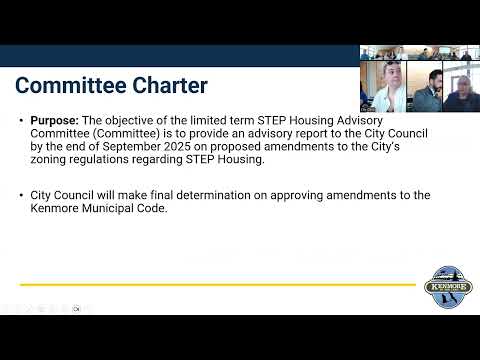
The City of Kenmore formed a citizen STEP (Shelter, Transitional and Emergency/Supportive) Housing Advisory Committee and began work on code recommendations that the committee will present to City Council by September 2025.
The committee — convened and supported by city staff — will meet monthly through the summer to study definitions, review land-capacity findings, and draft possible zoning amendments and community engagement plans. Nick Chen, a consultant with Kimley Horn, told members he and city staff will provide technical resources and compile recommendations for City Council. "If I don't know the answer, I will do my best to track it down and get back to you all," Chen said.
"I'm Debbie Benn, the Community Development Director," Benn said, describing the committee's charge: to develop a report with proposed amendments to the Kenmore Municipal Code related to STEP housing and to recommend community engagement materials the city can use when projects come forward.
The committee reviewed state guidance and local targets discussed in the staff presentation. Chen read Commerce definitions for the group, including: "Emergency shelter is a facility that provides a temporary shelter for individuals or families who are currently experiencing homelessness," and "permanent supportive housing [is] subsidized leased housing with no limits on length of stay" that pairs housing with services. The presentation said Kenmore was allocated 487 net new emergency-housing units (about 30 per year) and 539 net new permanent supportive-housing units (about 27 per year) under the statewide housing allocation process; staff also said Kenmore currently has 33 emergency-housing units and zero permanent supportive units.
Committee members raised community-engagement and equity concerns and urged the city to include people with lived experience in public input. Karina Fyle, a committee member with a background in policy and public health, highlighted legal and ethical precedents: "The 'Nothing About Us Without Us' Act ... aims to ensure that individuals with lived experiences are included in the policy making that directly impacts them," she said, urging the committee to find ways to incorporate that voice without pressuring individuals to disclose private experiences.
Members also discussed likely locations and zoning constraints. Staff said state law prevents some blanket prohibitions on indoor emergency housing: jurisdictions may not prohibit indoor emergency housing in zones where hotels are allowed (with limited exceptions). Committee members asked staff to circulate maps showing current multifamily and commercial zones — the primary candidate areas for STEP housing under the state guidance — and to explain how pending "middle housing" code changes might affect siting.
Several participants emphasized that housing must be paired with services. "Once they're housed and sheltered, they need those services to remain in housing," one committee member said while describing case management and behavioral health supports that providers typically supply with permanent supportive housing.
On process and next steps, city staff said they will assemble a panel of housing experts and service providers for a May meeting, circulate examples of code language used by other jurisdictions, provide maps and background materials in advance of meetings, and send a scheduling poll to set the next meeting date. The city also said a $60 per-meeting stipend will be available to committee members; staff are finalizing procedures with finance. Council will consider the advisory report after the committee presents in September, with a council public hearing expected before the end of the year.
Members closed by asking staff to bring examples of community engagement plans, "good neighbor" agreement examples, and model regulations from other cities. Staff said they will return with those materials, a proposed meeting schedule, and the planned expert panel roster.