Get Full Government Meeting Transcripts, Videos, & Alerts Forever!
Get email alerts on the Appropriations topic
No spam. Unsubscribe anytime.
Senate Appropriations Committee advances package of departmental budgets, recommends immediate effect on many bills
Summary
The Michigan Senate Appropriations Committee on Wednesday approved substitute versions and reported a slate of departmental budgets to the Senate floor, recommending immediate effect for multiple bills and adopting targeted amendments including $15 million for dam safety and a supplemental that includes $41.8 million for trust‑fund projects.
The Senate Committee on Appropriations voted to advance a broad set of departments' fiscal 2026 budgets and related amendments, recommending immediate effect on many measures and approving a FY‑25 supplemental that includes Natural Resources Trust Fund project funding.
The moves send dozens of budget bills — ranging from Medicaid and education to transportation and environmental programs — to the full Senate with committee recommendations that several take immediate effect. Committee members repeatedly adopted substitute versions of bills and recorded final roll‑call tallies, typically 12 yeas and 6 nays on reported measures.
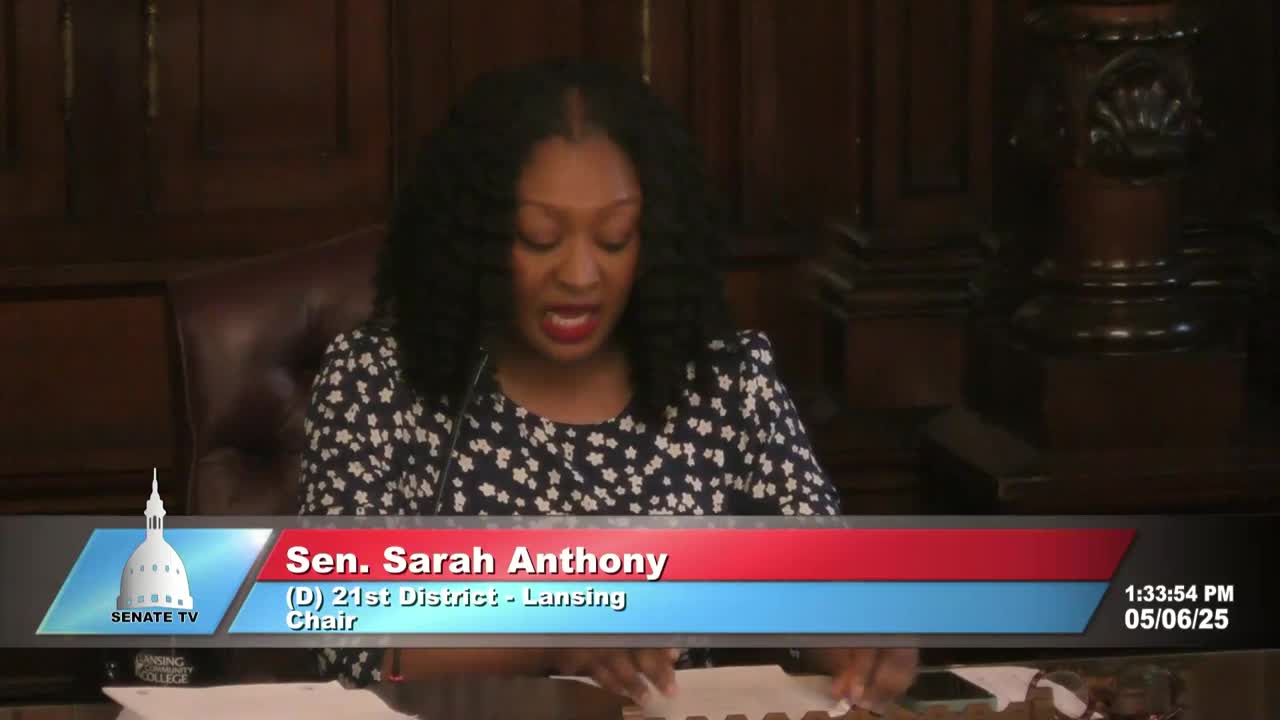
Committee chair Gerry Anthony called the hearing to order and asked members to be concise while presenting budgets. Senators provided brief overviews of departmental requests and priorities before the committee moved through a sequence of motions to adopt substitutes and report bills to the floor.
Senator Santana, speaking for the Department of Health and Human Services budget (Senate Bill 180), emphasized the scale of Medicaid in Michigan: “Medicaid is not just a line item, but it is a lifeline to over 3,000,000 Michiganders in the state of Michigan,” Santana said, noting the program covers children, seniors, people with disabilities and working families. The committee adopted the S‑1 substitute for SB 180 and reported the bill to the floor with the committee’s recommendation that it pass; immediate effect was also recommended in committee.
On natural resources and infrastructure, Senator Cherry secured and the panel adopted an amendment that adds funding for dam safety. The amendment — adopted on a roll call — would allocate $15,000,000 for dam safety work in the state and was folded into the Department of Natural Resources budget (Senate Bill 172) before the committee reported the bill to the floor.
Senator Erwin summarized the Department of Environment, Great Lakes, and Energy (SB 181), saying the budget prioritizes water‑infrastructure investments intended to hold down customer bills, remove lead service lines and support charging infrastructure for electric vehicles. The committee adopted the substitute and reported SB 181 to the floor with the recommendation that it pass.
Senator Hertel outlined the Department of Military and Veterans Affairs budget (SB 175), citing a $26,000,000 investment at Selfridge Air National Guard Base tied to a new fighter mission and a $1,000,000 line item intended for veterans impacted by federal funding reductions. The committee adopted the substitute and reported that bill to the floor, recommending immediate effect.
The Department of State Police budget (SB 176) advanced after Senator Hertel described deposits and grant lines intended to assist disaster response and public‑safety staffing. The subcommittee adopted measures that include a $10,000,000 deposit into the disaster fund, $10,000,000 for local recruitment grants, and a $1,000,000 line for multi‑agency efforts addressing fentanyl.
Education budgets moved with targeted amendments. The K‑12 and library funding discussions included a $900,000 allocation for the Michigan Electronic Library; the committee adopted amendments and reported those education bills to the floor. The Department of Lifelong Education, Advancement, and Potential (MILEEP, SB 164) advanced after the committee removed an originally proposed age limit from a program intended to reconnect students who had left college.
Senator Kleinfeld described the transportation budget (SB 174) as continuing investment in roads and transit while including a contingency authorization of $3,000,000,000 that contains no current spending; the committee adopted the substitute and reported the bill to the floor.
Senate Fiscal Agency analyst Josh Seffman gave a brief overview of the FY‑25 supplemental (SB 184 S‑1), describing gross appropriations of about $446.6 million, of which $101.3 million is general fund. The supplemental includes 85 state and local Natural Resources Trust Fund projects totaling about $41.8 million, allocations of federal grants and several boilerplate adjustments to ensure certain directed grants can be distributed.
Across the hearing the committee approved substitutes and reported bills with a common pattern: substitute adoption, a motion to report the bill to the Senate floor with the committee’s recommendation that it pass, and a separate motion recommending immediate effect in committee for many of the bills. Recorded vote tallies on reported measures commonly read as 12 yeas and 6 nays, as announced by the clerk.
The committee concluded its session after the chair urged members to continue working with civility. The body recommended immediate effect for many of the advanced bills and adjourned without substantive floor debate on items not already resolved in committee.
Looking ahead, the measures reported by the Appropriations Committee will be considered by the full Senate; committee action does not itself change law or appropriate funds beyond committee recommendation and any language contained in the bill copies reported to the floor.