Get Full Government Meeting Transcripts, Videos, & Alerts Forever!
Get email alerts on the Floodplain Permitting topic
No spam. Unsubscribe anytime.
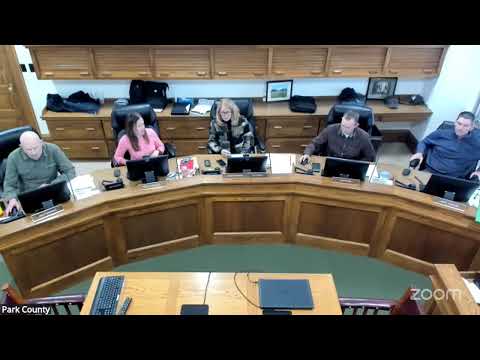
Park County delays decision on Riverwalk LLC floodplain permit after public opposition and engineering requests
Summary
Park County commissioners postponed a decision on a controversial floodplain permit for an in‑river water collection system proposed by Wyoming Riverwalk Investment LLC after residents and outfitters raised erosion, safety and cumulative‑withdrawal concerns and county engineers requested professional design and bank‑stability analysis.
Park County planning staff and the applicant for a proposed in‑river water collection system presented testimony and received sustained public comment before the Board of County Commissioners delayed a decision and asked for more engineer certification and documentation.
The application, filed by John Sauerwein on behalf of Wyoming Riverwalk Investment LLC, asked for a floodplain development permit for a buried, perforated pipe and submersible pump that would draw surface water from the Shoshone River and for an after‑the‑fact permit addressing previously placed fill and an access road on the riverbank.
Joy Hill, Park County planning director, told the commissioners that staff lacked specific design details needed to evaluate slope stability and changes to flood carrying capacity. “Staff witnessed falling rocks and unstable conditions resulting from the gravelly nature of the slope,” Hill said, summarizing field visits and aerial photos that show disturbed riverbank and downslope material.
County Engineer Brian Edwards recommended a Wyoming‑licensed professional engineer provide (1) an estimate of net increase in fill placed in the channel and adjacent floodplain, (2) an evaluation of slope and bank stability tied to the past and proposed work and the potential for catastrophic failure, and (3) engineered design plans and certification showing the system is installed as designed. Edwards also recommended electrical work be certified by a licensed electrician because the pump and wiring will be under or adjacent to the river.
Public comment was strongly opposed. River‑based outfitters and recreational users — including Elise Guarino of Wyoming River Trips, Gradient Mountain Sports owner Andy Quicke, and local river user Alex Benjamin — cited erosion, a large boulder that has recently dropped into the channel, risk to river users, concern about sediment and turbidity, and the applicant’s history of doing earthwork without permits. “This river is a jewel of the community,” Guarino said in written and oral comments; she asked how cumulative junior water withdrawals could affect in‑stream flow rights.
State and federal agencies provided technical guidance: the U.S. Army Corps of Engineers advised the applicant may not need a Corps permit if the pipe is bored under the bed and no discharge occurs; Wyoming Department of Environmental Quality noted permitting requirements for dredge‑and‑fill and stormwater; Game and Fish noted existing in‑stream flow rights downstream that could be affected cumulatively; and the State Engineer granted an extension on the applicant’s water‑appropriation permit through Dec. 30, 2025.
After public comment, Commissioners voted to postpone a final decision and asked staff to return to the May 20 meeting (next meeting) with (a) the professional engineering analyses Edwards requested, (b) the electrical and installation certifications, (c) any DEQ/USACE correspondence or permits that bear on dredge/fill or turbidity controls, and (d) the LOMA (Letter of Map Amendment) materials and any updated floodplain mapping. County staff also added a recommended permit condition that any approval would expire after one year unless the work was substantially begun.
Next steps: commissioners will re‑consider the application when county staff receive the requested engineering certifications and agency permits. The applicant and agencies have been asked to provide design proof, installation procedures, and documentation that the existing fill did not increase upstream or downstream flood elevations.