Get Full Government Meeting Transcripts, Videos, & Alerts Forever!
Get email alerts on the Juvenile Diversion Systems Of Care topic
No spam. Unsubscribe anytime.
Eau Claire schools outline three-year Systems of Care juvenile-diversion program for secondary students
Summary
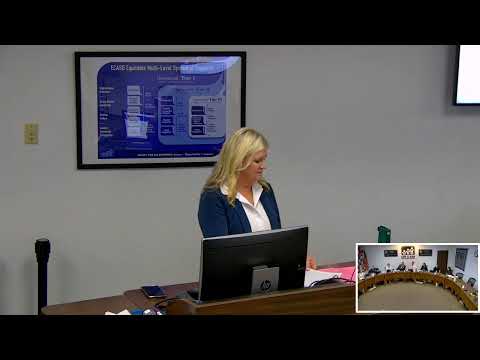
Superintendent Johnson introduced a district presentation on the Systems of Care program, a voluntary, school‑based diversion and support system for secondary students designed to reduce formal court involvement.
Superintendent Johnson introduced a district presentation on the Systems of Care program, a voluntary, school‑based diversion and support system for secondary students designed to reduce formal court involvement.
The program, district leaders said, was launched in the 2021–22 school year and was implemented across secondary buildings over the following three years. "We engaged in a collaborative effort with community partners, including the police department, corporation counsel and the Department of Human Services," a district presenter said, describing the program’s goal to "provide skills and access community supports to prevent formal court involvement." (Doctor Zhang, presenter.)
The presentation described how students qualify: referrals must involve on‑campus incidents that the district calls "focus acts," including truancy, disorderly conduct, misdemeanor battery, possession (including THC), theft and criminal damage to property. Participation is voluntary for both student and family; a family intake and a signed agreement are required. Exclusion criteria include students who have committed felony‑level offenses, students already on DHS supervision, and students 17 years old who have committed a criminal act, presenters said.
Cindy Waller, one of two Systems of Care coordinators, described the hands‑on work with students and families: relationship building, skill instruction (job interview and social skills), referrals to community services, and restorative practices such as community service or restorative circles. Waller said the program typically runs 8–16 weeks but may extend when needed: "This act does not need to define you. It's what you do from this point to change that trajectory," Waller said.
Misty (data lead) delivered historical counts: 589 total referrals since 2021–22; of those, 509 students engaged in the process, 68 declined to participate, and 12 were in progress at the time of the presentation. The district also reported 375 successful program completions, 33 unsuccessful closures, and 99 still in progress. Truancy was the most frequent referral category at both middle and high school levels, followed by possession (including THC) and disorderly conduct. Presenters said the program is currently available only at middle and high schools.
School administrators and a DeLong representative described operational details: administrators make referrals (SROs, counselors and school administrators are all potential referral sources), coordinators meet regularly with students (often 15–30 minutes weekly), and the coordinators coordinate with school staff and community agencies to provide services. A school administrator described the program as "another tool in my toolbox" that provides a different set of supports than internal tiered services.
District staff noted funding and capacity constraints: the county funds one coordinator FTE and the district funds the other; additional services (mentoring, substance‑use supports, school‑based mental health) are sought through competitive grants and partner programs. Staff also described an upcoming county change to truancy enforcement — moving to a citation model with deputized county workers — and said the district will need to align Systems of Care with that change so citations can be diverted if a family chooses the program.
Board members asked about data disaggregation, racial and demographic patterns, referral sources, and long‑term outcomes. Presenters said detailed disaggregation exists in county records but the district cannot publicly release some cross‑tabulations yet because cell sizes are small and the data are sensitive; staff said they are working to clean and present more detailed outcome analyses in future reports.
The presentation concluded with next steps: deepen community partnerships (mentoring, AODA supports, school‑based mental health), run correlations between Systems of Care participation and academic outcomes, and align program procedures with county truancy citation changes.
The board did not take a formal vote; the item was presented for information and discussion.