Get Full Government Meeting Transcripts, Videos, & Alerts Forever!
Get email alerts on the Stormflooding Sewer Backups topic
No spam. Unsubscribe anytime.
Cortland residents demand action after severe flooding; council vows to pursue options
Summary
Residents of Tournament Trail, Old Oak Drive and nearby streets told the Cortland City Council on May 5 that recurring creek overflows and sewer backups caused extensive home damage. City staff and the mayor said they will pursue short- and long-term options with federal, state and local partners, but no formal action was taken at the meeting.
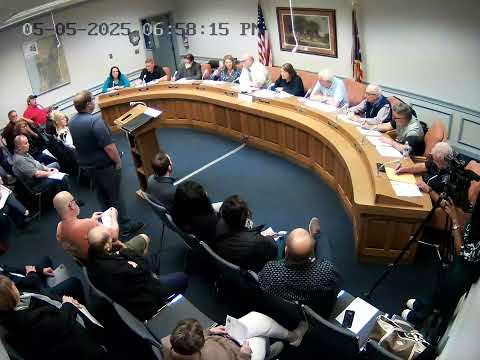
Cortland City Council heard more than an hour of public testimony on May 5 from residents who said a recent storm sent creek water and sewage into basements, destroying furnaces, hot-water tanks and personal property.
The public-comment portion was moved to the start of the meeting to accommodate residents; dozens described the night of flooding on Tournament Trail, Turner Trail and Old Oak Drive and urged the city to dredge the creek and upgrade sewer infrastructure.
Cheryl Thomas, a resident of 248 Orlando Drive, said the flood left almost a foot of water in her basement and that she and neighbors have “videos … that would make you wanna crack.” Thomas said, “I am scared to death,” and urged the council to “go down that creek … find out what garbage is down that creek, and it needs cleaned up.”
Resident Matthew Demaria said much of the damage on Turner Trail came from sewage backup: “the sewage backup was at least 3 feet deep before the water ever got to us from the creek.” Demaria said he had already spent “above $18,000 out of my own pocket” repairing damage and asked whether the city could help residents who do not qualify for FEMA or insurance payouts.
Sean, interim service director for the city, addressed several technical questions. He said the Hickory lift station did not fail completely during the storm but was overwhelmed by inflow and infiltration; staff alternated pumps to avoid shorting and brought in a gas-powered pump during the event. “Hickory never failed,” Sean said, and added that the lift station is “just not built for that type of capacity.”
The interim service director and other staff outlined steps the city is pursuing: inspecting and documenting manholes and lift stations, smoke-testing the sanitary system to locate illicit stormwater connections, pursuing upgrades to pumps and panels, preparing bids to replace an undersized lift station, and seeking grant funding. He noted the downstream sanitary pipe capacity—described in the meeting as 4-inch pipe in parts of the system—limits how much pumped water can be moved away from the area.
Mayor (name not given) told residents the city would look at “every option with our federal partners, state partners, local partners to try to move this forward to eliminate or reduce the chance that this happened again.” She said staff had already begun contacting regional agencies and nonprofits and would post updates on the city’s eNews subscription list and website.
Residents and staff also discussed household-level measures. Several speakers described installing sewage backflow valves (also called backflow or check valves) in basements; one resident said a backflow valve and multiple sump pumps had reduced repeated sewer entries, but warned that homeowners must avoid running water during events to prevent interior sewage backups. Meeting participants estimated the installed cost of a backflow valve at roughly $2,000–$3,000 per unit.
Speakers urged the city to ask the U.S. Army Corps of Engineers to inspect the waterway and advise about dredging and permits. City staff said the Corps controls permitting for work in navigable waterways and that pursuing Corps involvement may be slow and is not guaranteed. The mayor and staff said they would seek a meeting with the Army Corps to explain the situation and ask what actions, if any, the Corps could permit or support.
Residents asked whether state or federal disaster aid could be available; staff encouraged applying to Catholic Charities, the Red Cross and state programs (including H2Ohio and EPA contacts) and said they would check whether any assistance programs apply. The mayor said staff would contact DSRB managers, Red Cross and Catholic Charities as immediate next steps and would post follow-up information on the city website and eNews.
No formal motions or votes were taken on infrastructure measures during public comment. City staff said cost estimates for pipe replacement, lift-station replacement and larger-scale mitigation would likely be in the seven-figure range and require grant chasing, outside agency cooperation and council approval before spending city funds.
Residents asked for and were told how to subscribe to the city’s eNews for updates and were encouraged to provide names and addresses so the city could document the number of affected households for grant and agency outreach.
The mayor closed public comment by repeating the city’s promise to pursue information and funding with regional and federal partners; officials said they would return findings and proposals to council for any required decisions or funding approvals.