Get Full Government Meeting Transcripts, Videos, & Alerts Forever!
Get email alerts on the Redistricting topic
No spam. Unsubscribe anytime.
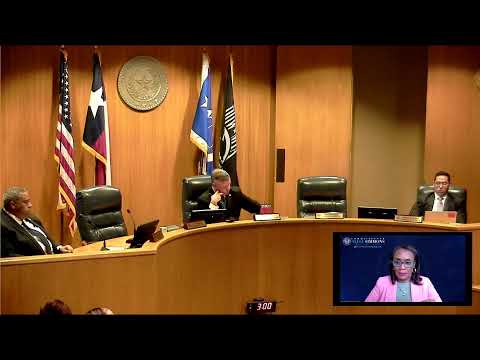
Tarrant County holds redistricting briefing, schedules four public input sessions amid protests over maps
Summary
The commissioners' court received a briefing on proposed mid-decade commissioner-precinct maps and announced four public input sessions; residents and elected officials raised concerns that the proposals appear targeted and lack data transparency.
Tarrant County Commissioners Court on May 6 received a briefing on proposed mid-decade changes to county commissioner precinct boundaries and announced four public input sessions to take public comment on draft maps.
The court posted five proposed maps online and scheduled public input sessions across the county: Precinct 4 on May 13 at Azle ISD administration building; Precinct 1 on May 14 at Como Community Center in Fort Worth; Precinct 2 on May 17 at the Arlington sub courthouse; and Precinct 3 on May 21 at the Gary Fickas Northeast Courthouse, the court announced.
Why it matters: speakers and several commissioners said the timeline and packet materials do not give residents enough time or data to evaluate how proposed lines would affect communities, minority representation and local services. Dozens of residents and advocacy groups called for additional hearings, translated materials and the opportunity for citizens to submit and test their own maps.
The briefing was led by a representative of the Public Interest Legal Foundation (PILF), who said the maps had been drawn at the direction of individual court members. Joe Dixon of the Palo Alto Freedom Foundation, who addressed the court during the briefing, said county administration had made the maps available online and that residents could submit comments and use interactive tools on the county website.
In public comment speakers repeatedly questioned both the justification for redistricting at this point and the choice of consultant. ‘‘The proposed maps are using the same data as was done in 2021. So why redraw the maps now?’’ said Janet Mattern of the League of Women Voters, referencing the county’s 2021 redistricting assessment. Multiple speakers said the current districts meet legal population-deviation thresholds and called the proposals partisan and racially discriminatory.
Commissioner Alyssa Simmons urged greater community access and said public hearings must be meaningful: "If we want to redistrict, fine, but make sure it's thorough and that everybody has an opportunity to have their input," she told the court.
Several residents and community groups asked the court to require the map drawer to appear and answer questions publicly. Commissioners and members of the public repeatedly asked whether the person who prepared the maps, identified in comments as Adam Kinkade, would appear; county staff and the consultant did not commit to a follow-up appearance at the May 6 meeting.
What the court did: the court previously approved property use requests to host the public input sessions and posted the draft maps online; no vote to adopt any new map was taken at the May 6 meeting. Commissioners and members of the public repeatedly requested additional analysis showing how many voters would be moved between precincts, demographic breakdowns (total population, voting-age population, citizen voting-age population) for each proposed map, and down-ballot election results by precinct to better estimate likely county-election outcomes.
Public reaction: speakers representing civil-rights, civic, faith and neighborhood organizations described the process as rushed and said the materials on the county website lack the detail needed for meaningful review. "The overlap between the 2024 election outcomes and all five of the proposed maps is so obvious it's breathtaking," said Mindy Tackett, a resident of Precinct 4.
Next steps: the court will take public comment at the scheduled sessions. The court did not set a date for further deliberation beyond the posted hearing dates; public commenters asked the court to extend the timeline, provide translation and mapping tools, and require the consultant to appear at a public meeting.
Ending note: commissioners and community members disagreed sharply about whether the county should proceed now. Several speakers warned that litigation could follow if the court adopts maps perceived as racially discriminatory or that materially dilute minority voting strength.