Get Full Government Meeting Transcripts, Videos, & Alerts Forever!
Get email alerts on the County Budget topic
No spam. Unsubscribe anytime.
Spalding County adopts first-reading for lean FY2026 budget, certifies rollback rate under new state laws
Summary
County manager presented a balanced, tightly constrained fiscal 2026 expenditure budget that funds a 2.5% cost-of-living increase for employees, adds public safety staffing and responds to an unfunded state court mandate; the board approved first reading and certified the rollback rate required by Georgia House Bills 581 and 92.
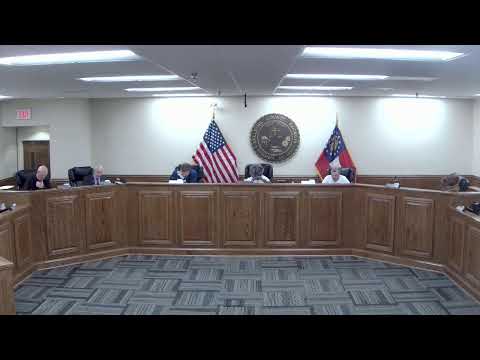
Spalding County Manager Dr. Christopher Ledbetter presented a balanced fiscal year 2026 expenditure budget May 5 and the Spalding County Board of Commissioners approved the budget on first reading and separately certified the county’s rollback rate to comply with Georgia House Bill 581 (2024) and House Bill 92 (2025).
The budget presented is a lean plan that Dr. Ledbetter said carries roughly a $2,035,785 increase over the prior year and a recommended total expenditure budget of $75,000,006.34. He told the board the plan is balanced and that staff is “working diligently hard” to reduce the millage between first and second readings as required by state law.
Why it matters: The budget moves funding to public safety and court needs while attempting to honor voter sentiment around tax reductions. Commissioners described the plan as a careful tightening of expenses that still funds employee pay increases and critical public-safety additions.
Dr. Ledbetter told the board that law enforcement represents about 35 percent of county expenditures and highlighted several line-item changes: a 2.5 percent cost-of-living increase for county employees; an estimated 2.1 percent average increase in residential property valuations; a $264,064.07 expected modest increase in local option sales tax receipts that is being held in fund balance; and a $500,000 general-appropriations investment earmarked for sewer planning. He also noted revenue and millage estimates are preliminary and will be refined before the second reading.
The budget includes targeted public-safety spending: a 0.2 mill increase in the unincorporated fire district millage to fund a third person on each shift at county fire stations, and an addition of five deputies to the sheriff’s department (the manager said the sheriff’s increases together approach roughly a $2 million total personnel impact). Dr. Ledbetter also described a proposed reduction in inmate population assumptions and a decision not to refill eight currently vacant correctional officer positions.
A major cost driver noted in the presentation was an unfunded state mandate to stand up an additional state court judge. Dr. Ledbetter said the county expects a half-year cost this fiscal year of about $970,000 to staff a second state court judge beginning in January 2026, with an estimated full-year operating cost of about $2,000,000 thereafter. The board discussed the mandate and the strain it places on an otherwise tax‑reduction-focused agenda.
The manager flagged NextGen 911 requirements from the state as another uncertain cost, with early estimates “between $75,000 or a million,” and noted the county is evaluating whether regionalization or system upgrades will be required. He also reported revenue from the county aquatic center (about $325,000 at the gate) and recommended reducing the number of recycling centers to two (Carver and Woodruff) to realize roughly $330,000 in savings to help offset other increases.
During the public hearing portion of the meeting, Joe Skinner, executive director of Nalo Spalding, identified his organization as an addiction recovery support center and offered the nonprofit’s support for county recovery programs.
Discussion among commissioners emphasized implementing the voters’ preference for tax relief after the November measure, staffing and pay issues, and the need to address unfunded mandates. Chair Clay Davis and other commissioners credited the county manager and staff for producing a balanced budget under constraints. The board voted 5-0 to approve the first reading of the FY2026 expenditure budget.
Separately, the board voted 5-0 to certify the fiscal 2026 rollback rate to satisfy reporting requirements under Georgia House Bill 581 and House Bill 92. Dr. Ledbetter explained that certifying early under HB 92 required moving the first and second readings earlier than previously scheduled.
The budget will return to the board for a second reading and final adoption after staff refines valuation data and millage-rate options.