Get Full Government Meeting Transcripts, Videos, & Alerts Forever!
Get email alerts on the Land Development Code topic
No spam. Unsubscribe anytime.
Walton County planners focus on compatibility standards to curb ‘monster houses’
Summary
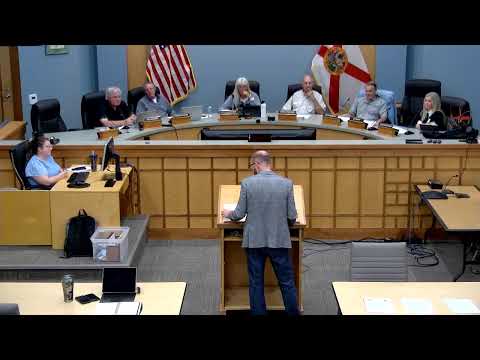
Walton County planning staff and commissioners used a public workshop to narrow options for limiting so‑called “monster houses,” focusing on objective compatibility standards that would trigger review for large or multistory homes and short‑term rentals that operate like hotels.
Walton County planning staff and commissioners used a public workshop to narrow options for limiting so‑called “monster houses,” focusing on objective compatibility standards that would trigger review for large or multistory homes and short‑term rentals that operate like hotels.
The county’s planning staff was directed to draft text amendments combining a compatibility standard with threshold triggers (more than two stories and a gross floor area threshold) and to return to the commission for a formal recommendation to the Board of County Commissioners.
Why it matters: residents said the new large houses change neighborhood character, raise parking and traffic pressures and reduce long‑term neighborhood livability; developers and some builders warned that overly strict measures could also block legitimate full‑time “dream homes.” The planning commission sought measures that are measurable, defensible and quick to put into the land development code so existing vacant lots are not converted en masse before rules change.
Most important facts: planning staff said short‑term rental listings on marketplaces such as VRBO and Airbnb are captured by the county’s monitoring software and that an initial compliance approach is a notice and certification process, escalating to magistrate enforcement with potential fines if owners don’t comply. Commissioners and members of the public discussed several quantitative triggers and mitigation tools: a height/number‑of‑stories test, gross square‑foot thresholds, a daylight plane (vertical envelope) to reduce bulk, adjusted setbacks, parking requirements and possible commercial tax designation for units clearly operating as short‑term rentals.
Commission and staff discussion: the group agreed on a working approach rather than a final code text. Commissioners and staff repeatedly returned to “compatibility” as the primary policy goal. Planning staff summarized other jurisdictions’ approaches (many use more stratified zoning such as R‑1/R‑2) and said Walton County is less stratified, which complicates simple zoning fixes.
On thresholds, workshop participants proposed candidate numbers during the meeting: 40‑foot height caps were discussed, as were gross area thresholds that ranged widely in public remarks. Local architect Jeff Chick said 4,500 gross square feet “is much, much too low” to capture only egregious rental houses and recommended starting at a higher gross threshold (he suggested 7,500 gross to capture the largest problem houses and reduce unintended regulation of ordinary new homes). Multiple residents and commissioners supported a compromise threshold; toward the end of the workshop staff noted commissioners were comfortable directing staff to prepare drafts using a square‑foot trigger in the midrange (a working figure discussed in the meeting was 5,500 gross square feet) plus any structure over two stories to trigger a compatibility review.
On short‑term rentals and enforcement: staff said the county’s rental‑regulation software flags properties that appear on rental marketplaces; the program then sends a notice and seeks certification such as DBPR registration. If owners fail to comply, cases can proceed to code enforcement and a magistrate, who may impose daily fines described in the workshop as up to about $500 per day per violation. Several speakers urged a fee structure scaled by size or room count; one resident suggested charging the short‑term rental certificate “per room” as a deterrent to 18‑bedroom listings.
Public input: more than a dozen residents spoke. Susie Delahunt of Blue Mountain Beach said, “There are some dream homes that are I would call them hotels,” and asked that any new rules apply to permanent homes that function commercially as rentals. Multiple Gulfview Heights residents described a cluster of new large houses (one developer with several lots) and urged quick action so additional vacant lots cannot be permitted under current rules before changes take effect. Others urged protections for property owners who want reasonable full‑time homes and cautioned against measures that would produce unintended loss of value or legal exposure.
Process and next steps: staff said the commission’s workshop guidance is advisory; staff will prepare a revised draft ordinance/text amendments, circulate the draft to commissioners for comment, present the changes to the Planning Commission for a formal recommendation and then forward the recommended language to the Board of County Commissioners. No formal motion or vote was taken at the workshop; the outcome was direction to staff to draft a hybrid package focused on measurable compatibility tests and associated mitigation requirements.
What was not decided: the workshop did not adopt a final numeric threshold, an absolute height limit, or a finalized notice procedure; staff will return with code language and a proposed administrative process. Several speakers and commissioners noted state preemption concerns if the county attempts to impose detailed architectural controls, so staff said the county would focus on massing, setbacks, vertical envelope (daylight plane) and objectively measurable triggers.
Ending: staff and commissioners said they will try to move the draft quickly because pending permits and vacant lots give developers time to file under existing rules. Planning staff and several commissioners asked residents who support changes to attend future Planning Commission and Board of County Commissioners public meetings when the draft returns for public hearings.