Get Full Government Meeting Transcripts, Videos, & Alerts Forever!
Get email alerts on the Fisheries Loans topic
No spam. Unsubscribe anytime.
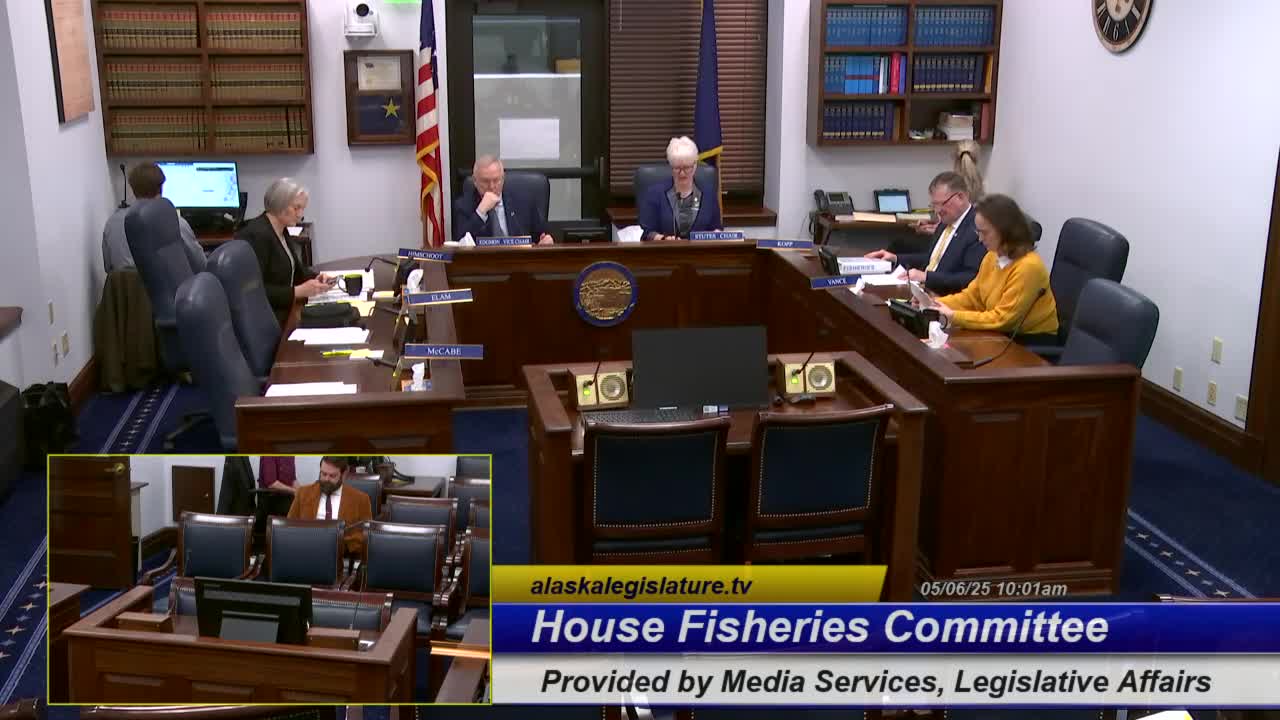
House committee advances bill to lend $3.7 million to Alaska Commercial Fishing and Agricultural Bank
Summary
The Alaska House Special Committee on Fisheries voted to move House Bill 199 out of committee after hearing that the bill would provide a one-time $3.7 million state investment in the Alaska Commercial Fishing and Agricultural Bank to allow it to refinance loans and offer reduced-rate lending to Alaska residents for up to two years.
The Alaska House Special Committee on Fisheries on May 6 voted to move House Bill 199 out of committee, advancing a proposal to provide a one-time, approximately $3.7 million state investment in the Alaska Commercial Fishing and Agricultural Bank (CFAB) to allow the bank to refinance existing loans and issue new lower-interest loans to Alaska residents.
The committee adopted a committee substitute as a working draft and then, by unanimous consent, reported House Bill 199 out of committee "as amended with individual recommendations and accompanying fiscal note," Chair Stutes said.
The bill would, pending appropriation, provide the funds through the purchase of Class C nonvoting shares in CFAB and allow CFAB to offer loans at a fixed interest rate of 5.25%, matching the state-run commercial fishing revolving loan fund for a temporary two-year period. Kyle Newman, staff to the House Fisheries Committee, told the committee the investment "would provide a 1 time temporary investment of approximately $3,700,000 of state money to bolster Alaska's commercial fishing and agricultural bank or CFAB" and that CFAB "will repay the state in full within 20 years." Newman also said the substitute clarifies that the Division of Banking and Securities will conduct a one-time review of loans generated under the bill.
Members asked whether the dollars come from the Capstone Avionics Revolving Loan Fund and what happens to that fund. Newman said the Capstone fund had been left unobligated after prior reappropriation attempts and that the bill would effectively end that program: "This act is repealed 07/01/2027," the chair read from the bill language during discussion. The substitute specifies that the state investment would be repaid through CFAB repurchasing shares from the state within a statutory timeframe.
Several lawmakers pressed CFAB and staff on eligibility and the program's focus. Representative McCabe criticized the idea of recapitalizing the bank without broader changes to retain more seafood industry value in Alaska, saying, "I don't think that we should be capitalizing an industry that is doing nothing for us." CFAB senior lender Steve Worley replied that CFAB "only lend[s] to Alaskan residents" and that the bank finances Alaskan operations even when a resident may fish outside state waters. Worley also said CFAB's largest loan on the books is about $1.5 million and that most CFAB loans are smaller than the large catcher-processor loans cited by some members.
Committee staff and CFAB representatives said the bill is intended to "level the playing field" after changes last year that reduced the state's revolving loan fund rate and made refinancing through that state program more attractive than CFAB loans. Newman said the substitute limits the state-provided funds to commercial fishing loans, and noted CFAB's agricultural and tourism lending are smaller portions of its portfolio.
Questions in committee also covered the geographic and operational scope of eligible borrowers. Worley said the bank can make loans to fishermen and businesses across Alaska — including Cook Inlet, Bristol Bay, Southeast Alaska, Kodiak, Homer and Seward — and that loans could be available for set-net and drift-fleet operations as well as smaller charter or tourism businesses when those activities fit CFAB eligibility.
After discussion and clarification from staff and CFAB, Representative Edgmond moved the committee substitute as a working document. With no objections to final passage out of committee, House Bill 199 advanced with the committee's accompanying fiscal note. The committee chair asked members to remain to sign paperwork; no additional follow-up assignments or directions to staff were recorded beyond the clarifications given during the hearing.
What happens next: The committee reported the bill to the full House with individual recommendations and the fiscal note; any further amendments or floor action will be recorded in subsequent House proceedings.