Get Full Government Meeting Transcripts, Videos, & Alerts Forever!
Get email alerts on the Stormwater Management topic
No spam. Unsubscribe anytime.
Public hearing closed on New Canaan Avenue contractor yard; commission asks staff for draft resolution and clarifications
Summary
The Norwalk Conservation Commission and Inland Wetland Agency on April 22 closed a public hearing on application S‑16‑499B for 284 New Canaan Avenue and asked staff to prepare draft resolution language with conditions and clarifications before a final decision.
The Norwalk Conservation Commission and Inland Wetland Agency on April 22 closed a long public hearing on a corrective‑action permit modification for the contractor’s yard at 284 New Canaan Avenue (application S‑16‑499B) and directed staff to prepare draft resolution language for consideration at the commission’s May meeting.
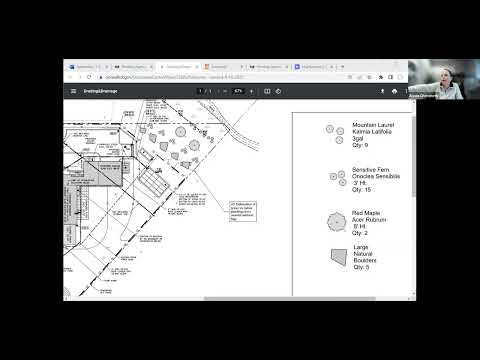
The application, brought by AJ Pena & Sons (represented by attorney Rick Costantini) proposes two principal changes: restoration of a previously disturbed area on the eastern portion of the yard, and modification of a previously approved above‑ground stormwater treatment arrangement to a subsurface gallery (referred to in the record as a Coltec/Caltec underground system). The applicant’s engineer and wetland scientist, Brian Carey of LandTech, told the commission the change was reviewed and approved by Norwalk public‑works engineering staff and that the proposed underground galleries would provide stormwater treatment equivalent to or better than the prior above‑ground design.
Neighbors and their counsel raised concerns. Several abutters spoke during the public comments, including a next‑door neighbor (Robert Kolodny) and Karen Wilson, who asked whether a third‑party inspection of the existing underground system had been completed and whether independent testing should be required before approving the modification. Commenters said they have observed late‑night truck idling, stockpiled materials, and other operations that they said have occurred beyond what they expected at the site and urged heightened safeguards to protect wetlands and watercourses.
Commissioners heard that additional materials were added to the record earlier the same day, including a memorandum submitted by neighbor counsel (Megan Miles of Carmody) and a rebuttal from the applicant’s consultant. The applicant noted an earlier precedent on the site: the commission previously allowed a similar change from above‑ground to subsurface treatment for another area of the property in 2018 and the applicant said that change had been installed in late 2024.
Commission discussion focused on two issues: the eastern restoration area (where commissioners generally agreed the restoration plan as revised by staff was acceptable) and the proposed switch to an underground gallery system. Several commissioners said the gallery system, as designed and reviewed by city engineering staff, likely offers better pretreatment and maintenance (catch‑basin sumps, swirl concentrator/Downstream Defender, and an operation & maintenance plan) than the previously proposed grass swale and above‑ground basin, but others said the commission was missing independent technical review and specific assurances about long‑term maintenance and about any existing impacts from years when the site operated without the designed stormwater treatment.
Commissioners asked staff to refine permit conditions that would address neighbor concerns if the commission moves to approval. Topics staff was asked to include in a draft resolution: a restoration plan with increased tree counts and minimum planting sizes (staff and the applicant agreed to increase trees in the restoration area from 16 to 20 and to accept larger planting stock where feasible), a clear requirement to remove foreign fill and construction debris from the restored footprint, a requirement that the applicant record an operation and maintenance plan for the underground system on the land records (and provide post‑installation certification and photos), a mechanism for annual compliance reporting, and clearer physical demarcation (a combination of masonry block and berm or curb) along the yard edge to keep yard runoff channeled to the treatment system and away from the wetland.
The commission formally closed the public hearing by unanimous vote and did not render a final permitting decision April 22. Staff member Alexis Carrichetti said she will prepare one or more draft resolutions for the commission’s May meeting (May 13) that reflect the discussion and suggested conditions. Commissioners indicated the record will be the basis for the agency decision, and several members reiterated that if the commission were to deny the modification, the applicant could appeal — a path that, several commissioners said, would likely result in litigation and transfer the question to a court. The commission left open the option of requiring third‑party technical review as a condition in the draft resolution, although members were divided about whether such a review is necessary before the agency acts.