Get Full Government Meeting Transcripts, Videos, & Alerts Forever!
Get email alerts on the Special Districts topic
No spam. Unsubscribe anytime.
Supervisors review challenges in Butte County's 77 county service areas; staff asked to return with policy options
Summary
A lengthy April 22 discussion examined funding limits, Prop 218 constraints and options to consolidate or limit county service area (CSA) roles. Staff was asked to return with a formal policy proposal including consolidation options and guidance for future subdivisions.
The Butte County Board of Supervisors spent an extended portion of its April 22 meeting discussing the county service area (CSA) program, its history, fiscal pressures and possible policy changes for existing and future special districts.
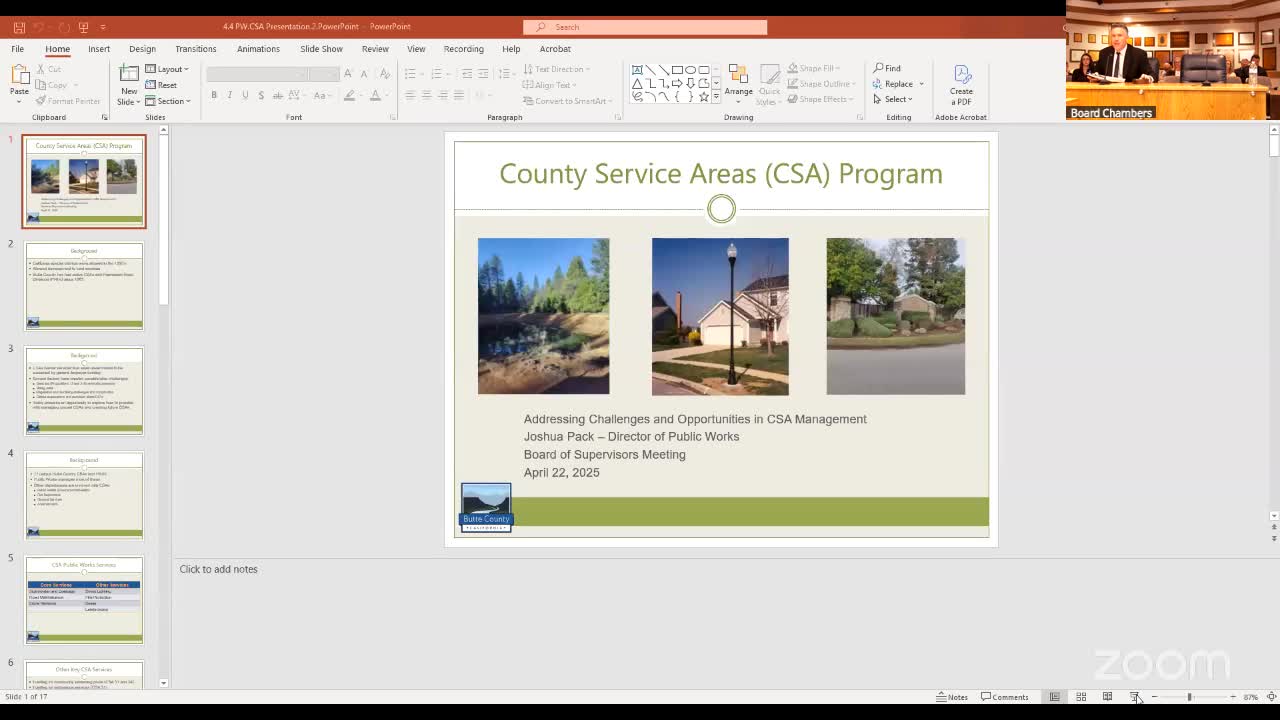
Director of Public Works Joshua Pack summarized the program and its origins, telling the board Butte County currently oversees about 77 special districts (roughly 72 managed by Public Works) that provide services ranging from street lighting and road maintenance to sewer, ambulance and landscaping. Pack said the program grew in three phases beginning in the 1960s, expanded after Prop 13 prompted state fixes, and was further constrained by Proposition 218 (1996), which requires voter approval for any assessment increase.
Pack described several structural challenges: many assessments established decades ago did not anticipate long-term replacement costs; Prop 218 makes even small inflationary adjustments subject to an election, and Prop 218 elections can be costly (staff cited roughly $8,000–$10,000 per election). He said street lighting accounts for more than 50 of the special districts and that some smaller CSAs lack fiscal capacity to pay for needed maintenance or one-time repairs. Pack suggested options including consolidating similar CSAs (a proposed pilot to combine lighting districts), limiting new CSAs to services aligned with county expertise (roads, drainage, stormwater), and steering water, sewer and fire infrastructure toward other providers (HOA, private utilities or developer-funded solutions).
Supervisors pressed on practical impacts and equity. Several members urged that new CSAs include inflation or consumer-price-index adjustments when they are formed and that any future development proposals that rely on CSAs be required to demonstrate fiscal sustainability, reserves and cost recovery. Board members also emphasized they were reluctant to subsidize individual CSAs from the general fund and that, if residents vote against needed increases, alternatives include reduced service levels, formation of private HOAs or development of other funding mechanisms. Several supervisors said they would support consolidation when it reduced administrative costs; others stressed the county should keep core services such as roads if they meet county standards.
Members of the public and several supervisors raised examples: an existing landscaping CSA with about 44 parcels that pays more than $21,000 annually for maintenance, CSAs that cannot afford a Prop 218 election, and failing HOAs or private associations whose roads and infrastructure collapsed after the Camp Fire. John Stonebraker (public commenter) urged the county to ensure future subdivisions include an entity that remains solvent in the long term and warned that failed private entities can shift costs to neighboring taxpayers.
Joshua Pack asked the board for guidance and said staff would return with options. Multiple supervisors asked staff to prepare a formal written plan that: (1) evaluates opportunities to group or consolidate CSAs where appropriate (lighting pilot), (2) recommends standard fiscal requirements for new CSAs (including inflation escalators and reserve policy), (3) proposes policy limits on what services the county will provide through CSAs (focusing on roads, drainage and stormwater and avoiding county operation of water/sewer/fire where alternatives exist), and (4) outlines a strategy for existing underfunded CSAs (including LAFCO dissolution where cities now provide service, limited service levels, or loans/revolving-fund options for critical one-time repairs).
The board did not take formal action on the CSA program at this meeting but directed staff to return with a policy proposal and implementation plan for future consideration.