Get Full Government Meeting Transcripts, Videos, & Alerts Forever!
Get email alerts on the Capital Improvement Program topic
No spam. Unsubscribe anytime.
Buckeye retools CIP, readies geobond to fund fire stations, roadway pinch‑point fixes and public‑safety projects
Summary
City staff described a restructured capital improvement program, new project‑selection processes and a planned geobond program that would fund two fire stations, public‑safety headquarters design and priority transportation projects; staff said Sensei IQ and tighter KPIs will improve delivery.
City staff described a restructured capital improvement program (CIP) and an initial geobond financing plan during a Buckeye City Council workshop, presenting new governance, project‑selection criteria and delivery tools intended to reduce carryovers and speed project completion.
The changes matter because the CIP accounts for the largest share of the recommended FY‑26 budget and funds transportation, public safety, utilities, parks and other projects; staff said improved project controls and additional funding are needed to deliver a larger volume of projects.
Javier (CIP management office) said staff reworked selection and delivery after years of inconsistent scopes and reporting: “The ultimate measure of a capital program is its ability of delivering projects that meet expectations.” He described steps taken with consultant LJA to limit the program to projects the city can deliver, standardize scopes and create clear performance indicators.
Staff said the program now uses a year‑round planning cycle, a monthly CIP committee (deputy city managers, the city manager, finance, the PMO and submitting directors), and a criteria‑based check list that evaluates projects for factors such as ongoing construction, public safety impact, regulatory obligations, council priority and economic development value. Staff emphasized the need to scope projects early, to avoid adding features later that increase cost and delay delivery.
Jim Sciano (PMO staff) described process improvements and the decision to implement Sensei IQ project management software for dashboards and transparency. “Things that get tracked get done,” James Riley said when describing planned KPIs and reporting. Staff told council they will plan and scope projects earlier in the year so that many FY‑26 projects are fully scoped by the time the budget is adopted, allowing procurement and construction to begin sooner.
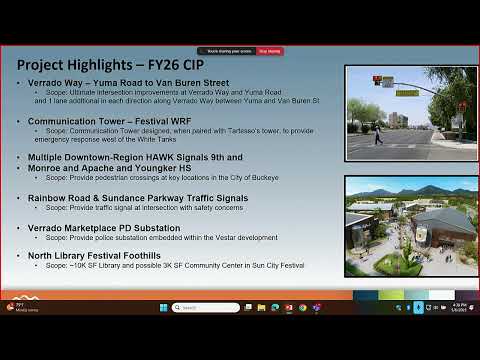
Staff outlined an initial geobond program with an approximately $75 million first tranche to fund selected streets and public safety projects and said a second issuance is anticipated in FY‑29. Projects mentioned for geobond funding or near‑term CIP focus included two fire stations (Westpark and Victory), design and land work for a public safety headquarters and training facility, Indian School road improvements phased over bond rounds, Miller Road ultimate cross section and multiple “pinch‑point” roadway improvements intended to relieve congestion.
Other CIP highlights included Sun Valley Parkway lighting (design in front of two community master planned areas, construction in phases), a police communications center nearing completion, wastewater projects, airport runway environmental work tied to a future runway extension, and public‑facing investments such as a North Library in Festival Foothills.
Staff acknowledged constraints: variable construction costs, supply‑chain and labor pressures, the need for land acquisition for certain transportation projects and the city’s ability to hire or contract project managers to match increased program throughput. They said LJA consultants will supplement city project managers as needed.
Council asked about value‑engineering roadway projects where full ultimate cross sections are not immediately necessary; staff said they are preparing design concept reports and iterative options to allow interim lane improvements where appropriate and to plan for land acquisition when needed.
Staff said the restructured process aims to reduce annual project carryovers and improve delivery metrics so more projects reach completion each year; the PMO will report KPIs to council and use Sensei IQ dashboards to track scope, schedule and budget performance.