Get Full Government Meeting Transcripts, Videos, & Alerts Forever!
Get email alerts on the Land Use Plan Update topic
No spam. Unsubscribe anytime.
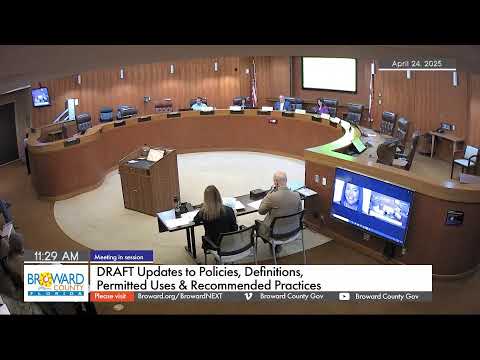
Broward Next steering committee advances land‑use plan updates focused on resiliency, housing and parks
Summary
Committee members reviewed proposed Broward County land use plan changes — including resiliency maps and water‑storage criteria, a new affordable‑housing bonus density, in‑lieu fee options and clarifications for parks and recreational lands — and directed staff to refine language before public release.
The Broward Next steering committee on April 17 reviewed a package of proposed updates to the Broward County Land Use Plan that staff say will steer future development toward resilient, transit‑served corridors while adding tools to encourage affordable housing and protect parks and conservation lands.
Committee members heard staff present a reorganized “framework” document with tracked edits, then discussed three priorities: (1) new resiliency measures tied to two mapping tools (a social‑resilience map and a future‑conditions water‑storage map), (2) revisions to affordable‑housing incentives including a proposed bonus density with on‑site affordability requirements and (3) updates to how the plan treats parks, conservation and community lands.
The committee’s discussion centered on balancing stronger county direction with local flexibility. Planning staff described the water‑storage map as a mechanism to identify areas where a redevelopment applicant would need to demonstrate how stormwater requirements and sea‑level‑rise adjustments will be met. As staff told the committee, projects within mapped priority areas would be expected to avoid increasing flood or heat risk “under current and future conditions,” but developers could propose off‑site or pooled measures that provide a “net community benefit” if on‑site mitigation is infeasible. Planning consultant Dr. Jurado said the water‑storage mapping reflects two years of resilience planning and aims to capture basin‑level storage needs for shared risk reduction.
Staff also outlined changes to affordable‑housing policy. Ralph Stone said proposed bonus‑density provisions would allow selected multifamily sites to exceed the current 50 dwelling‑unit‑per‑acre cap — in some cases up to 75 units per acre — if the project dedicates at least 15% of units as affordable (a suggested minimum split of 5% moderate and 10% low income was shown in the draft). Stone framed the bonus as an additional incentive layered on existing tools. As staff noted, Broward’s in‑lieu fee options are already in use: the presentation said one in‑lieu option would require 15% of units be affordable for at least 30 years; another remains a payment currently described as $1 per gross square foot per dwelling unit for some categories, while the Geller policy in‑lieu amount was shown in the draft at $10,609 per unit (escalating 3% annually).
Parks and conservation policy drew sustained comment. Committee members urged clearer definitions for “community” and “recreational” uses so that adaptive uses — for example, a project that adds a café or event facility within a park or a municipal partnership that opens school grounds after hours — are not automatically treated as a conversion. Some members said the draft should explicitly promote reciprocal use agreements with school districts and other public landowners to reduce park deserts, while still “strongly encouraging” preservation of designated conservation lands. Staff agreed to capitalize and align defined terms with the permitted‑uses and definitions sections to reduce confusion.
Committee members pressed for legal clarity on the proposed “net community benefit” approach for stormwater. Several members asked whether the county can require or accept off‑site mitigation without creating impermissible burdens on neighboring property owners; staff said they will work with the county attorney’s office to craft language that balances regulatory limits (including Burt Harris considerations) with the policy intent to capture basin‑level benefits. Planning staff also flagged that the implementation document (administrative rules) will be developed after policy adoption because it depends on the final policy text.
Other updates discussed included: clarifying permitted uses for special residential facilities to match state statute wording; modernizing compatibility and activity‑center policies to emphasize transit corridors and pedestrian/bicycle connectivity rather than prescribing parking ratios; and removing the historic “mining” permitted‑use category because no lands are designated mining. Staff told the committee the revised materials incorporate written public comments received through April 17 and will be posted on the Broward Next website for broader review before a formal recommendation to the planning council later in the summer.
The committee set its next meeting for May 21 to review edits and additional topics. No final votes or land‑use decisions were taken at this session; staff said formal recommendations to the planning council will follow further refinement and public comment.
Committee members and staff who spoke frequently during the discussion included Chair DiGiorgio; planning staff member Barbara Blake Boyd; planning analyst Ralph Stone; consultant/technical staff Dr. Jurado (resiliency); and elected members Mayor Steve Geller (referenced in discussion of policy origins), Mayor Robert Brunson (participating remotely), Mayor Ana Gomez, Mayor Lev Levy and Councilmember Horland.