Get Full Government Meeting Transcripts, Videos, & Alerts Forever!
Get email alerts on the Equity And Justice Plan topic
No spam. Unsubscribe anytime.
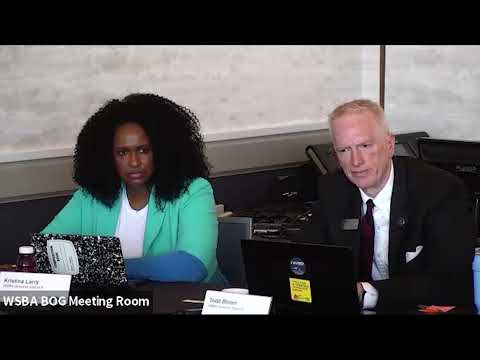
WSBA Board Approves Equity and Justice Plan after Rejecting Amendment to Rename It
Summary
The Washington State Bar Association Board of Governors approved the Equity and Justice Plan after a heated debate over whether to change the plan’s title to “Justice for All.” The amendment failed and the board voted to adopt the plan as presented.
The Washington State Bar Association Board of Governors approved the association’s Equity and Justice Plan on its second reading after members rejected a motion to change the document’s title to “Justice for All.” The title amendment failed, with three votes in favor, and the plan was then adopted by roll call vote of all members present.
The plan is intended as a roadmap for the bar’s work on diversity, equity and justice across the state’s roughly 40,000 mandatory bar members. Supporters of keeping “equity” in the title said the word reflects the plan’s process-oriented goals; opponents said the word could alienate members and recommended a title that would broaden its appeal.
“Having equity in the title is gonna cause most people to not even read it,” Governor Tom Ahern said, arguing the association should use a title that reaches members who are skeptical of current DEI terminology. Ahern moved to change the title to “Justice for All.” Sharon Sakamoto, co-chair of the Equity and Justice Plan Committee, said the committee had considered alternatives and voted to proceed with the existing title because it better reflected the work and the plan’s objectives. “Our committee voted to go forward with what we felt all would encompass,” Sakamoto said.
Several board members and staff pushed back against removing the word equity. Miriam Gordon, the committee’s other co-chair, urged preserving the term to highlight that some groups remain underserved: “There was a reason to include the word equity in the title because we need to recognize that it's not there.” Executive Director Nevitt said the potential symbolic harm of dropping “equity” outweighed any modest benefit from changing the title.
President-elect Adewale and Chief Equity and Justice Officer Diana Singleton spoke about implementation and outreach. Adewale urged adopting a title that helps with implementation but said he supported the plan’s substance; Chief Singleton described using the plan as a unifying roadmap for bar staff work and outreach to local and affinity bars. The committee chairs and staff described months of outreach, and presenters said the work has taken two to three years of meetings and consultation with local bars, affinity bars and judges.
Miriam Gordon cited governing language when pushed on the choice of terms: she directed attention to GR 12, which the committee saw as aligned with the plan’s values. Several speakers referenced a recent public remark by the state’s chief justice as underscoring the court’s view that bias exists in the justice system and that the profession must address it.
After discussion, the board proceeded to a roll-call vote on the title amendment; the motion to change the title failed (three votes in favor). The board then moved to approve the Equity and Justice Plan as presented; that motion passed on a roll-call vote of the members present. Following adoption, board leaders and staff thanked the committee co-chairs and volunteers for their multi‑year effort and said staff will use the approved plan as the working roadmap for implementing equity and justice efforts across the association.
The board’s action affects the Washington State Bar Association’s internal policies and outreach to its mandatory membership; no new statutory changes were proposed at the meeting and no implementation funding schedule or deadlines were adopted on the floor during the vote.