Get Full Government Meeting Transcripts, Videos, & Alerts Forever!
Get email alerts on the License Fees topic
No spam. Unsubscribe anytime.
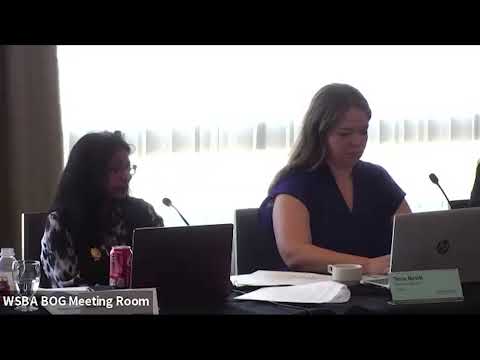
Bar Association holds first read on license-fee philosophy; staff to collect feedback and return proposal in July
Summary
The Bar Association’s Board of Governors conducted a first read of a proposed license fee philosophy intended to guide annual fee-setting; staff launched a webpage and one‑pager, and governors raised concerns about wording, messaging and the possibility of perceived automatic increases.
The Bar Association’s Board of Governors held a first read of a proposed license fee philosophy intended to guide how the organization sets license fees, with staff asking governors to send feedback and planning to return a revised proposal at the July meeting so the board can set 2027 license fees.
The proposal, presented by Director of Finance Tiffany Lynch, includes slight revisions since an initial draft in March and comparative data on the cost of practice in other jurisdictions. Lynch said the association also launched a webpage and distributed a one‑page summary and a feedback folder for governors to review.
Why it matters: Governors said members are confused about whether the proposal means automatic annual fee increases. The discussion centered on clarifying language, outreach to sections and members, and preserving the board’s discretion when setting actual fee amounts each year.
Director Lynch said the materials include requested comparative information and that the association has created a responsive web page and a one‑pager for governors to use when talking with members. Lynch said members’ feedback has been collected in a shared folder and invited governors to review it in advance of budget‑committee work.
"This is first read," Lynch said, adding that feedback should go to the budget committee and that the goal is to return to the board at the July meeting so the association can set license fees for 2027.
Governor Jordan, who identified himself as a workers’ compensation attorney, pressed for clarity on two points members had raised: whether inactive status requires retaking the bar exam and how the cost‑of‑living adjustment (COLA) is being used. Jordan said he understood that reinstatement after a long inactive period often requires demonstrating competence and, in some cases, retaking an exam if an attorney has been inactive for roughly six years. He also said the COLA referenced in the materials is not set by the Department of Labor and Industries for workers’ compensation but noted the COLA is used in workers’ compensation contexts.
Jordan pushed back on messaging that members have interpreted as an automatic yearly increase: "This is not — we are not saying bar dues are going to go up every single year no matter what," he said, describing the philosophy as a starting point for annual conversations about fees that could result in keeping fees flat, reducing them, or adjusting them based on reserves and costs.
Executive Director Nava and communications staff Sarah described a communications plan. Sarah said the association has been distributing the one‑pager and web page content through Bar News, Take Note, section leaders, county bar leaders and affinity bar leaders, and that the materials include graphics showing the changing value of money and comparative bar costs. Sarah said the web page aggregates the materials governors asked for and invites continued member feedback.
Several governors warned that the wording in the draft materials could be misread by members. Governor Nancy Hawkins pointed to the draft language (cited as "page 151 b a" in the meeting materials) that states, "In order to maintain existing programming and services, it is anticipated that license fees will increase annually," and said that phrase invites misunderstanding. "I don't care what's on the website. That's what's in the materials that goes out. It's available to the membership — that it will increase," Hawkins said. She urged the board to change language that she said members interpret as a guaranteed annual increase.
Other governors offered differing views on process. Governor Price and Governor Faye recommended language changes: Faye suggested treating the document as a policy rather than a "philosophy" and replacing the word "increase" with "license fee adjustment" to allow for upward or downward changes. Brent Williams, speaking for the RPPT section, said his section supports the proposal because small, predictable adjustments are easier to explain to members than multi‑year locked increases that could force larger changes later.
Governor Blume expressed member concerns about "mission creep," noting that paragraph B of the draft addresses use of fees to support services and to develop tools for legal professionals; Blume urged continued focus on fiscal prudence and cost‑benefit analysis for new initiatives so members do not view fee changes as funding mission expansion without clear member benefit.
Discussion vs. direction vs. decision: - Discussion: Governors debated wording ("increase" vs. "adjustment"), duration for revisiting fees (annual vs. multi‑year), and concerns about mission creep and member perceptions. - Direction: Staff were asked to continue outreach, maintain the web page and one‑pager, collect and collate member feedback (available in the shared folder), and bring a revised proposal and budget committee input to the July board meeting to set 2027 license fees. - Decision: No formal motion or vote was taken during the first read.
Next steps: Staff and communications agreed to keep promoting the materials and to offer in‑person outreach when sections request it; Director Lynch and others volunteered to meet with section leaders. The board recessed for lunch with the expectation that the matter will be revisited after the break if necessary.
Ending: The item remains at first read. Governors and staff emphasized outreach and clearer language to ensure members understand the proposal is intended as a framework for discussion, not an unconditional annual increase.