Get Full Government Meeting Transcripts, Videos, & Alerts Forever!
Get email alerts on the Amicus Brief Public Defense topic
No spam. Unsubscribe anytime.
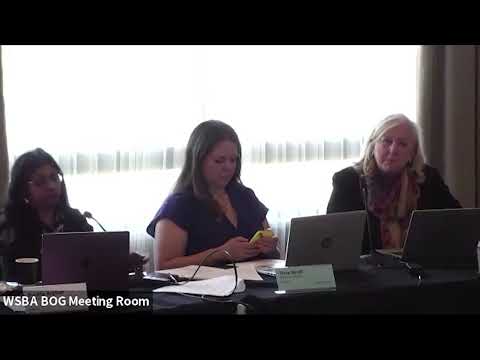
WSBA Board Tables Decision on Amicus in In re Detention of ME, Sets June 1 Deadline for More Input
Summary
The Washington State Bar Association Board of Governors voted 7-5 to table a decision on whether to file an amicus brief in In re Detention of ME and asked staff to gather additional input before a special meeting no later than June 1.
The Washington State Bar Association Board of Governors voted 7-5 to table a decision on whether to file an amicus brief in the Washington Supreme Court case In re Detention of ME and directed staff to gather additional input from membership and outside groups before reconvening no later than June 1.
The request, made by Toby Marshall of Terrell Marshall Law Group on behalf of the King County Department of Public Defense (DPD), asked the WSBA to explain why its indigent defense standards — including maximum caseload limits and a standard on the independence of public defense agencies — should be enforced by the courts. Marshall told the board, “The right to assistance of counsel is fundamental in our system of justice. And for that right to be satisfied, the representation must be effective.”
Board members debated whether the WSBA should weigh in. Some, including Judge Flood, argued silence would be “a betrayal.” Judge Flood said, “If you remain silent, silence is a betrayal for not speaking to the issue that you have said you support.” Others questioned whether filing an amicus would improperly influence judges or draw the WSBA into an institutional dispute between superior courts and the Washington Supreme Court. Governor Faye warned, “If there’s gonna be a hockey game between the superior court judges and the Supreme Court, I don’t think we ought to be the puck.”
Why it matters: The case asks whether superior court judges can require public defense attorneys or agencies to accept more cases than their staffing and caseload limits permit. The petitioner’s position, as explained by Marshall, is that exceeding WSBA maximum caseload limits and undermining agency independence raises the risk of ineffective representation and ethical violations for public defenders and threatens indigent defendants’ rights. Marshall said the DPD had documented that it had reached capacity and that court orders requiring additional assignments followed despite that showing.
Board members considered three procedural options presented by staff: vote to file the amicus, vote not to file, or gather more information and hold a special meeting before the amicus filing deadline. Staff told the board the practical filing deadline would be “mid to late July” because an amicus must be filed “45 days before oral argument,” and the court had not yet set argument for the September term. The board’s motion to table — made to allow more input and to permit a special meeting before the filing deadline — passed 7-5. The motion as amended specified the matter be returned no later than June 1 so the board would have time to consider member feedback and any outreach to judicial associations.
Board discussion touched on legal and ethical dimensions. Counsel Kate Schurr (WSBA general counsel’s office) emphasized the WSBA’s regulatory role: the association could address not only its own standards but also “the ethical impact on our membership of a court asking our attorneys to take on a caseload that goes beyond the professional guidance.” Governor Bloom and others noted the WSBA had previously sought legislative or budget remedies for public defense funding and that filing an amicus is only one of several ways to support the standards. Several governors asked for input from the judiciary and from prosecutors; staff said the King County prosecuting attorney’s office had taken the opposite position in the case and that no judges had filed amicus briefs to date.
On the record, concerns included the risk that WSBA participation could be construed as a bid to influence a judge’s discretion (some governors cited Code of Judicial Conduct Rule 2.4 in that context) and whether the WSBA would be repeating material the court already had (the WSBA’s standards are already before the court in other contexts). Supporters said the association has a duty to defend standards it promulgated and to describe why those standards exist. As Toby Marshall put it: “The WSBA’s voice will go a long way to helping the Supreme Court decide these issues.”
Next steps: Staff will solicit comment from WSBA membership and outreach targets identified by the board (including judicial associations) and schedule a special meeting so the Board of Governors can take final action before the June 1 time certain. Staff told the board that if the board votes to proceed after that outreach, they would post a draft for comment and prepare the amicus for filing; if the board decides not to file, no brief will be submitted.
The board’s tabled motion and the scheduled follow-up leave open whether the WSBA will take a position in the Washington Supreme Court on caseload limits and agency independence in public defense.