Get Full Government Meeting Transcripts, Videos, & Alerts Forever!
Get email alerts on the Stormwater topic
No spam. Unsubscribe anytime.
Consultant outlines ERU stormwater-fee study for Mooresville's MS4 obligations
Summary
Wessler Engineering presented a proposal for an equivalent residential unit (ERU) study to redesign Mooresville's stormwater utility fees, tying charges to measured impervious area and helping fund municipal MS4 permit obligations.
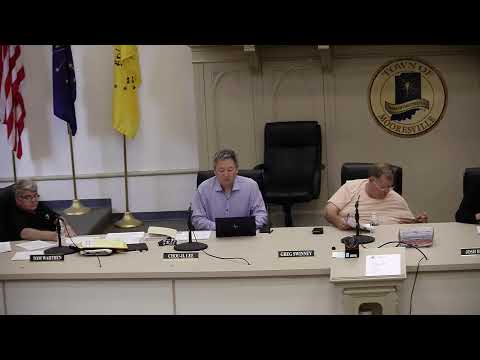
Wessler Engineering presented a proposal to the Mooresville Town Council on May 6 to conduct an ERU (equivalent residential unit) study that would change how the town charges for stormwater management and help fund Municipal Separate Storm Sewer System (MS4) permit obligations.
Mary Atkins, vice president at Wessler Engineering, told the council, “I have 25 years experience,” and outlined the firm’s work with MS4 programs and stormwater utilities around the state. Atkins said the study would measure residential and nonresidential impervious surfaces from aerial imagery and establish an average residential impervious area as the ERU. That ERU would become the base billing unit: “All residential properties pay 1 ERU,” Atkins said.
The consultant described program components the fee would fund, including inspection and maintenance of pipes and inlets, construction-site inspections, illicit-discharge enforcement, staff training, storm mapping and capital projects to fix failing drainage infrastructure. Atkins said the analysis uses aerial photos brought into AutoCAD and GIS tools for initial measurements, with manual verification.
Wessler showed sample figures from other Indiana communities and national surveys. Atkins cited an Indiana per‑ERU average of about $5.55 from a Western Kentucky University survey and noted local examples ranging from roughly $1.25 per ERU up to $20 per ERU in communities that had bonded for construction projects. She said nonresidential properties (churches, schools, parking lots) would pay multiples of the ERU based on their measured impervious area.
Tim, identified in the meeting as the town’s MS4 coordinator, was noted by Atkins as the staff lead who implements many of the MS4 tasks. A resident asked, “How do you get your measurements?” and Atkins replied the firm uses aerial photos and GIS/AutoCAD measurements and then double‑checks them.
Atkins described public involvement steps Wessler recommends: advisory committees, public meetings, outreach to high‑rate payers such as schools, and sample ordinances and billing-transition assistance. She said Wessler would coordinate with the town attorney and with a financial consultant to set the per‑ERU rate and help with utility‑billing changes. Atkins said the firm has prepared a proposal and would provide policy and procedure templates and dispute‑resolution processes for property owners who challenge measurements.
Council members and staff did not make a final decision; the council took the presentation under consideration. “I think what we'll do is we'll take this under consideration and maybe at a later date make a decision on it,” a council member said at the close of the presentation.
Why it matters: Revising the stormwater fee structure ties revenue to measured impervious surface and could increase charges for larger nonresidential properties while leaving most single‑family homes at a single base unit. The fee would be used to meet state MS4 permit requirements and pay for inspection, maintenance and future capital repairs.
Questions remaining: The council did not set a timeline, a proposed per‑ERU rate, or when Wessler’s formal proposal would come back for action. Atkins said a proposal is prepared and available when the council decides to proceed.