Get Full Government Meeting Transcripts, Videos, & Alerts Forever!
Get email alerts on the Harbor Management topic
No spam. Unsubscribe anytime.
Norwalk Harbor Management Commission briefed on advisory powers, FOIA limits and recusals
Summary
City lawyers trained the Norwalk Harbor Management Commission on the scope of its advisory powers, state review of harbor management plans, public meeting rules under the Freedom of Information Act and conflict-of-interest procedures, including how to handle recusals and remote participation.
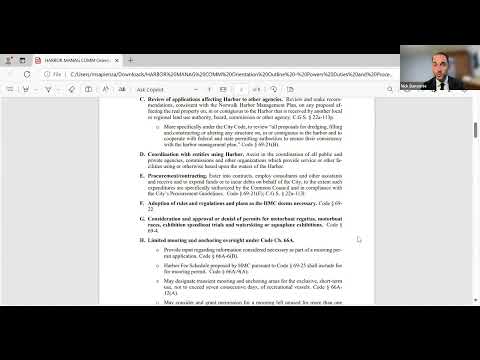
Norwalk Harbor Management Commission members attended a training session with the city law department that reviewed the commission’s advisory role, the process for harbor-management-plan amendments, public meeting and records requirements under the Freedom of Information Act (FOIA), and guidance on conflicts of interest and recusals.
The training, led by Mario Coppola, the city’s corporation counsel, and Matt Sapienza, assistant corporation counsel, and supported by Nick Bumante of the municipal law firm Birch and Moses, emphasized that most of the commission’s powers are advisory to the Common Council but noted several specific authorities and procedural limits the commission should observe. "My name is Mario Coppola. I am the corporation counsel for the city," Coppola said at the start of the presentation.
The presenters explained why the harbor-management plan matters: the plan frames the commission’s recommendations and must be approved by the state Department of Energy and Environmental Protection (DEEP) before amendments take effect. Matt Sapienza said, "The planning and zoning commission isn't bound by the harbor management plan or the commission," but noted that when a harbor-management plan is incorporated and approved by DEEP it can affect the weight of local recommendations. Commissioners were told the Norwalk code chapters most relevant to their work are chapter 69 (harbor regulations) and chapter 66a (mooring and anchorage).
Why it matters: the commission frequently reviews proposals that affect waterside development, dredging, mooring and events such as regattas. The law department told commissioners the commission should expect to be consulted on applicable planning and zoning referrals and can recommend changes to local ordinances, fee schedules and restricted-speed zones. The training noted examples of limited permit authority the commission does exercise directly (for instance, certain boating events) and the commission’s ability to retain consultants or adopt rules if authorized by the Common Council and city procurement rules.
The lawyers reviewed FOIA basics and common pitfalls. They said a "meeting" under FOIA includes not only gatherings of a quorum but also any substantive communications among a quorum (emails or texts). Staff and counsel cautioned commissioners against engaging in substantive email exchanges with a quorum on pending matters and recommended using the formal meeting record for deliberations. The presenters also covered site visits (which can constitute a meeting), the limited and specific grounds for executive session (for example pending litigation or certain personnel or contract negotiations), and the fact that public records related to commission business — including personal emails used for city business — can be subject to FOIA requests.
On recusals and conflicts, the law team urged commissioners to avoid both actual conflicts and appearances of conflicts. They described common triggers — family relationships, current financial or business ties, membership in an organization that is a party to an application — and said that when in doubt a commissioner should err on the side of recusal to preserve public confidence. The discussion included practical instructions for remote meetings: a commissioner who recuses should remove themself as a panelist (or rejoin only through the public participant link) and avoid appearing on camera as a panelist while the matter is considered.
Commissioners asked several substantive follow-ups. Commissioner John raised concerns about the legal effect of the word "binding" in harbor-management-plan language and how DEEP applies that standard in practice, noting that the commission sometimes seeks only an explanation when DEEP reaches a different conclusion. "We're not asking for authority over it. We're only asking for why did you choose a different action?" Commissioner John said. Counsel acknowledged the question is fact- and plan-specific and offered to work with the chair, staff and DEEP when particular disputes arise.
The session closed with staff and counsel offering to provide the written materials to commissioners after the meeting and to provide confidential advice on recusal or FOIA questions on a case-by-case basis. Counsel also encouraged commissioners to route most requests to the law department through the commission chair to preserve orderly records and avoid inadvertent communications among a quorum.
The training combined legal overview, recurring practical advice (for example: treat draft minutes and deliberations on the record, be cautious with social media and emails, and treat site visits as observation-only unless properly noticed) and offers of follow-up assistance from the city law department.