Maricopa supervisors approve CD 7 special-election plan, bar automatic mailings to remote voters
Get AI-powered insights, summaries, and transcripts
SubscribeSummary
The Maricopa County Board of Supervisors on May 5 approved the 2025 special-election plan for Congressional District 7 and voted to prohibit automatic mailing of ballots to remote precincts not on the early-voting list, while officials detailed logistics, signature‑verification changes and tight recount timelines.
The Maricopa County Board of Supervisors on May 5 approved the county’s plan for the 2025 special primary and general elections in U.S. Congressional District 7 and voted to exclude automatic mailing of ballots to remote precincts that are not enrolled in the early ballot program.
The vote followed presentations from the county elections director and recorder’s office about outreach, voting locations, ballot timelines and changes to signature verification. The board approved the plan on a roll-call vote with four ayes and one member absent.
At issue was how to serve roughly 59,810 registered CD 7 voters in Maricopa County, most concentrated in Tolleson and Avondale. Scott Jarrett, Maricopa County elections director, told the board “So currently, there are just shy of 60,000 voters in Maricopa County. I believe, as of last week, is 59,810.” The plan lays out critical deadlines, vote‑center locations and staffing, and the recorder’s office described recent procedural changes intended to speed provisional‑ballot and signature‑curing work.
Officials stressed key dates and logistics. The voter registration deadline for CD 7 is end of day June 16. Because July 4 falls on the statutory E‑11 deadline for requesting a ballot by mail, that deadline moves to the next business day: July 7; elections staff warned voters that ballots requested after July 3 will likely need to be returned in person at a voting center for timely counting. The general election day is Sept. 23; the equivalent last‑mail‑request date for the general election stays Sept. 11.
The board debated a recorder proposal to automatically mail ballots to voters in remote precincts who are not on the active early‑voting list. Under the recorder’s suggested criteria, envelopes would have been sent to registered voters in precincts with fewer than 100 voters or where a drive to a vote center would exceed two hours. That option prompted concern about precedent and statutory authority. Supervisor Brophy McGee moved adoption of the plan “to exclude and prohibit automatic mail ballots to voters in remote precincts not enrolled in the early ballot program.” The motion was seconded and the board approved the plan as amended.
The recorder’s office and elections department outlined how they will run the election. Ballots for military and overseas voters must be mailed by May 31 for the primary and by Aug. 9 for the general; the recorded mailing schedule (E‑27, E‑11) and the UOCAVA requirement were cited as operational constraints. Jarrett described turnout projections that guide staffing: the primary is forecast at about 20–35% turnout in Maricopa County and the general at about 35–50%, translating to an estimated 21,000–30,000 voters countywide in CD 7 under the higher scenarios.
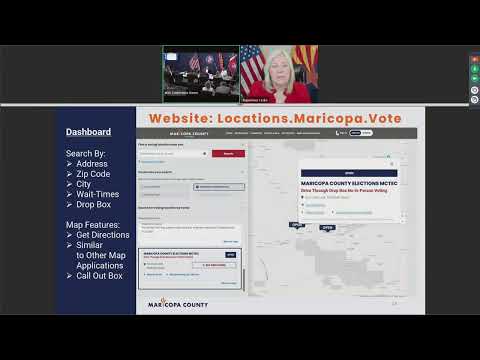
Officials described an eight vote‑center plan, opened in phases: one 27 days before election day (Avondale City Hall volunteered at no charge), additional centers in staged openings through the final five centers on election day. The elections director said the vote‑center model limits harm if a single site becomes unavailable because voters may use any other center. For very remote precincts, the recorder explained the office will send ballots proactively only in the limited circumstances approved by the board (the automatic‑mail proposal was removed by the motion).
Signature verification and provisional ballots were a major focus. Sam Stone, chief of staff for the recorder, said “Ballots that are returned by mail 100% are signature verified,” and described changes implemented after the previous administration’s backlog. Stone said the recorder’s office has begun clipping multiple past signatures (up to four) so verifiers see only signature images rather than the full affidavit envelope, and that the party registration will no longer appear on the verification screen. He said the office has added staff cross‑training, digital tools to speed verification, and a dual, double‑blind initial review so reviewers from different parties independently assess signatures. Stone said the office will flag very fast reviewers for manager audit and maintain a 2% audit of “good” signature calls.
Board members raised problems from past elections: the recorder’s office reported it processed a mass drop of roughly 70,000 registration forms in a previous cycle and that about 30% of those were incomplete or could not be validated. Stone said the office has completed an analysis of that batch and has staffing and temporary‑staff contingencies to avoid recurrence.
Outreach and budget: staff said they do not have a paid advertising budget for the specific messaging about the moved E‑11 deadline, and will rely on earned media, press conferences and social media; the board suggested seeking reimbursement or legislative relief if additional outreach funds are required. The elections and recorder offices gave a planning estimate of $906,000 for the CD 7 special elections; Jarrett said the county will seek full reimbursement from the state for actual costs.
Recount timing: Jarrett warned the calendar is compressed. Because the automatic recount threshold under state rules can be triggered by a margin of 0.5% or less, the schedule leaves narrow windows for canvass, recount and the separate mailing deadlines for military and overseas voters — the Secretary of State’s canvass and any recount could compress timelines for subsequent ballots.
The board approved the plan with the amendment to bar automatic mailings to remote voters; Chairman Galvin noted the cooperative work between the elections department and the recorder’s office and said he was “extremely confident that once again, at the end of the day, we're gonna have an election that is safe, secure, and accurate.”
A resolution listing the precise voting‑center addresses will return for formal adoption at the next regular board meeting. Staff were directed to continue public messaging about the July 7 mail request deadline and to pursue earned‑media outreach; the recorder and elections departments were also directed to continue procedural testing and to report back to the board on signature‑verification results and any unanticipated operational problems.