Get Full Government Meeting Transcripts, Videos, & Alerts Forever!
Get email alerts on the Solid Waste Transfer Station topic
No spam. Unsubscribe anytime.
Rutherford County committee approves opening tipping fees for new transfer station, debates who may adjust rates
Summary
The Public Works Committee voted to approve a proposed tipping-fee schedule for Rutherford County’s new transfer station and discussed (but did not record a separate delegation vote) whether the mayor, the solid waste director and the committee chair should be able to adjust rates between meetings as market conditions change.
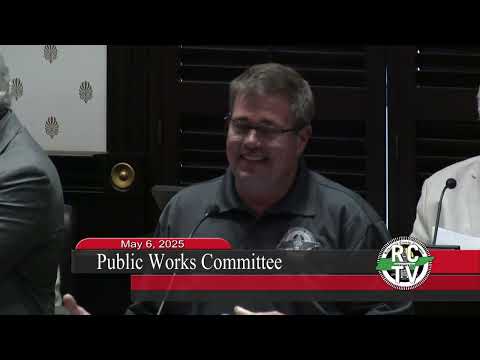
Rutherford County’s Public Works Committee on May 6 approved a proposed tipping-fee schedule to begin operations at the county’s new transfer station and discussed how future rate changes should be handled.
Bishop Wagner, Rutherford County solid waste director, described how waste will be processed at the facility: “waste that that enters our facility will go over the scales. It will be weighed, and then it will go on to what is called the tipping floor.” Wagner and county staff said material will be compacted into sealed “tube” trailers and hauled to regional landfills, reducing litter and liquids, and improving in-and-out times for haulers.
The committee’s approval clears the gate-rate schedule as a starting point while officials continue to refine operations ahead of the facility’s expected July 1 opening. The committee also debated whether to formally delegate limited authority to make interim rate adjustments to the mayor, the solid waste director and the Public Works chair; several members said they preferred routine committee review and that any interim changes should be reported back at the next meeting.
Why it matters: the transfer station is intended to give county officials control over the local solid-waste stream as Middle Point Landfill approaches closure. County leaders say the facility will let Rutherford County manage diversion and recycling strategies, reduce truck traffic and avoid leachate incidents observed at nearby landfills.
Most important facts
Mayor McFarlane told the committee the county budgeted about $20 million for the facility and that current, not-final figures show the county’s total construction cost is roughly $17,000,000, saying the effort “looks like, holding our breath, that we will save the county about $3,000,000 on the construction of this facility.” County staff did not present a final audited number at the meeting.
County staff and WM (formerly Waste Management) provided the technical basis for the rate schedule. The gate rate for small “cash” customers — residents or others dropping less than 200 tons per month — was presented as $95 per ton. Staff said the tiered schedule uses an assumed annual throughput of 100,000 tons and may change as volume and market conditions become clearer.
Bishop Wagner and WM’s regional official Don Gentlecore (area director of disposal operations for WM) described operational details: loads will be weighed at the scale house, dumped on the covered tipping floor, then either loaded into standard open-top trailers or into compactor-fed tube trailers that seal the load and reduce exposed waste on routes and at landfills. Gentlecore said WM plans to supply compactor-equipped trailers and to stage hauling assets in the area to meet demand.
Budget and host agreement
County staff said the solid-waste fund (Fund 116) — funded by a portion of county sales tax, not by property tax or the general fund — had an operating budget around $8.1 million in the most recent year. Wagner said if the county were to process the convenience-center and school waste currently going to Middle Point (36,700 tons in 2024) through the transfer station, the direct cost to the county would be about $2,800,000 per year. County officials emphasized they expect commercial revenue and operational savings (reduced haul time, less vehicle wear) to offset county costs and aim for no net increase in property taxes tied to the transfer station.
The committee received assurances that the county will honor its existing host-benefit agreement with Middle Point Landfill and that convenience-center and school loads will continue to go to Middle Point while that site remains open.
Capacity, diversion and longer-term goals
County and WM officials said the new transfer station was built with a larger-than-expected physical capacity; staff described facility capacity in terms of daily tonnage (discussed at up to 2,000–3,000 tons per day in presentations) and argued the plant can meet current county needs (county-generated waste cited at roughly 450,000 tons annually) and support future recycling and diversion efforts.
Wagner and WM representatives emphasized the transfer station’s role as the “linchpin” for future programs — single-stream recycling bays, potential composting and other diversion strategies — and said the facility should make coordinated municipal recycling programs (including Murfreesboro, Smyrna and La Vergne) more practical.
Hazardous material controls and enforcement
Commissioners pressed staff on controls for unacceptable waste and verification of waste origin. Wagner said the county will publish an explicit list of unacceptable materials and will continue to accept certain household items at convenience centers; some construction and demolition material will be accepted at the transfer station with a fee. For origin tracking, staff described using the state’s solid-waste origin reporting system and stated that haulers will self-report origin at the scale. Wagner and WM said practical and logistical factors (haul distances, equipment types) make large-scale out-of-county diversion unlikely, but they acknowledged some out-of-county material could appear and noted measures (accounting controls, “wall of shame” denial for noncompliant haulers, collection of payment guarantees) to limit abuse.
Commissioners also asked about screening for radioactive or other special wastes and for lithium batteries, which staff called “our biggest concern as it relates to hazardous waste.” Wagner said county staff have not finalized specific detection equipment for the new station but that portable detectors and enhanced inspection protocols would be considered and that communications with state environmental authorities and other facilities are part of the plan.
What the committee voted on
The Public Works Committee approved the proposed tipping-fee schedule as presented and recorded a roll call in favor. The fee schedule approval allows staff to finalize preparations for opening and to forward budget and operational details through the county’s budget pathway. Committee members also instructed staff to report back on operational software, billing and account procedures and to bring recommended changes to rates or policy to the committee and the full commission as appropriate.
Outlook and next steps
Officials plan to open the transfer station and begin commercial operations in advance of potential closure of Middle Point. Staff will continue negotiating operational details with WM and its subcontractors, finalize billing software and account controls, and pursue recycling and diversion pilots that could use a dedicated recycling bay inside the transfer station. The mayor announced a public christening scheduled for June 17 (date to be finalized) and asked commissioners to attend.
Direct quotes in this article come from county staff and WM representatives who spoke at the May 6 meeting.