Get Full Government Meeting Transcripts, Videos, & Alerts Forever!
Get email alerts on the Automated Traffic Safety Cameras topic
No spam. Unsubscribe anytime.
Council committee approves updated automated traffic camera ordinance and lifts budget proviso for non‑school cameras
Summary
Seattle’s Transportation Committee on May 6 recommended passage of an ordinance aligning city code with recent state changes to automated traffic safety cameras and approved measures on how camera revenues and data are used.
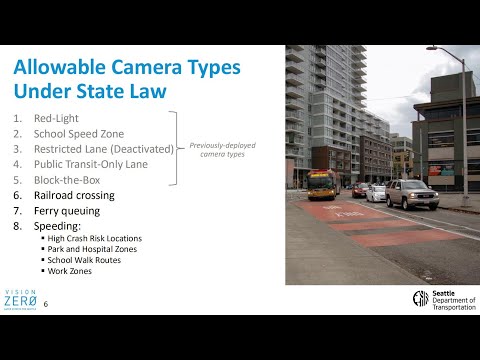
Seattle’s Transportation Committee on May 6 recommended that the City Council pass an ordinance aligning Seattle Municipal Code with 2024 state changes to automated traffic safety cameras and approved measures to govern how camera revenue and data are handled. The committee also voted to lift a budget proviso so Seattle Department of Transportation (SDOT) can spend previously authorized funds to plan non‑school speed camera deployment.
The committee chair, Rob Saka, opened the meeting by framing automated traffic safety cameras as “a crucial tool” for reducing unlawful driving behavior and said the ordinance would bring local code into conformity with state law. Central staff described the bill as mainly aligning municipal code with the state changes and updating financial policy language; the Seattle Police Department’s traffic section said it is expanding staff capacity to review camera detections.
The nut of the ordinance is technical alignment with state law and policy direction about how revenue and enforcement will be handled. The committee debated six amendments that narrowed or clarified how camera revenues can be spent, required documentation before deploying cameras at non‑school locations, standardized warning periods, and added privacy and reporting protections for camera data. Several members of the public and transportation advocacy groups urged stronger links between ticket revenue and safety investments.
During public comment, speakers asked the council to prioritize reinvesting camera revenue into local safety projects. Gordon Padelford, executive director of Seattle Neighborhood Greenways, said the public will better support automated enforcement if revenues “are reinvested in safety projects where those cameras are located.” Tyler Vasquez of Cascade Bicycle Club and Clara Canter of Whose Streets Are Streets emphasized pairing enforcement with physical street‑design improvements and called for standardized 30‑day warning periods and restrictions on how revenue is used. Remote speakers, including Ethan Campbell with the Vision Zero Network, urged the committee to adopt amendments requiring SDOT to document why lower‑cost physical mitigations were not feasible before installing cameras.
Central staff (Calvin Shaw) told the committee that 2023 revenue figures showed roughly $5.2 million from red‑light cameras and $9.5 million from school‑zone cameras in that year; he also said the executive had signaled an interest in exploring non‑school camera locations beyond doubling the number of school‑zone cameras. Public commenters and several councilmembers also cited SDOT’s prompt temporary barrier placement at Fourth Avenue South after a fatal crash as evidence that cameras should be paired with physical and maintenance investments.
On the amendments: Amendment 1, offered by Councilmember Saka, would have redirected 15% of camera revenue into new sidewalks, sidewalk alternatives and sidewalk repair and reduced the share flowing to the general fund; it failed on a 2‑3 roll call. Amendment 2 (adopted 5‑0) asked SDOT to reexamine locations that had been previously designated as “restricted racing zones” in a 2023 ordinance (examples cited included Alki and Harbor Avenue, Magnuson Park and Golden Gardens Park) to determine whether they qualify for deployment under the state’s new authorities. Amendment 3 (adopted 4‑1) clarified that operational and maintenance expenditures from camera funds should support Vision Zero and traffic safety and added guidance that appropriations should prioritize locations where cameras are installed. Amendment 4 (adopted 5‑0) standardized a 30‑day warning period for all camera deployments after the legal review clarified that school‑zone cameras could be treated the same as other cameras for warnings. Amendment 5 (adopted 3‑2) strengthened the requirement that SDOT’s location analyses identify physical traffic‑calming measures considered and explain why they would not be feasible prior to camera deployment. Amendment 6 (adopted 5‑0) added privacy and vendor‑contract protections modeled on recent rules the council adopted for automated license‑plate readers, including limiting public disclosure and requiring notice when warrants or subpoenas seek camera data.
Captain Sean O’Donnell of the Seattle Police Department’s traffic section described SPD’s role in reviewing camera detections and said SPD is working to supplement staffing (including parking enforcement officers) to handle review and citation processes as the camera program expands. Committee members asked about the department’s readiness as the city plans to double school‑zone cameras this year and begin non‑school deployments; SPD said it is training additional reviewers and working with SDOT.
After debate and roll calls, the committee voted 5‑0 to recommend passage of council bill 120971 as amended; it also voted 5‑0 to pass a separate ordinance, council bill 120972, to lift a proviso in the 2025 budget so SDOT can expend funds on non‑school speed camera planning and procurement.
The chair noted ongoing concerns about public legitimacy and emphasized council priorities to reinvest camera revenues in safety improvements. Several councilmembers said they support pairing enforcement with engineering and capital work and suggested further coordination with the Finance and Budget Committee on longer‑term spending priorities. The committee sent both measures to the full council with recommendations for passage.
The committee’s discussion highlighted three consistent themes: (1) the city will expand camera deployment while trying to protect privacy and ensure revenues fund safety, (2) the technical work to determine camera locations must document why lower‑cost physical mitigations are not feasible at a particular site, and (3) SPD and SDOT must coordinate staffing and data to support timely implementation.
Looking ahead, the chair and staff said the full City Council will consider the measures at the council meeting on May 13, 2025.