Get Full Government Meeting Transcripts, Videos, & Alerts Forever!
Get email alerts on the State Legislation topic
No spam. Unsubscribe anytime.
Seattle officials review 2025 state legislative session, highlight budget cuts and key bills
Summary
Seattle's Office of Intergovernmental Relations briefed the City Council on the 2025 Washington state legislative session, outlining the final $77.8 billion operating budget, major revenue changes and bills of local importance, and noting program cuts that could affect city services.
The City of Seattle's Office of Intergovernmental Relations (OIR) told the City Council on May 5 that the 2025 Washington state legislative session closed amid sharp political division and a $16 billion budget shortfall, producing a final $77.8 billion operating budget that includes both cuts and new revenue measures.
The briefing, delivered by Mina Hashemi, director of the Office of Intergovernmental Relations, summarized the session and what passed that affects Seattle. "From the opening days, the atmosphere in Olympia was fraught with deep division," Hashemi said. She told the council the final budget includes nearly $6 billion in cuts and about $9 billion in new revenue across the four-year outlook and that the governor may sign or partially veto the package.
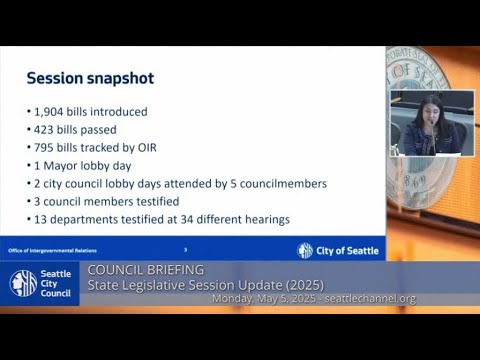
Why it matters: the budget sets funding for programs Seattle relies on, and several of the session's revenue and program changes will affect city departments and community partners. OIR said it tracked 795 bills and secured appropriations for dozens of Seattle priorities while some proposals the city supported did not pass.
Key outcomes and local impacts included: 1) public safety and criminal justice funding in a large public safety bill (identified in the briefing as House Bill 2015) that provides recruitment and retention grants and a new 0.1% local sales-and-use tax option for criminal-justice purposes; 2) transportation revenue changes including a 6-cent gas tax increase and other measures that fund projects and a $9 million allocation to address homeless encampments on washed-out rights of way, with a $1 million carve-out for Seattle safety and debris cleanup; 3) housing and homelessness capital investments that included $10 million in the current biennium for Fort Lawton redevelopment and an expanded Housing Trust Fund appropriation; and 4) climate and environment appropriations including grants for Lower Duwamish remedial action and park renovations.
OIR also flagged program reductions and delays: Hashemi said the final plan contains cuts or reductions to some behavioral-health programs, assisted outpatient treatment, short-term housing subsidies, recovery residences, and certain grant programs; OIR noted the reinstatement of a 25% local match for sending recruits to the basic law enforcement academy. Council members asked OIR to follow up with department-level analyses so the city can quantify direct impacts on Seattle programs.
Other legislative highlights cited by OIR included bills on outdoor dining and special-event alcohol regulation, condominium development and affordable homeownership, recycling reform, and state funding for World Cup-related public safety and transit needs. Hashemi reported that OIR and Seattle delegations secured multiple direct appropriations and that the team held more than 100 meetings with legislators during the session.
Council members asked for follow-up on several topics raised in the presentation, including the potential effect of sales-tax changes (the new sales tax on some previously exempt services), whether private laboratories could be authorized to process toxicology samples (a bill that stalled but which the budget partially addressed with funding to reduce the state lab backlog), and the specific local impact of cuts to grant programs.
OIR repeatedly cautioned that the governor has up to 20 days to sign or veto bills and that some final funding may change during the executive review. The office said it will return with a more detailed, department-level assessment in the coming weeks.