Get Full Government Meeting Transcripts, Videos, & Alerts Forever!
Clark County Planning Commission reviews wide-ranging biannual code amendments including ADU, forest-practices and impact-fee changes
Summary
Clark County Planning Commission Chairman Carl Johnson called the commission’s April 17 work session to order to review the county’s packet of biannual code amendments to Title 40, the county development code.
Clark County Planning Commission Chairman Carl Johnson called the commission’s April 17 work session to order to review the county’s packet of biannual code amendments to Title 40, the county development code. Land Use Review Manager Brent Davis and staff detailed proposed edits ranging from accessory dwelling unit rules to forest-practices procedures and impact-fee timelines.
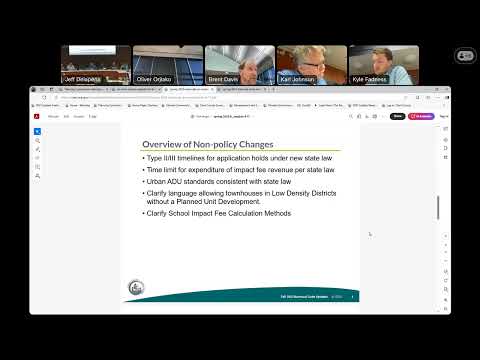
The package bundles corrections, clarifications and a few minor policy changes that county staff said are intended to align the county code with recent state statutes and to fix unclear language in existing standards. Brent Davis, Land Use Review Manager in the Department of Community Development, said the county filed a 60-day notice with the Washington State Department of Commerce and plans a public hearing May 15 and a Clark County Council hearing July 1.
Why it matters: The amendments would change how the county handles development review timekeeping, where accessory dwelling units (ADUs) are allowed, how long public agencies have to spend impact-fee revenue, and how small forest-harvest permits are processed inside the county. Those changes affect builders, landowners, school districts that collect school-impact fees, and county environmental protections.
Major items discussed
Permit-review timelines: Davis told commissioners county code currently allows staff to add 14 days to the review clock after an applicant submits additional information so staff can verify the response. A recently enacted state statute requires the county to restart the clock as soon as the applicant submits new information. Staff proposes removing the county provision that adds 14 days so the county’s procedure matches the state rule.
Impact fees and spending horizon: County code currently requires expenditure of certain impact-fee revenues (primarily traffic/road impact fees) within six years. Davis said state statute was changed in 2011 to allow a 10-year spending period, and the county proposes extending its timeframe to 10 years to give Public Works more time to plan and deliver projects. Davis noted project delivery timelines—including planning and permitting—often exceed six years; Oliver Jack, Community Planning Director,…
Already have an account? Log in
Subscribe to keep reading
Unlock the rest of this article — and every article on Citizen Portal.
- Unlimited articles
- AI-powered breakdowns of topics, speakers, decisions, and budgets
- Instant alerts when your location has a new meeting
- Follow topics and more locations
- 1,000 AI Insights / month, plus AI Chat