Get Full Government Meeting Transcripts, Videos, & Alerts Forever!
Get email alerts on the Civic Processes topic
No spam. Unsubscribe anytime.
Barrington prepares for financial town referendum in 2026; no early or mail voting planned
Summary
Board of Canvassers and town officials outlined a timeline for the switch from a financial town meeting to an all-day townwide financial town referendum (FTR) beginning May 27, 2026, and described key deadlines, signature thresholds and the lack of early/mail ballots.
The Barrington Board of Canvassers and town staff presented a preliminary implementation plan for the town's shift from a traditional financial town meeting to an all-day financial town referendum (FTR) in 2026. The council received the outline but did not vote on policy changes.
Why it matters: Voters approved the charter amendment in November 2024 to replace the town meeting with a single-day referendum. The new process will concentrate budget decisions into one day and introduces new signature, timing and procedural constraints for citizen petitions and budget amendments.
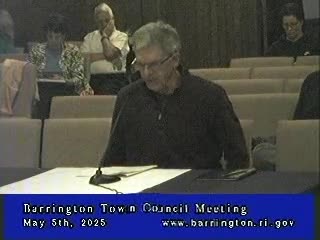
Key elements presented by Dan O'Mahoney of the Board of Canvassers: - The inaugural FTR is scheduled for Wednesday, May 27, 2026, with voting from 7 a.m. to 8 p.m. at a single polling location (Town Hall/council chamber). - There will be no early voting period and no procedure for mail ballots for the FTR under the current timeline. - Ballots will include the COA (Committee on Appropriations) proposed consolidated budget, any council- or school-committee amendments, and any citizen petitions that qualify. - To qualify, a citizen petition to appear on the FTR ballot must collect verified signatures from 2,685 registered Barrington voters (20% of registered voters, per the charter's requirement) by a prescribed deadline. - The COA will conduct two hearings: the first is informational (no vote) where the budget is presented and public comment solicited; the second is the final presentation of the budget as it will appear on the ballot.
O'Mahoney and town officials said they have met with stakeholders'including the town financial director, the committee on appropriations, the town moderator and the school committee'to shape a calendar that fits state and charter deadlines. Staff noted constraining dates already fixed in the charter: the first Monday in March for the school budget submission and the second Monday in March for the municipal budget submission, and the fourth Wednesday in May for the FTR vote.
Town Clerk and elections staff told the council they do not plan to mail ballots or offer early voting for the FTR because the charter's schedule leaves little time to print, verify and distribute ballots within statutory notice windows; the clerk's office and board of canvassers will revisit procedures as questions arise. O'Mahoney noted the clerk's office will accept COA candidate nominations by declaration rather than signatures and that COA candidate names will appear on the ballot.
Other procedural points explained to the council: - Petition sponsors may begin signature-gathering at any time but the clerk must receive petitions early enough to verify signatures ahead of the FTR; an illustrative deadline mentioned was April 27, 2026, to allow time for verification before the May 27 vote. - The COA will incorporate feedback from the informational hearing and may change the budget before the final presentation; the final presented budget will be the ballot measure.
Questions from council members and residents focused on voter turnout (historically low for town meetings), the logistics of single-site voting, and the potential for public notification efforts to drive turnout. Several speakers suggested the town should plan an outreach campaign to ensure residents know they must go to Town Hall on the scheduled FTR day.
Ending: Town officials said implementation questions will continue to be refined in coordination with the town solicitor and clerk's office. The presentation represented a planning milestone: the town has a working calendar and a list of unresolved implementation questions (including what processes will be required if competing citizen petitions appear, and how to handle statutory notice timelines). Council members and staff agreed to continue stakeholder meetings and to return with refinements.