Get Full Government Meeting Transcripts, Videos, & Alerts Forever!
Get email alerts on the School Budget Millage Feep topic
No spam. Unsubscribe anytime.
Budget workshop: FEFP scenarios, potential millage change to cover SRO increase and capital project updates
Summary
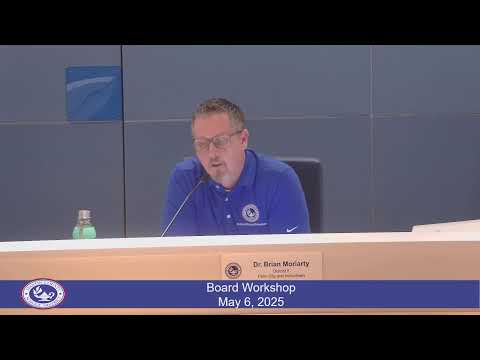
Chief financial and operations staff briefed the school board on May 6 during Budget Workshop No. 3 about state funding scenarios, district revenue pressures and capital-plan changes.
Chief financial and operations staff briefed the school board on May 6 during Budget Workshop No. 3 about state funding scenarios, district revenue pressures and capital-plan changes.
Carter Morrison, Chief Financial Officer, walked the board through differences between the House and Senate proposals for the Florida Education Finance Program (FEFP) and showed how those scenarios would affect the district’s state funding and local revenue needs. Among the factors discussed were the treatment of Family Empowerment Scholarship (FES) vouchers, changes in base student allocation and proposed categorical funding amounts. Morrison said the situation remained fluid because the legislature was in extended session and the district was still reconciling FTE counts with the Department of Education.
Morrison described several local budget pressures: increased Florida Retirement System (FRS) employer rates, inflation and tariff-driven cost increases, potential additional costs for the annual federal operational audit, and a pending request from the Sheriff’s Office to increase the School Resource Officer (SRO) contract. He said the current SRO contract is funded partly from operating funds (about $2.6 million) and voter-approved millage (about $682,000), for a total near $3.2 million; the Sheriff’s requested increase would raise the total to about $5.35 million, adding roughly $2 million in district cost.
To cover that increase, staff demonstrated that keeping the existing 0.425 millage rate would not generate sufficient additional revenue but raising the millage to roughly 0.481 (still inside the voter‑approved 0.5‑mill ceiling) would generate about $2.0 million in additional proceeds. Morrison said the district will present millage options and a pro forma budget in a subsequent workshop and that the board would have to give direction before staff proposes a tentative millage for the public notice and tentative budget process.
Procurement and operations topics: Jeff Carver, director of purchasing, explained a recurring‑vendor list used in neighboring districts that would let the superintendent issue purchase orders to a preapproved list of vendors up to a board‑approved aggregate amount and then report quarterly to the board. Carver said Indian River County had used the approach to speed routine purchases while keeping quarterly transparency; he proposed an initial list of 15–25 vendors and quarterly reporting. Several board members expressed a desire to retain transparent, stand‑alone agenda review for larger purchases and asked the superintendent to return recommended language for board review and vote.
Operations staff proposed a landscaping contract using a cooperative bid that could immediately save more than $100,000 for three district properties compared with current vendors; staff said the contract’s unit pricing and mowing schedules (work performed when students are not present) were beneficial. Morrison also said the superintendent had used emergency authority earlier to avoid a $92,000 cost increase on Chrome devices.
Capital updates: Mark Secrest, director of facilities, described proposed reassignments of student stations, including moving some Pre‑K classes from Perkins and Old Salerno into Port Salerno Elementary and Warfield, and noted that the district planned to reprogram $1.3 million in five‑year capital funds to support that work. Secrest said RFQs for architecture and engineering for a major renovation (including Buildings 9, 10 and 18) are underway with an A/E RFQ due May 8; adding those buildings has nearly doubled previous cost estimates and staff said they would reallocate funds from other capital projects. He gave an updated range for one large project of roughly $32 million–$34 million before any insurance recoveries for hurricane/tornado damage.
Board guidance and next steps: Board members asked staff to provide the board with the proposed recurring‑vendor language for consideration, to show a pro forma that reflects options if millage is increased (including possible reductions in millage‑funded line items), and to return with updated five‑year capital spreadsheets. Morrison confirmed that any millage change would be public and would come to the board for direction prior to tentative budget adoption.
Why it matters: The FEFP outcomes, FRS rate changes and local millage decisions directly affect the district’s ability to maintain staffing, pay negotiated supplements and cover contracts such as SROs. The board must balance state funding uncertainty with local taxpayer approvals and ongoing capital needs.
What’s next: Staff will return with amendments and proposed language for recurring vendor approvals, a millage/pro forma package showing options to raise additional revenue within the voter‑approved millage ceiling, and a revised five‑year capital plan reflecting project reallocations and insurance recoveries as available.