Get Full Government Meeting Transcripts, Videos, & Alerts Forever!
Get email alerts on the Wind Energy topic
No spam. Unsubscribe anytime.
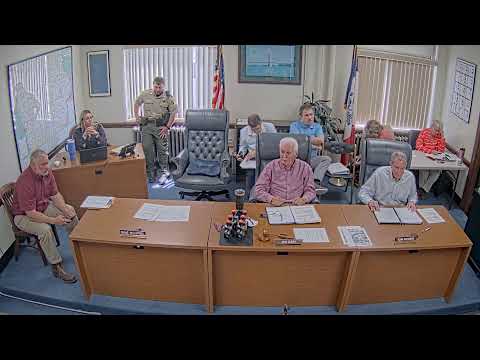
Des Moines County hears heated public comment on proposed Big River Wind Farm; residents urge ordinance changes or moratorium
Summary
The Des Moines County Board of Supervisors on May 6, 2025 heard extended public comment on the proposed Big River Wind Farm, a project AES says would sit in northwest Des Moines County and involve voluntary leases with nearly 12,000 acres of private land.
The Des Moines County Board of Supervisors on May 6, 2025 heard extended public comment on the proposed Big River Wind Farm, a project AES says would sit in northwest Des Moines County and involve voluntary leases with nearly 12,000 acres of private land.
AES project developer Evie told the board the project is “still in its early stages, and there's much work to be done developing it,” and provided preliminary financial and timing estimates: about $1,300,000 already invested in development, roughly $30,000,000 in development and planning costs, and a total build cost AES estimated at about $400,000,000 (Evie). AES gave early estimates that the project could generate about $2,600,000 in annual tax revenue to the county and roughly $80,000,000 over the project’s lifetime (Evie).
Why it matters: speakers said the project raises questions about land use, public safety, noise, migratory birds, agricultural land preservation and county rules for siting commercial wind energy. Many residents asked the board either to pause permitting while the ordinance is revised or to strengthen setback, sound, lightning-protection and decommissioning requirements.
During the public-input session, landowner and citizen commenters pressed for a moratorium and substantial ordinance changes. Melanie Patton, who said she helped draft a comprehensive wind ordinance in Henry County and is speaking for the Des Moines County Know Group, argued that “a moratorium gives the county the opportunity to look at the ordinance and make updates and do sessions like this” so supervisors have time to revise rules before applications arrive (Patton). Patton walked the board through the county comprehensive plan language and cited Iowa code provisions (transcript references: “Iowa code 3 35 5”), arguing county goals include preserving prime farmland and discouraging development on the most productive soils.
Patton and other speakers urged larger setbacks than Des Moines County’s current 1,800-foot distance from a nonparticipating occupied dwelling. Patton noted the county’s present standard for nonparticipating property lines is 1.1 times turbine height (which she calculated as about 715 feet for a 650-foot turbine) and urged reconsideration; she said some local commenters favor a 5,280-foot (one-mile) setback from nonparticipating property lines. She also recommended adding explicit sound standards, infrasound protections, lightning protection and fire-suppression requirements to the local ordinance. Patton cited a Nordex operations manual passage recommending workers withdraw 1 kilometer (3,280 feet) from turbines during certain storms and linked that to safety concerns for nearby residences (Patton).
Other residents raised concerns about county road impacts from heavy construction traffic, the presence of sensitive natural resources and the Mississippi River flyway for migratory birds. Commenters asked how emergency response and firefighting would be handled for tall turbines and expressed worry about long-term effects on wildlife and on the county’s agricultural land base; several speakers said they would like more evening meetings so more residents can attend.
Not all speakers opposed the project. Kenny Olsen, president of the Des Moines County Energy Districts and a representative of the Clean Energy Districts of Iowa, urged the board to consider economic benefits and existing Iowa experience with wind: “Wind works when it's done right,” Olsen said, and he cited statewide job and tax figures and offered to facilitate site visits to neighboring counties that host turbines (Olsen). Other proponents told the board the project offers lease payments to landowners and new property-tax revenue that could support local services.
Several speakers — including AES and outside commenters — urged the county to focus on ordinance updates rather than a protracted moratorium. Evie of AES said the company supports reopening the ordinance and working with the regional planning commission, and warned a moratorium could create uncertainty for landowners and businesses considering investment.
No formal permitting vote or moratorium was taken at the May 6 meeting. The session was a public work session and input opportunity; supervisors repeatedly stated they were collecting community concerns and would take the comments into consideration as they and regional planning staff evaluate potential ordinance changes.
Clarifying details recorded from public remarks and staff statements at the meeting: - AES development-investment estimate: $1,300,000 (Evie). - AES preliminary project costs: ~$30,000,000 development/planning; ~$400,000,000 build; total ~ $430,000,000 (Evie). - AES preliminary tax estimate: ~$2,600,000 annually, ~ $80,000,000 over project life (Evie). - Developer timetable given by AES: county permit expected mid‑2026, construction early 2028, operational by 2029 (Evie). - Current Des Moines County setback cited in discussion: 1,800 feet from nonparticipating occupied dwelling; property-line setback at 1.1× turbine height per existing ordinance language (Patton). - Public commenters requested additions to the ordinance including sound and infrasound standards, lightning protection and fire‑suppression systems, CSR (Corn Suitability Rating) screening for prime farmland, and larger setbacks (Melanie Patton and others).
Quotes (verbatim): - Evie, project developer, AES: “This project is still in its early stages, and there's much work to be done developing it.” - Melanie Patton, Des Moines County Know Group: “So a moratorium gives the county the opportunity to look at the ordinance and make updates and do sessions like this.” - Kenny Olsen, Des Moines County Energy Districts: “Wind works when it's done right.”
Ending: The board held the comments as part of a scheduled work session; no ordinance change or moratorium was adopted at the meeting. Supervisors said they heard the public input and will consider it as they and county planning staff evaluate whether and how to amend the county wind-energy ordinance and next procedural steps.