Get Full Government Meeting Transcripts, Videos, & Alerts Forever!
Get email alerts on the Flood Disaster Recovery topic
No spam. Unsubscribe anytime.
IEDA outlines CDBG‑DR timeline, $34.7M allocation and priorities for 2024 Siouxland floods
Summary
Representatives from the Iowa Economic Development Authority briefed the Woodbury County Board on a draft action plan to allocate $34,687,000 in CDBG‑DR funds for communities affected by 2024 Siouxland flooding, emphasizing mitigation, infrastructure and housing for low‑ and moderate‑income residents.
Representatives from the Iowa Economic Development Authority on Tuesday briefed the Woodbury County Board of Supervisors on an action plan to allocate Community Development Block Grant–Disaster Recovery (CDBG‑DR) funds for communities affected by the 2024 Siouxland flooding.
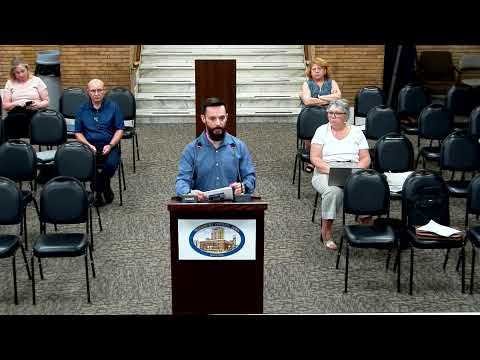
Robert (Rob) Wick, CDBG and disaster recovery team lead with the Iowa Economic Development Authority, told the board HUD promulgated a Federal Register notice in January that established an overall allocation of $34,687,000 for the affected region. "A big component of that that we have to develop firstly is the unmet needs assessment," Wick said, describing outreach, surveys and stakeholder meetings to identify remaining community needs before the action plan is finalized and submitted to HUD.
Wick said 80% of the allocation must go to the federally identified most-impacted-and-distressed counties — Clay, Sioux, Cherokee and Woodbury — and that 70% of the total allocation must benefit low- to moderate-income (LMI) residents. He said the funds are intended as the funding of last resort and will be used to support or complement other disaster programs such as FEMA and insurance. "The disaster recovery money has to come in as that last in," Wick said.
IEDA staff outlined program priorities: planning and updated flood mapping (including work with the Iowa Flood Center and restoration/expansion of stream sensors and push-notification alerts), mitigation projects to reduce future flood risk, critical infrastructure repairs (stormwater, drinking water, sewer) and housing rehabilitation or new construction targeted to LMI households. Wick emphasized sequencing: prioritize mitigation and planning first, then infrastructure, and then housing so rebuilding does not occur where flood risk remains.
The agency plans a public comment period in May into June, two virtual public hearings (one morning and one evening), a June 20 deadline to submit the draft action plan to HUD and a HUD review period of 45 days after submission. If HUD does not object, Wick said the state expects to execute a grant agreement with the federal government roughly 30–45 days after HUD's review and aims to open grant applications in November or December, though timelines depend on federal processing.
Wick said some federal requirements differ for CDBG‑DR: certain Buy America or Davis‑Bacon rules may not apply for small housing projects (seven units and under), which can affect project costs and affordability. He encouraged local officials, department heads and potential applicants to complete IEDA’s short survey and to participate in pre-application workshops the agency expects to hold in mid‑October if the timeline proceeds.
Woodbury County Treasurer Tina Bertram asked how the program might interact with property tax assessments and whether assistance would cover costs tied to construction versus tax‑assessment relief; Wick replied the programs are generally for new construction or rehabilitation and that applicants can be counties or municipalities. "If there is a need to have some funding that is other than just a traditional construction and rehabilitation type activity, let us know," Wick said, and IEDA will evaluate eligibility based on a community’s submission.