Get Full Government Meeting Transcripts, Videos, & Alerts Forever!
Get email alerts on the Osp Replacement topic
No spam. Unsubscribe anytime.
Oregon DOC calls for replacement of Oregon State Penitentiary, cites more than $110 million in deferred maintenance
Summary
The Oregon Department of Corrections told the Public Safety Subcommittee that Oregon State Penitentiary’s century‑old infrastructure requires replacement or extensive retrofit; DOC estimates deferred maintenance and seismic needs exceed $110 million and replacement planning should begin with feasibility work.
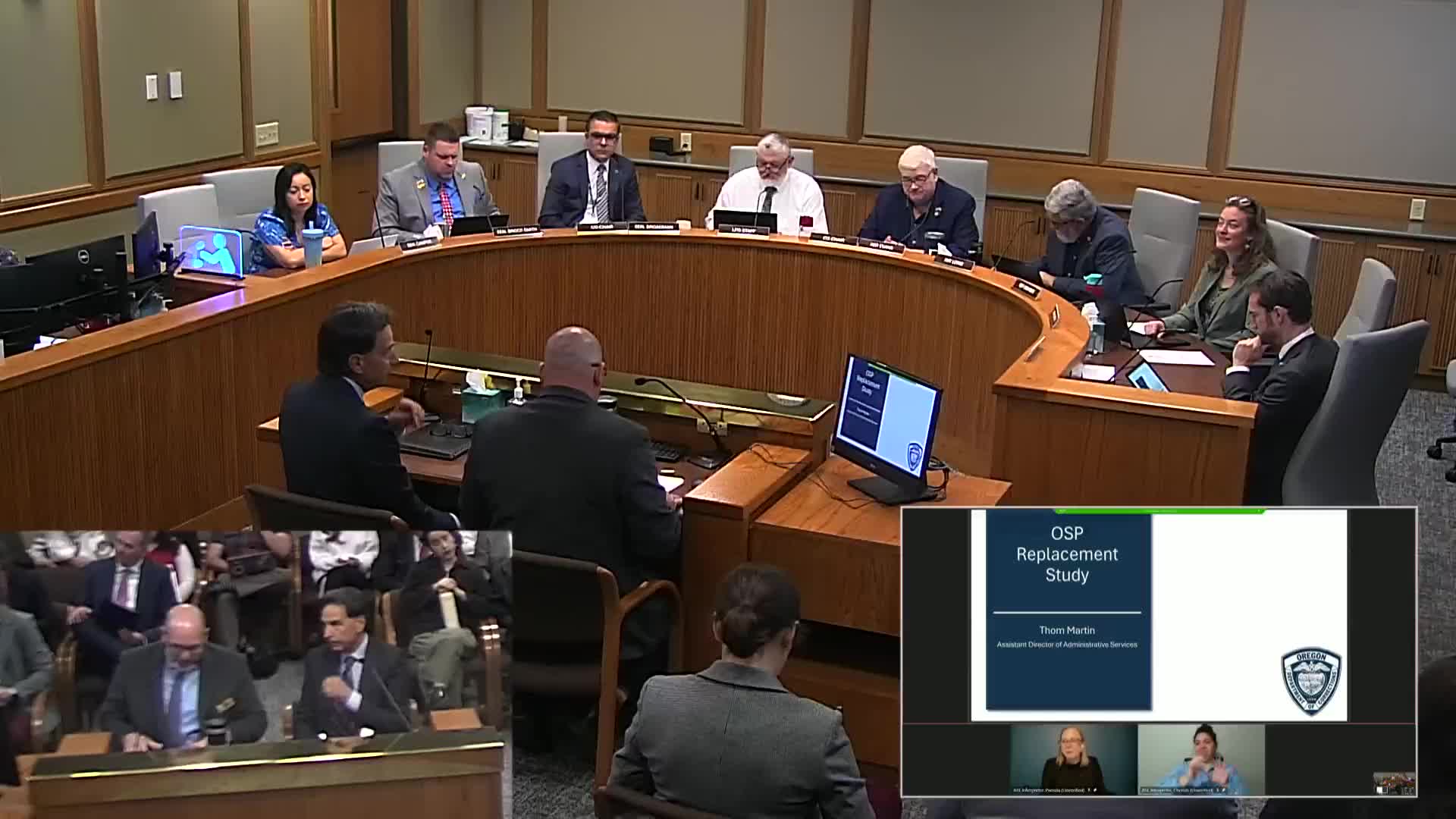
Tom Martin, assistant director for Administrative Services at the Oregon Department of Corrections, told the Public Safety Subcommittee on May 6 that the Oregon State Penitentiary (OSP) campus has many buildings more than 100 years old and is no longer fit for current corrections programming or ADA‑compliant care.
"Many of the main structures on the OSP campus are over a hundred years of age and were not designed for the populations we serve today," Tom Martin said, describing fire‑suppression, HVAC, elevator and boiler failures and plumbing breaks that have produced costly emergency repairs.
The nut graf: DOC said deferred maintenance, seismic retrofit and HVAC upgrades at OSP exceed $110 million, with total investments to achieve ADA compliance and modern functionality estimated above $200 million; the agency urged feasibility and conceptual design work this biennium to plan a replacement rather than continuing emergency repairs.
Martin described repeated examples: sprinkler pipes clogged with sediment, shower and basement areas chronically damp, boiler failures that require temporary units costing nearly $100,000 per month, and sewer line breaks that could require relocating more than 300 adults in custody. He said the infirmary and medical spaces are undersized and located on upper floors served by an older elevator. "The infirmary at the Oregon State Penitentiary is severely outdated," he said, noting risks to staff and people in custody when elevators or HVAC fail.
DOC presented a 2020 facilities strategic plan by DLR Group that identified a need for roughly 203,000 square feet of additional housing to meet American correctional space standards and about 50,000 square feet of programming space. Martin described plans to study two candidate replacement sites (OSP and an available property at OSCI/Junction City) and said feasibility work for each site would include environmental assessments, utility analysis, archaeological review and zoning studies at a cost the agency estimated at more than $750,000 per site.
Committee members asked about alternatives and timing. Agency witnesses and legislators discussed justice reinvestment and other policy initiatives that previously delayed construction of new prison capacity. DOC said the new work is intended to replace aging infrastructure rather than add system capacity. Martin said DOC intends to use a construction manager‑general contractor procurement model to enable early collaboration and risk mitigation and estimated that final design and construction activity would extend into the early 2030s depending on approvals and scheduling.
Ending: The presentation ended with the subcommittee taking the briefing for the record and members requesting further details; no formal action was taken at the hearing.