Get Full Government Meeting Transcripts, Videos, & Alerts Forever!
Get email alerts on the Tribal Relations topic
No spam. Unsubscribe anytime.
Oregon Senate adopts resolution marking 50 years of Legislative Commission on Indian Services
Summary
The Oregon Senate on a unanimous roll call adopted Senate Concurrent Resolution 31 praising the Legislative Commission on Indian Services (LCIS) and reaffirming a commitment to tribal consultation and partnership as the commission marks its 50th anniversary.
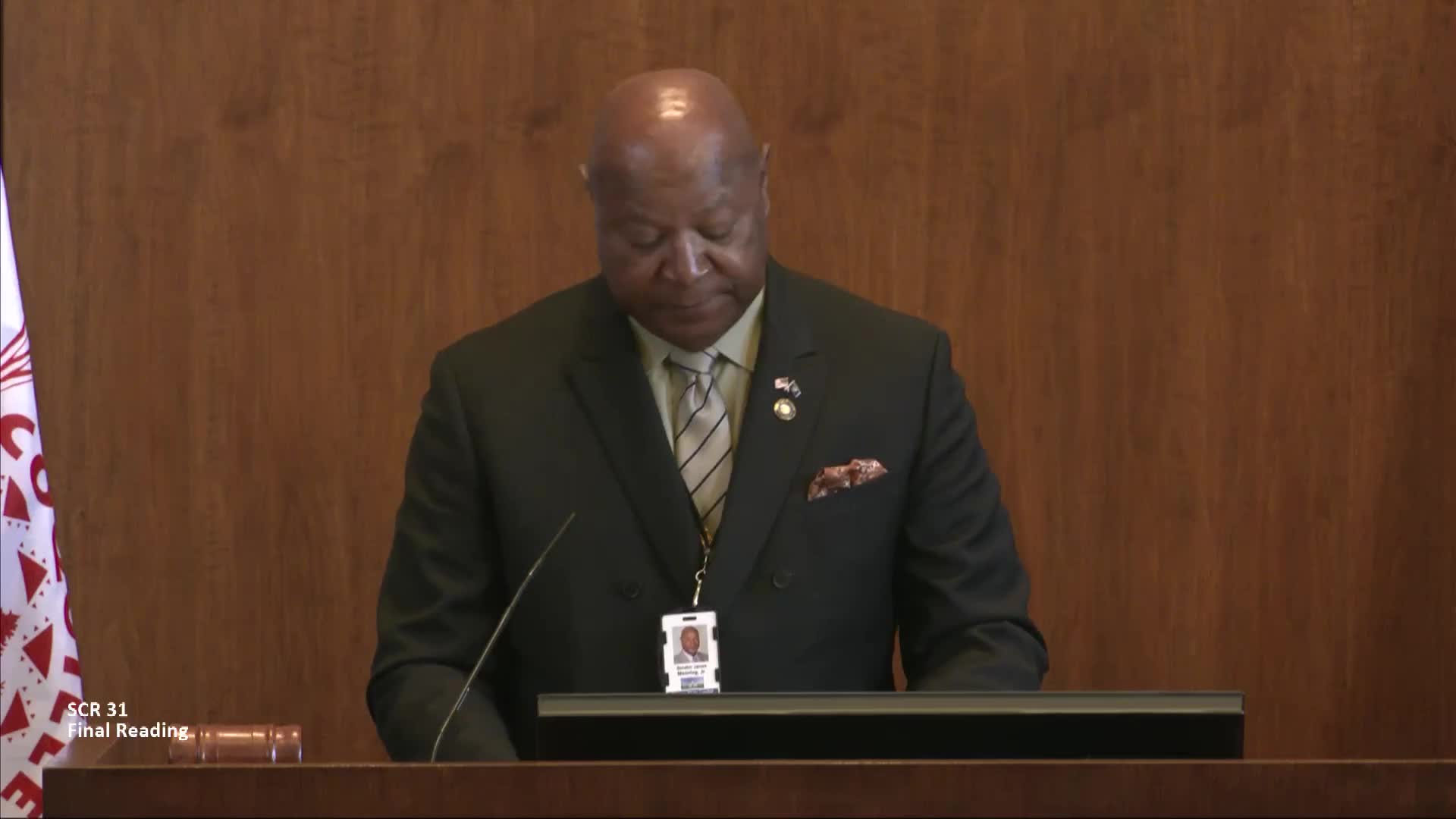
The Oregon State Senate on Tuesday adopted Senate Concurrent Resolution 31, commemorating the 50th anniversary of the Legislative Commission on Indian Services and reaffirming the Legislature's commitment to consultation and partnership with Oregon's nine federally recognized tribes.
Senate President Rob Wagner opened debate on the resolution, noting that "tribes have existed on this land that we now call Oregon since time immemorial" and tracing LCIS's origin to passage of Senate Bill 386 in 1975. Wagner said LCIS was created to "help foster a relationship, built and rooted on trust and cooperation between our state government, the state of Oregon, and our 9 tribal nations." He urged members to "commit to respect the tribes as independent sovereign nations with distinct individual sovereign governments."
The resolution recognizes LCIS's role in facilitating state-tribal collaboration on health care, education, public safety, natural-resource management and cultural-resource protection, and it congratulates the commission on five decades of work connecting legislators and tribal leaders. During floor remarks, several senators described LCIS as an important forum that has improved early engagement with tribes on policy issues.
Chairman Burke of the Confederated Tribes of the Umatilla Indian Reservation delivered an invocation earlier in the session and described his tribe's treaty history with the United States and continued ties to homeland; in his remarks he said, "We honor that treaty to this date." A commission member representing the Confederated Tribes of Coos, Lower Umpqua and Siuslaw read a prayer submitted for the day's proceedings.
Senator Bonham, who served previously on LCIS, told colleagues the commission provided him an opportunity to "proactively engage" with tribal nations and to learn that tribes are not monolithic, noting tribal councils often deliberate and vote in differing ways. Senator Frederick said the commission's work has had an impact beyond reservation boundaries, offering Portland-area and other urban indigenous residents a reason for hope. Senator Anderson, a newer commission member, urged that each of Oregon's nine tribes "be fully integrated into decisions that impact us all."
On a roll call conducted by the clerk, SCR 31 received the constitutional majority required for adoption and was declared adopted. The resolution will be entered in the Senate journal with the recorded vote.
The action was ceremonial and declarative: the resolution commemorates LCIS and reaffirms legislative commitment to consultation and partnership; it does not itself change law or appropriate funds.
Background: LCIS was created following the 1975 legislative action (Senate Bill 386) to establish a formal legislative body for communication between the Legislature and Oregon's nine federally recognized tribes: Burns Paiute Tribe; Confederated Tribes of Coos, Lower Umpqua and Siuslaw Indians; Coquille Indian Tribe; Cow Creek Band of Umpqua Tribe of Indians; Confederated Tribes of Grand Ronde; Klamath Tribes; Confederated Tribes of Siletz Indians; Confederated Tribes of the Umatilla Indian Reservation; and Confederated Tribes of Warm Springs. The commission now includes tribal appointees and legislators from both chambers, with legislative membership expanded in 2013 to two members from each chamber.