Get Full Government Meeting Transcripts, Videos, & Alerts Forever!
Get email alerts on the Pharmacy 340b Clearinghouse topic
No spam. Unsubscribe anytime.
House passes bill allowing 340B claims clearinghouse for FQHCs amid transparency questions
Summary
Lawmakers approved House Bill 3409 to let federally qualified health centers and pharmacies use a neutral clearinghouse to process 340B commercial insurance claims, a change sponsors said will reduce paperwork and errors. Opponents raised concerns about a possible preexisting vendor relationship and the bill's 90‑day effective date.
The Oregon House of Representatives passed House Bill 3409 on final reading to permit federally qualified health centers (FQHCs) and pharmacies to use a neutral third‑party clearinghouse to validate and reconcile 340B drug claims in the commercial insurance market, lawmakers said on the House floor.
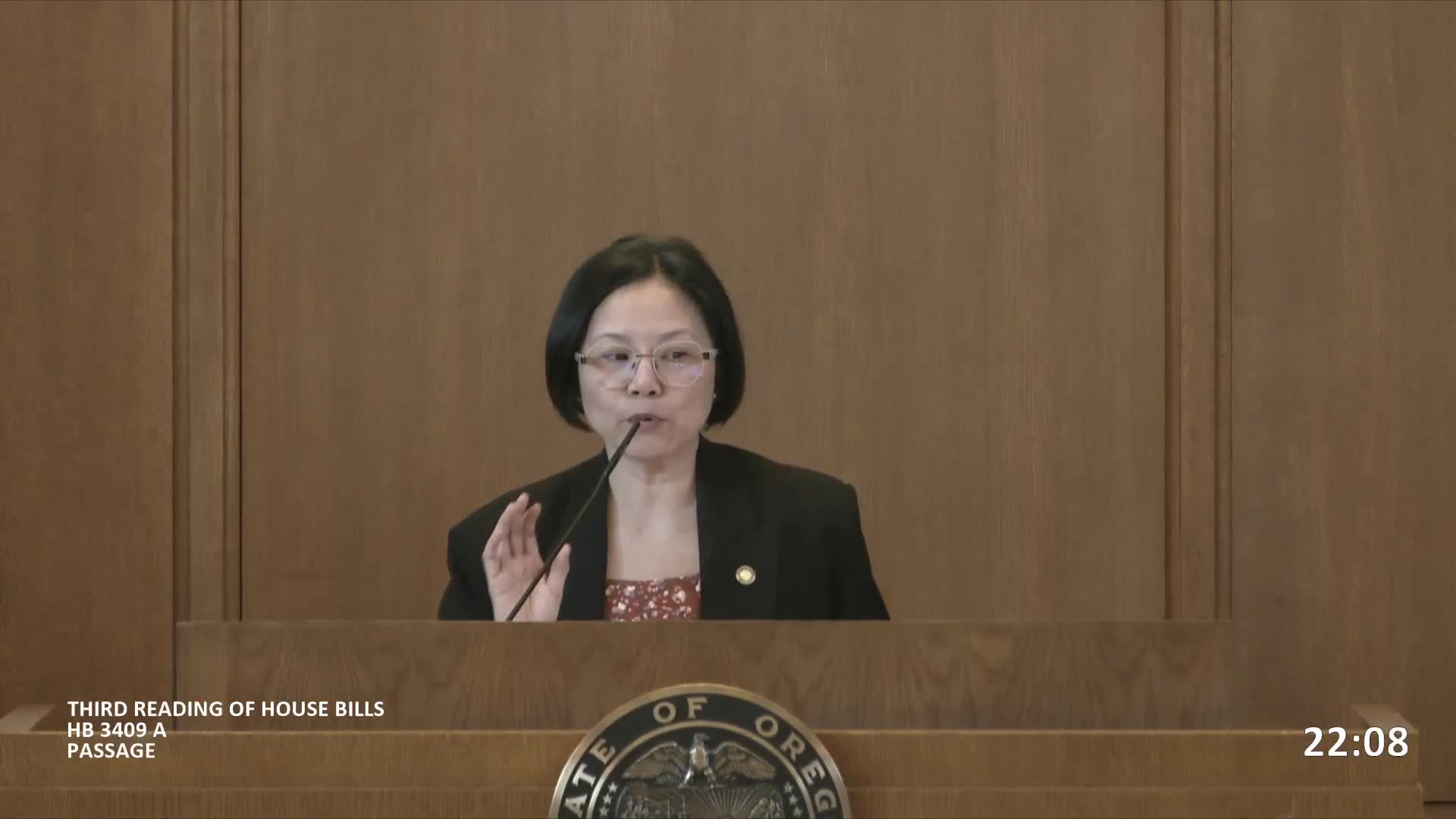
Supporters said the change mirrors an existing Medicaid process, would reduce administrative burdens on FQHCs and pharmacies, and increase transparency for manufacturers and pharmacy benefit managers (PBMs). Representative Nos, who carried the bill on the floor, said the measure is “an administrative process” and “simpler, it's cheaper, it's faster, and it's more transparent.”
The bill replaces a requirement that providers apply a post‑dispense modifier to claims to identify 340B eligibility with a clearinghouse model that would allow manufacturers, PBMs and covered entities to share and validate claim data. That approach already is used for Oregon Medicaid through a vendor that the Oregon Health Authority uses to match HRSA data with submitted claims, witnesses noted during debate.
Opponents raised questions about procurement and transparency. Representative Reschke told colleagues that proponents had not disclosed a vendor contract and asked, “Why the secrecy? Why the lack of transparency?” She also argued the state should not adopt an untested model while federal legislation — the draft “Sustain Act” discussed by U.S. lawmakers — remains under development.
Sponsors responded that the Sustain Act draft influenced the bill's conflict‑of‑interest protections and that state action would prepare FQHCs for any future federal requirements. Representative Nos also said Oregon's current Medicaid clearinghouse model provides a workable precedent and that the bill applies only to commercial payers, not Medicaid.
Members also questioned the bill's 90‑day effective date rather than the usual Jan. 1 effective date; the sponsor said they did not know the legislative reason for the shorter window when asked on the floor.
House Bill 3409 passed on a voice and recorded vote; the clerk declared, “HB 3409a, having received the constitutional majority, is declared passed.” The final roll call and any subsequent corrections were entered before adjournment.
The measure directs state regulators to define clearinghouse functions and requires neutrality and conflict‑of‑interest protections. It does not change who is eligible for 340B discounts or alter Medicaid procedures, supporters said.