DOGAMI seeks $330,000 USGS grant to map Cornucopia mining district and assess critical minerals

3205275 · May 6, 2025

Loading...

AI-Generated Content: All content on this page was generated by AI to highlight key points from the meeting. For complete details and context, we recommend watching the full video. so we can fix them.

Summary

The Oregon Department of Geology and Mineral Industries asked the Natural Resources Subcommittee for Ways and Means for permission to apply for a $330,000 U.S. Geological Survey Earth MRI geologic mapping grant to produce detailed mapping and a mineral-resource evaluation of the Cornucopia District in eastern Baker County.

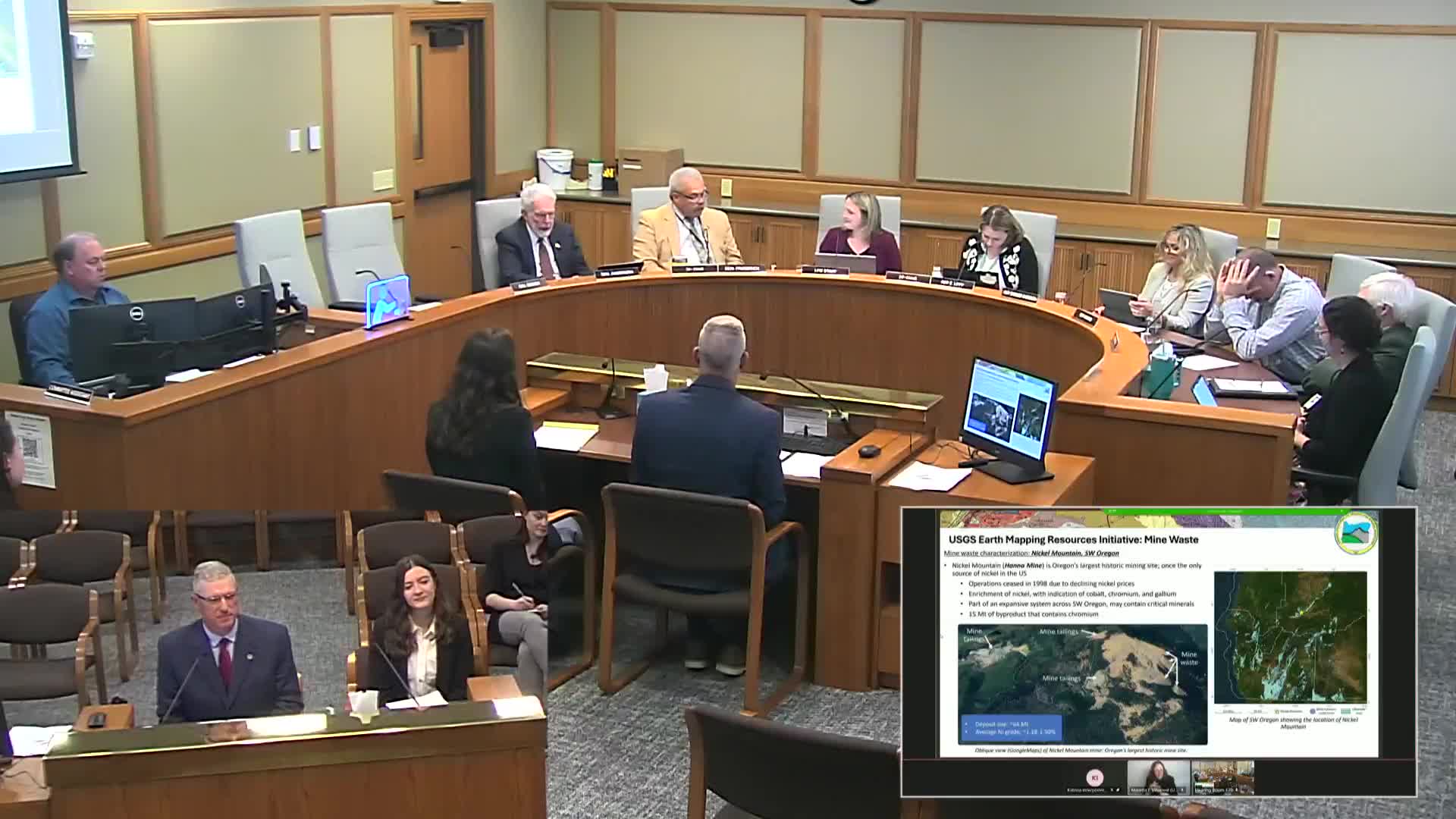
The Oregon Department of Geology and Mineral Industries asked the Natural Resources Subcommittee for Ways and Means on May 6 for permission to apply for a $330,000 U.S. Geological Survey Earth Mapping Resources Initiative (Earth MRI) geologic mapping grant to map and evaluate critical minerals in the Cornucopia Mining District.

Jason McClary, program manager for the Geological Survey and Services program at DOGAMI, told the committee the proposed project would produce new detailed geologic mapping of the Cornucopia and Dead Man Point quadrangles using lidar topography and upcoming high-resolution aeromagnetic and radiometric data. "Mapping and mineral resource evaluation of the Cornucopia Mining District" would inventory occurrences of chromium, cobalt, gallium, nickel, tungsten and zinc alongside other metals, McClary said, and the results would be released publicly as a DOGAMI geological map series publication.

McClary described Cornucopia as the site of Oregon’s largest historic gold mining operation, with more than 36 miles of underground workings and combined reported production of about 470,000 ounces of gold and 2.5 million ounces of silver before operations closed in 1941. DOGAMI said the Cornucopia District lies within overlapping Earth MRI focus areas and that new mapping there could serve as a model for geologic mapping and critical-mineral exploration across parts of the Blue Mountains between Cornucopia and Grant County.

The proposed USGS Earth MRI mapping grant would be for $330,000, carry no required state match, and DOGAMI said it would charge its full indirect rate; the agency did not request an expenditure limitation. The Legislative Fiscal Office and DAS Chief Financial Office recommended approval, and a committee member moved adoption of the LFO recommendation; no objections were raised and the motion passed by voice vote. DOGAMI said the proposal to USGS is due in June 2025 and, if funded, DOGAMI would begin the three-year project in late summer or fall 2025.

The subcommittee’s vote granted permission for DOGAMI to submit the federal proposal; it did not appropriate state funds or guarantee an award of the grant.