Get Full Government Meeting Transcripts, Videos, & Alerts Forever!
Get email alerts on the Juvenile Justice Oversight topic
No spam. Unsubscribe anytime.
Oregon Youth Authority details backlog of investigations, outlines staffing and oversight changes
Summary
Interim Oregon Youth Authority leaders told the House Judiciary Committee the agency is addressing a backlog of aged investigations in its Professional Standards Office with new staffing, weekly reporting and external oversight, but said timelines for completing cases vary by complexity.
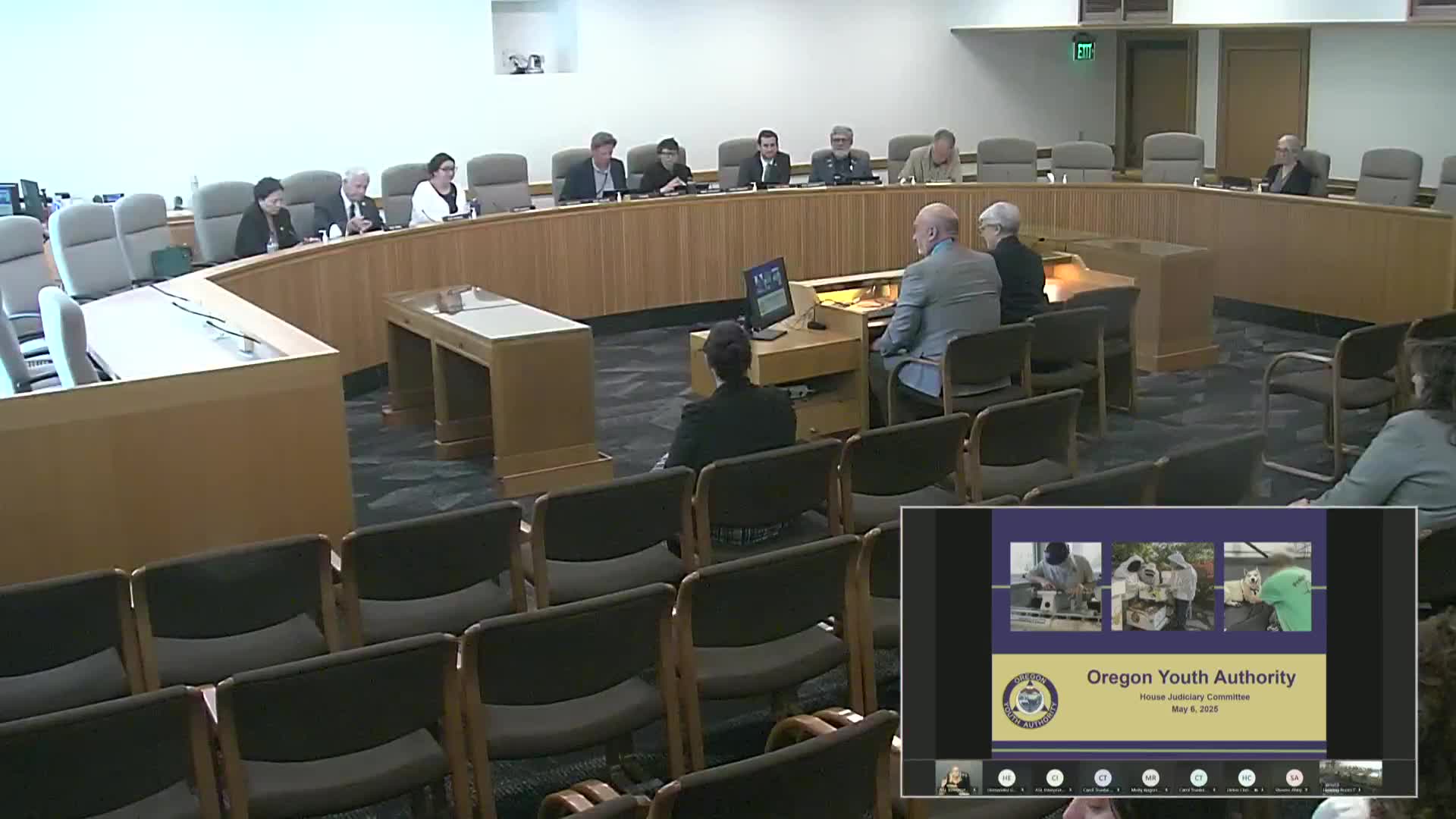
Interim Oregon Youth Authority Director Jana McClellan told the House Committee on Judiciary on an informational hearing that the agency has prioritized hundreds of investigations that had remained open more than 180 days and has put new staffing and oversight in place to speed cases to resolution.
McClellan said the agency’s January peer review by the Oregon Department of Corrections found hundreds of aged cases and thousands of cases awaiting sign-off by the chief investigator, which led to leadership changes. “We share a desire for safety and transparency,” McClellan said, and described steps to triage aged matters while keeping current caseloads moving.
Nut graf: The agency reported it has reduced the count of aged cases from numbers cited in the January peer review and established a combination of immediate staffing fixes, reporting tools and external oversight intended to improve case tracking, coordination with partner agencies and victim services.
OYA presented specific operational changes the Professional Standards Office, or PSO, has implemented: a newly appointed chief investigator, temporary investigators to clear aged cases, new weekly reporting that can isolate cases older than 180 days, and regular coordination meetings with the Oregon State Police, the Department of Human Services and district attorneys. McClellan said PSO has assigned investigators to all aged or suspended matters and can now run real-time status reports across the caseload.
McClellan and new Chief Investigator Ken Jeske said the office will continue to refer criminal matters to the state police and that victims will be connected to county victim services where available. “Each case takes as long as each case takes,” McClellan told the committee when asked how long the backlog would take to clear, cautioning that case complexity and resource needs vary.
The agency shared data for May 1 showing 502 open or suspended aged cases (defined as open more than 180 days), down from an initial tally reported in the DOC peer review. McClellan said there remain roughly 3,100 investigations that an investigator had closed but still required chief-investigator sign-off; some of those may be reopened for further work if the chief determines additional investigation is needed.
OYA’s presentation also covered the coordination between PSO investigations and Prison Rape Elimination Act (PREA) reviews. Alicia Goodwin, OYA’s PREA coordinator, explained that PREA reviews operate independently of PSO investigations and track required PREA elements such as retaliation monitoring and notifications; she said some PREA reviews take longer than administrative investigations and that the oldest PREA-aged investigation dates to 2021.
McClellan described new external oversight and victim-advocacy roles: a youth and family advocate, Kayo Berger, who will report to the governor’s office, and a safety task force scheduled to meet soon. McClellan said the Secretary of State’s scheduled 2025 audit of youth safety will likely review many of these processes.
Committee members pressed the agency on supports for youth affected by delays and on how the agency will prevent recurrence. Representative Tran asked what services are provided to youth harmed by a delayed investigation; McClellan said the agency is making victim services available both internally and through counties and that qualified mental health professionals at facilities are being used as resources. She acknowledged difficulty in contacting youth from cases many years old.
The agency described improvements to internal controls: more frequent supervisory reviews, standardized data reports, employee retraining, and a performance improvement plan based on the DOC peer review. McClellan said PSO staff have increased in-office presence to support team learning and direct supervision.
Ending: McClellan told members she would share the performance plan regularly with a safety task force and is prepared to provide additional updates to the committee as work proceeds.