Get Full Government Meeting Transcripts, Videos, & Alerts Forever!
Get email alerts on the Ai Policy Magic School topic
No spam. Unsubscribe anytime.
Hatboro‑Horsham AI committee recommends district‑wide platform (Magic School) and a district AI policy; board to consider first reading
Summary
An AI committee of teachers, students, administrators and community members recommended the Hatboro‑Horsham School District adopt a district AI policy and the Magic School platform, and expand staff professional development.
District staff and a standing artificial‑intelligence committee presented recommendations to the Hatboro‑Horsham School District Board of School Directors on May 5, 2025, urging the adoption of a district AI policy and recommending Magic School as a district AI platform after a teacher pilot.
The district formed the AI committee in September and included administrators, teachers, students, a board member and community parents. Dr. D'Angelo, director of special projects and systems, and Christine Jenkins chaired and described the committee’s responsibilities: evaluate whether the district needs a district‑wide AI policy (the committee recommended yes), identify classroom best practices, ensure ethical and equitable AI use, and prioritize professional development for staff.
Committee members reviewed national and local policies, corporate frameworks and educational platforms. Teachers piloted two platforms — Magic School and School AI — in multiple classrooms across grade levels and content areas and provided comprehensive feedback via surveys. The committee reported unanimous preference for Magic School among pilot participants and cited several features that influenced the recommendation: Magic School reportedly does not retain or sell personally identifiable student information, includes built‑in teacher and student training, offers roughly 30 educator/student tools, supports single sign‑on with Canvas and Clever, and can be customized to district needs.
High‑school science teacher Jeff Thompson demonstrated a study chatbot feature that generates adaptive study plans and progress reports for students; seventh‑grade social studies teacher Nicole McClure described a writing‑feedback tool that gives individualized suggestions and engagement metrics; third‑grade teacher Sonia Matura described using Magic School’s translation features to give an English‑language‑learner third grader accessible instructional text and comprehension activities in the student’s home language.
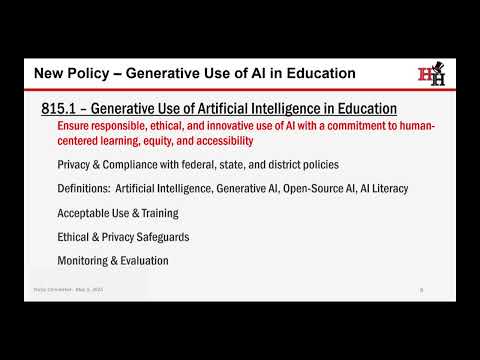
The committee recommended three immediate steps: (1) adopt a district AI policy emphasizing ethics, privacy, equity and a human‑centered approach; (2) purchase and pilot Magic School as the district’s standard AI platform; and (3) expand targeted professional development for teachers and staff. Presenters emphasized that adopting a single platform was recommended to protect student privacy, standardize access and align tools with curricular goals, but that the policy and platform would be subject to ongoing evaluation.
Administrators said policy language will be brought forward through the policy committee for a first reading at the May 19 board meeting. The committee also noted that the teacher pilot was broad and that its final committee meeting for the year was scheduled for the day after the work session. No formal purchase or board vote occurred during the work session; recommendations were presented for consideration and referral to the policy process.