Get Full Government Meeting Transcripts, Videos, & Alerts Forever!
Get email alerts on the Homelessness Services topic
No spam. Unsubscribe anytime.
4C Health expands Howard County street outreach with GBHI grant and county opioid funds
Summary
4C Health reported expansion of its homeless street outreach work across Howard, Cass and Miami counties after receiving a GBHI grant and local opioid fund match; staff described enrollment numbers, housing assessments, distribution of survival kits and use of mobile iPads to enroll people in services on site.
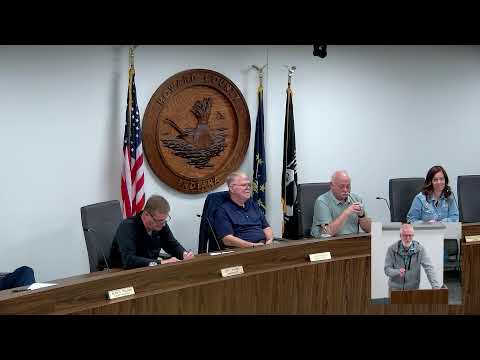
Dr. Caldwell and Alana Leese of 4C Health briefed the Howard County commissioners on expansion of the organization’s homeless street outreach program, supported by a federal GBHI grant and county opioid funds used as a local match.
Dr. Caldwell told the board that “in calendar year ’24, we served over 1,200 Howard County residents providing over 46,000 mental health and substance use services.” She said about 75% of people served are on public health insurance (Medicaid, HIP, or Medicare) and roughly 61% arrive by self‑referral. Dr. Caldwell introduced Alana Leese, director of adult intensive and residential services, to discuss the street outreach grant work.
Leese said, “To date, we have served 23 homeless individuals and enrolled them in our program,” and that the GBHI grant covers Cass, Miami and Howard counties with roughly 75% of served individuals in Howard County. She reported 59 individuals had been referred to services and that 21 housing assessments were completed; of those assessments, 66% identified respondents as living on the street for more than 30 days. Leese said staff had distributed 68 survival backpacks and that about 4% of the total individuals in Howard County covered by the grant had been housed in the first six months.
Leese described a recent operational change: outreach teams now carry iPads to complete assessments and enroll people in 4C services at the point of contact, which staff said reduces barriers to care. She described coordination with the county’s supportive housing site (“Sergeant’s Place”) and with Kokomo Rescue Mission, whose planned expansion staff said will nearly double bed capacity.
Commissioners asked for clarification on causes of homelessness; Leese said the most common cause she sees is inability to afford rent. She also said more than half of the individuals they serve in Howard County “identify at least some sort of past or present substance abuse issue,” and that the program’s peer recovery department can provide in‑community support.
When asked about sustainability, Leese said the GBHI federal grant has “another 4 years” remaining and characterized the county opioid dollars as seed or match funding that helped expand the outreach team. A county official noted commissioners “took our opioid dollars and we put money towards this” as a local match for the work.
No formal county vote was recorded on new funding during this discussion in the transcript; commissioners expressed support and appreciation for the work and staff said they expect enrollment to increase with the operational changes.