Get Full Government Meeting Transcripts, Videos, & Alerts Forever!
Get email alerts on the School Construction Safety topic
No spam. Unsubscribe anytime.
School board reviews middle school contingency tracker and considers campus safety study ahead of possible high‑school use
Summary
The Waunakee Community School District board reviewed contingency balances for the new middle school, discussed add‑on items including a track, storage shed and fence, and heard a staff proposal to commission a traffic and safety study if the district moves to place high‑school students in the existing middle school by Sept. 1, 2026.
The Waunakee Community School District Board on May 6 reviewed the construction contingency trackers for the new middle school, discussed several potential add‑on items for the site and considered a proposal to fund a traffic and campus‑safety study if the district decides to place high‑school students in the existing middle school by Sept. 1, 2026.
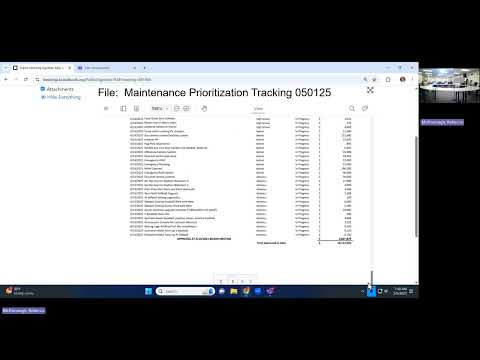
Board member Joan called the meeting to order and staff opened the contingency tracker. A district staff member summarized the two contingency columns on the tracker, saying, "The column that's labeled 300000191, that is the current total of the construction management contingency. The column to the right is the 219279. That's considered the owner's contingency." The staff member said the district had parked costs related to inflation and prevailing‑wage impacts in the owner's contingency, which lowered that column’s balance.
The staff member told the board the construction manager contingency has shown little activity in recent months and that several outdoor items remain listed as "pending," including track and field equipment, a maintenance shed and a project site fence. The staff member said contractor bids allowed a track alternate to be moved into the project and that the district will ask the facilities committee in June to review site plans, fencing and equipment placement with Adam from Vogel and athletic staff.
Why it matters: the board is balancing limited available maintenance and project funds while weighing whether to add items that were outside the original project scope. The district also faces scheduling and safety choices if it relocates some high‑school programs into the existing middle‑school building for 2026–27.
Board staff gave updated funding figures for planned maintenance and available cash: interest‑allocated funds were listed as increasing from 6,500,000 to 6,800,000 and project savings were updated from 3,500,000 to 4,500,000 after a reconciliation of high‑school work that was not performed. Staff estimated additional interest of about 1,500,000 through August 2026 and said the tracker showed roughly $2.7 million available now, with an additional roughly $600,000 expected to be returned from the Heritage parking‑lot holdback when Vogel closes that project.
On a related and lengthier discussion, staff asked the board whether it wanted to authorize a proposal by civil engineer Roxanne Johnson and a traffic engineer to produce a comprehensive safety study of the high‑school campus and the route between the high school and the existing middle school. The purpose of the study would be to model vehicle and pedestrian flows, review options to gate or reconfigure Community Drive, and identify required investments — such as clock/bell and public‑address upgrades, campus security cameras, and secured entries — if the district places high‑school students in the older building on Sept. 1, 2026.
Staff said those three investments were already in prior planning materials and that, without them, the high school would not be able to reliably communicate with or view the older building on a common campus system. "The Clark Valley PA system, I think it's the most and the safety entrance are the I mean, it's all critical pieces to to make it all work," said Dr. Brown during the discussion.
District administrators told the board that moving some high‑school classes to the existing middle school could relieve crowding at the high school, free space for teachers, and provide classroom or program space (including for the FACE program). They also cautioned that those moves would require targeted investment in safety and communications, and that the scope and cost could be affected by the state budget and any decisions about upcoming referenda.
No formal vote was taken on the safety study or on placing high‑school students in the middle school. Board members asked staff to hold the discussion and to schedule a special meeting or workshop this summer to review the four high‑school proposals already priced at a high level by the district’s consultant, Vogel. Staff said Roxanne Johnson would be asked to hold a placeholder in her fall schedule so an on‑site traffic study could be done before winter bid timelines if the board decides to proceed.
The board emphasized it did not have to decide immediately whether to place high‑school students in the building but instructed staff to prepare the safety analysis and cost estimates so members could evaluate options at a future workshop.