Get Full Government Meeting Transcripts, Videos, & Alerts Forever!
Get email alerts on the Municipal Complex Selection topic
No spam. Unsubscribe anytime.
Brentwood committee forms RFQ subcommittee, outlines schedule for municipal complex design selection
Summary
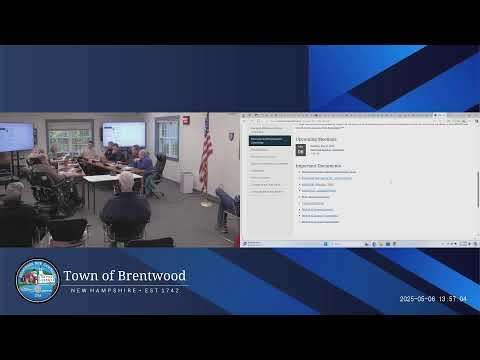
A regularly scheduled meeting of the Brentwood Municipal Complex Committee advanced the town’s search for a designer for a proposed municipal complex and police department by forming a four‑member RFQ review subcommittee and setting a rapid selection timeline.
A regularly scheduled meeting of the Brentwood Municipal Complex Committee advanced the town’s search for a designer for a proposed municipal complex and police department by forming a four‑member RFQ review subcommittee and setting a rapid selection timeline.
Committee members said five teams submitted requests for qualifications (RFQs). The committee will conduct an administrative check for responsiveness, score firms on set criteria, and shortlist up to three teams for interviews before recommending a firm to the Select Board for contract approval.
The matter matters because the committee’s choice of consultant will shape concept designs and cost estimates that Brentwood officials plan to present to voters as part of a future warrant article and possible bond. Committee members emphasized open communication and transparency with the public during the design and budgeting process.
Committee chair Eric Kelly summarized the immediate next steps: a preliminary administrative review to confirm firms followed RFQ instructions, a qualitative review under published evaluation criteria, combined scoring and shortlisting, and—if needed—interviews. The RFQ’s minimum eligibility requirements include that firms be licensed in New Hampshire and have delivered at least two municipal facility projects in the last 10 years, including at least one police department project within the past five years. The committee said qualifications carry the heaviest weight (40%), project experience 25%, project approach 20%, and responsiveness/administrative items the remainder.
“We met a few of the clients. I believe most of them, if not all of them, did submit RFQs,” said Chief Justin Doty, who will serve on the subcommittee. He and others said the town’s “big emphasis from them was open communication and transparency to the community.”
The committee voted to form an RFQ subcommittee made up of Chief Justin Doty (police department representative), Selectman Jimmy Schode (select board representative), Letty Bedard (committee member), and Chair Eric Kelly. A motion to form the group was made and seconded and was approved by voice vote. The subcommittee will carry out interviews (if the full committee elects to interview) and report findings back to the full committee.
Committee members said they received five submissions; one electronic submission initially had a broken link and was later distributed. Members were given hard copies and, where file sizes allowed, electronic copies. Eric Kelly said he would try to downsize large files for email distribution and post non‑proprietary materials online or make them available in a public space.
The committee set tentative deadlines: committee feedback on a top‑three shortlist by Friday, May 16; interviews tentatively the week of May 19 or the week of May 26; a report to the Select Board on June 3; and a target of executing a contract by the Select Board on June 17, subject to legal review. Committee members said the final consultant selection would be recommended to the Select Board for contract award; the Select Board must approve expenditures and sign contracts in accordance with town rules.
Members discussed options for the consultant’s scope. Several committee members urged the town not to repeat work done in previous space‑programming and conditions reports, saying the selected firm should begin from existing documentation where appropriate to save time and expense. The RFQ allows consultants to propose schematic concepts, cost estimates, and up to three options: a standalone police facility, a standalone police facility with additional undefined space, or a joint municipal facility. The committee said it expects consultants to present conceptual floor plans, renderings and preliminary cost estimates to enable a warrant article and public information sessions later in the year.
Committee members also discussed procurement process details: the committee may carry forward up to three firms for interviews (the RFQ allows interviewing up to three) but may also waive interviews and proceed to negotiation if the committee prefers. Interviews are typically qualitative—assessing how firms present, their team makeup, responsiveness and references. The committee said reference checks will include direct conversations with prior clients to ask about schedule, budget, change orders and responsiveness.
Several members raised contracting concerns that the town will address during negotiations, such as not‑to‑exceed language, escalation clauses, and clarifying how any future design‑build phase would be procured. Committee members said consultants could be hired for one phase (conceptual design and cost estimating) and later retained or replaced for subsequent phases.
Public comment focused on transparency, document access, site questions and budget signals. Becky Dunham urged the committee to make membership and agendas easier to find on the town website and requested RFQ documents be posted. “It would be nice to have the committee listed on the website,” she said. Bruce Stevens and other residents asked that RFQ materials that are not proprietary be available in a public place for inspection; the committee said it will review submissions for proprietary content and, where allowed, post or make them available—in this case offering to place materials in the police department lobby for public review.
Residents also asked that carrying costs—ongoing utilities, staffing and maintenance for any new building—be included in public materials. “The public needs to know the carrying costs,” said Bruce Stevens during public comment.
Several speakers sought clarity about likely sites. Committee members said prior discussions singled out land behind the recreation center as the primary option under consideration; they also noted earlier plans to colocate facilities with the firehouse were not pursued because the approved fire station design did not support an addition. The committee reiterated that consultants will be asked to evaluate siting options and to produce concepts scaled to the town’s needs, including a footprint sized for a police force estimated previously at roughly 15–16 officers.
The committee and public also discussed finance and voting mechanics. Committee members clarified that a bond or appropriation for construction would be a warrant article at town meeting and that bond approvals in New Hampshire are subject to the statutory ballot process and, where applicable, higher‑threshold votes. Committee members referenced the state “limit of appropriation” (the town’s 10% rule) and the requirement for certain warrant/bond votes to meet a three‑fifths threshold, noting those are constraints the town must consider when crafting financing and ballot language.
Budget Committee chair Jim Hazard said he will work with the committee on financial messaging and the likely fiscal picture, and he told the meeting: “I can tell you that it absolutely can be done,” urging the committee to prepare both concept renderings and clear financial plans for voters.
The committee closed by scheduling its next meeting for June 3 at 1:30 p.m. and by directing members and the subcommittee to complete RFQ reviews and return rankings on the published rubric so interviews and negotiation can proceed on the timeline the committee set.
What happened: the committee formed a subcommittee to review RFQs, set scoring criteria and a target schedule for interviews and Select Board review; public commenters pressed for greater transparency, easier public access to RFQ documents, inclusion of carrying costs in public materials and clearer answers about site options and ballot mechanics.
What’s next: the subcommittee will screen submissions for responsiveness and proprietary content, compile scores, conduct reference checks and, if needed, interview shortlisted firms. The full committee will consider the subcommittee’s recommendation and forward a recommended selection and contract terms to the Select Board for approval and execution.