Get Full Government Meeting Transcripts, Videos, & Alerts Forever!
Get email alerts on the Economic Development topic
No spam. Unsubscribe anytime.
Developers pitch Sanford Horizons civic-infrastructure plan; councilists raise traffic, schools and scale concerns
Summary
Landmark Development and Sanford University asked Homewood officials to consider a private‑funded civic infrastructure program to enable a multi‑phase Creekside East/West mixed‑use project.
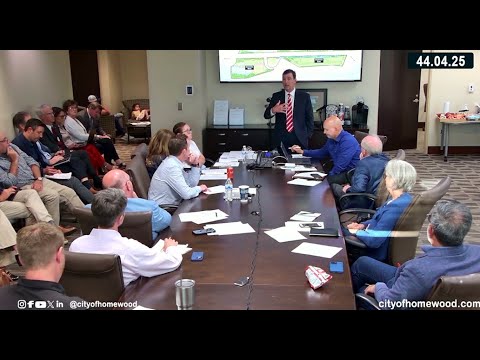
Landmark Development and representatives of Sanford University presented a multi‑phase plan called “Sanford Horizons” and asked Homewood officials on May 5 to consider a private‑funded civic infrastructure program that would fund horizontal infrastructure for a proposed Creekside East/West development.
The proposal, presented by Bob Dunn of Landmark Development and members of the Sanford team including Dr. Colin Coyne, framed the plan as a long‑range, mixed‑use master plan tied to a university “civic anchor.” Dunn said the private team would build and finance roughly “about a hundred and $4,000,000” in civic infrastructure and asked the city to consider a value‑capture arrangement that would recover a portion of new lodging, sales and property tax revenues over time.
Why it matters: developers argued the plan would generate new tax base and private investment, deliver recreational and pedestrian infrastructure and strengthen Sanford University’s competitiveness. Council members and residents said the proposal is large in scale, raises questions about traffic, student housing and school enrollment, and needs clearer commitments on sports field replacement, bridge and stormwater details.
Dunn told the Finance Committee the development team’s economic model forecasts “as high as $400,000,000 or more over the planning horizon” in new tax revenues to the City of Homewood and said the private team expects “nearly a billion dollars” of private investment across the master plan. He described a proposed financing split in which private value capture would cover an estimated mid‑20% share of infrastructure costs and the private developer would assume construction risk.
Councilors asked for clarity on several points Dunn raised in the presentation. Councilor Guatney, who led the discussion after Councilor Smith recused himself, asked whether the presented value‑capture percentages were firm; Dunn replied the numbers are mid‑range estimates that the team expected to refine. Council members repeatedly pressed the developers on student housing design and control, whether Creekside East recreational fields would be relocated to city sites, and the hotel height shown in early renderings.
Several council members and residents said community messaging and timing have eroded trust. Councilor Brandt said moving the university’s track and soccer complex onto city park property “is not a feasible option” and that the city should not be asked to sacrifice school capacity or neighborhood quality of life. Councilor Andrews said many constituents oppose the hotel height and the scale of development near the high school; Councilor Sims and others noted the proposal has “struck a nerve” with residents.
Developers and university representatives responded that community engagement has been extensive, that a Development Advisory Group (DAG) of about 18 local stakeholders has shaped alternatives, and that the team has been studying options to deliver community benefits — for example, locating sports and recreation where they are least disruptive and building a pedestrian bridge over Lakeshore Drive. Dunn emphasized the team’s intent to record covenants governing privately developed housing on university‑owned land and said Sanford would retain land ownership and use ground leases for vertical development.
Committee actions and next steps: the Finance Committee did not vote to approve incentives or value‑capture terms. Members agreed to carry the item and hold further public discussion: a Planning & Development meeting was scheduled for May 19 and the full City Council will consider items on June 9. The city attorney and developers agreed to clarify whether proposed changes to Creekside East require the development plan to return to the Planning Commission. Councilors asked staff to bring firmer cost and cap numbers for any incentive or development agreement before the council considers approvals.
Ending: Developers left the meeting with a calendar of follow‑up meetings and repeated invitations for public comment; council members said they will expect more concrete figures, formal covenants for university‑affiliated housing, traffic and stormwater analyses, and clearer written alternatives for sports and recreation before any financial or zoning approvals.