Get Full Government Meeting Transcripts, Videos, & Alerts Forever!
Get email alerts on the Development Impact Fees topic
No spam. Unsubscribe anytime.
Casa Grande staff, consultant present proposed update to development impact fees; fees rise largely from higher construction costs
Summary
City of Casa Grande staff and a consultant from Tishler & Baez presented a proposed update to development impact fees at a study session, saying higher construction and equipment costs drive most of the proposed increases.
City of Casa Grande staff and a consultant from Tishler & Baez presented a proposed update to the city’s development impact fees at a study session, explaining the plan, projections and the lengthy adoption timeline.
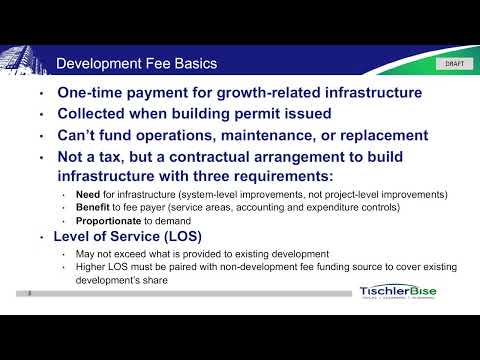
"Municipalities in Arizona may assess development impact fees to offset infrastructure costs to a municipality for necessary public services," Stephen, a city staff member, told the council as he introduced the study. Ben Griffin, the consultant from Tishler & Baez, led the presentation of the land use assumptions, the infrastructure improvement plan and the proposed fee schedule.
The update uses 10-year growth projections and the incremental methodology for most service areas, meaning fees are calculated to maintain the city’s existing level of service rather than raise it. Griffin said the study shows increases across most fee categories largely because construction, vehicle and equipment costs have risen since the last update. "Level of service is important to impact fees because you can't charge future development for a higher level of service than existing development receives unless you've identified an outside funding mechanism to raise your current level of service," Griffin said.
Key figures presented in the study include an estimated 10-year increase of about 11,400 housing units (about 3,000 people per year), and a projected nonresidential increase of roughly 12.5 million square feet that would add about 16,000 jobs. The consultant’s examples showed, for a typical 2,500-square-foot single-family home, non-utility fees around $12,000 and utility-related fees about $8,200 — roughly $20,000 in combined proposed charges in the draft schedule.
Major categories and notable estimates from the presentation: - Fire: Maintain existing level of service would require about 26,000 additional square feet of facilities (roughly $26 million), 17 additional apparatus units (about $11 million) and about $3.7 million for communications equipment. - Parks and recreation: The study excludes parkland acquisition but includes amenities, recreation buildings, pools and trails. It shows about 367 additional park amenities (~$28 million), roughly 3,700 square feet of recreation facilities (~$1.5 million), nearly 5,000 additional square feet of pool surface (~$8.2 million) and about 11 additional trail miles (~$22 million). - Police: New facilities were added to the study. To maintain current service the study lists roughly 23,000 additional square feet of police facilities (~$8.2 million), about 39 vehicles (~$3.5 million) and about $900,000 in equipment costs. - Streets: The travel-demand model projects approximately 13 additional lane miles (~$63 million) and 12 additional intersection improvements (~$20 million) over 10 years; the study includes a $40 million bond credit to avoid double-counting recent or planned arterial/intersection work. - Wastewater: The study divides the city into three wastewater service areas (North/East, South and a new West area). It reports a projected increase of about 9.2 million gallons per day (over the 10-year window) of treatment demand in two service areas, an available/planned treatment capacity of roughly 10.6 million gallons and an estimated treatment-capacity cost just under $20 per gallon (total treatment-related capital in the study about $200 million). Collection-system improvements in each service area are accounted for separately.
Council members and staff clarified policy choices that affect fee levels: the study generally uses an incremental methodology rather than a plan-based approach (except for wastewater), the parks component excludes land acquisition because the city already has undeveloped parkland, and the treatment of excess construction sales tax revenue is still to be decided and is shown in the draft as "TBD" credits. Mayor Pro Tem Herrmann and other council members emphasized that impact fees are intended to ensure new development pays for growth-related infrastructure rather than shifting those costs to existing residents.
No ordinance or fee schedule was adopted at the study session. City staff described the statutory adoption process and timeline under Arizona law: if the city advertises on June 1, there is a 60-day waiting period before a public hearing on land-use assumptions and the infrastructure plan; after adoption of those pieces there is a further public hearing and 30–60 days before fee adoption, and fees cannot take effect for 75 days after adoption. Staff said that timeline makes the earliest realistic effective date for any newly adopted fees in the winter months following the process.
City staff and the consultant noted possible credits that would lower final fees before adoption: an anticipated parks-related municipal bond (the "geo bond") and an excess construction sales tax credit. Staff said they will present a final recommendation on those credits during the formal adoption process.
The presentation and follow-up comments focused on data, methodology and policy choices rather than final decisions. Griffin and city staff answered council questions about level-of-service choices, cost assumptions (the study uses current costs as the baseline), and options to scale back components such as police facilities if the council elected to limit the 10-year capital list.
Next steps: staff will provide a timeline and final materials for formal advertisement and public hearings pursuant to Arizona statutes; no vote was taken at the study session.